Extreme weather events have swept across multiple regions of East Asia over the weekend, leaving at least five people dead and triggering widespread flooding and infrastructure damage in northern China and southern coastal areas, Chinese state media confirmed Sunday. The double weather disasters separated by hundreds of kilometers unfolded within a 24-hour window, forcing mass evacuations of at-risk residents and leaving local emergency response teams stretched thin.
In northern China, two consecutive torrential downpours triggered fatal flash floods and urban inundation. On Saturday evening, a sudden mountain flash flood swept through a rural area in the eastern section of China’s Inner Mongolia Autonomous Region, killing two local villagers, according to official Xinhua News Agency. Local authorities confirmed the pair were moving their cattle herds away from the rising floodwaters when the incident occurred: one drowned while herding livestock, and the other fell into rushing floodwaters while driving the herd to higher ground.
Just 240 miles southeast of Inner Mongolia, in Fushun City of neighboring Liaoning Province, three more residents died from weather-related incidents on the same day, Xinhua reported, though full details of the fatalities have not yet been released. Fushun was battered by hours of extreme early-morning rainfall Saturday, with one local monitoring site recording a total accumulation of up to 13 inches of rain. Viral footage posted to social media showed major city streets transformed into rushing, waist-deep waterways, displacing thousands of local residents. As of Sunday, approximately 3,600 Fushun residents had been relocated to designated emergency safe shelters.
While northern China grappled with deadly rain-triggered floods, southern coastal regions faced the impact of Tropical Storm Maysak, which made its second regional landfall over the weekend. After dumping heavy rain across China’s Hainan Island last week, the storm crossed the Gulf of Tonkin and made landfall Saturday night in Vietnam’s Quang Ninh Province, packing maximum sustained winds of 63 miles per hour. As it moved inland, the system gradually weakened from severe tropical storm intensity to standard tropical storm status before tracking northward into China’s Guangxi Zhuang Autonomous Region on Sunday.
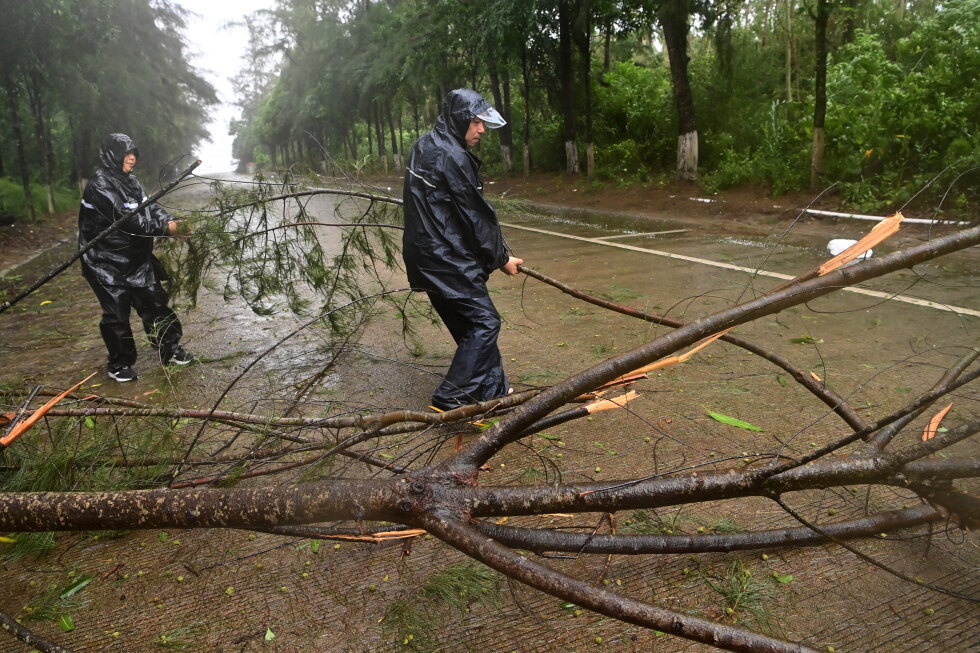
In Fangchenggang, a port city in southern Guangxi, storm-driven rainfall pushed local rivers past their banks, triggering severe flooding that submerged passenger vehicles up to their rooflines, footage from state broadcaster CCTV showed. Local residents told China News Service that the flooding is the worst the region has seen in two decades. Emergency rescue teams deployed inflatable boats to navigate submerged neighborhoods and extract residents trapped in their homes and vehicles. The storm also knocked over mature trees in Dongxing, a Guangxi border city that sits directly adjacent to Vietnam.
Across the border in Vietnam’s Mong Cai Town, the storm’s strong winds downed trees and tore metal roofing off residential and commercial buildings Saturday evening, Vietnamese state media reported. After wind speeds eased, municipal work crews used chainsaws and heavy construction equipment to clear fallen debris from roadways and reopen blocked transport routes.
As of Sunday, there has been no update on additional missing persons or the full scale of property damage from either the northern rain events or southern Tropical Storm Maysak.