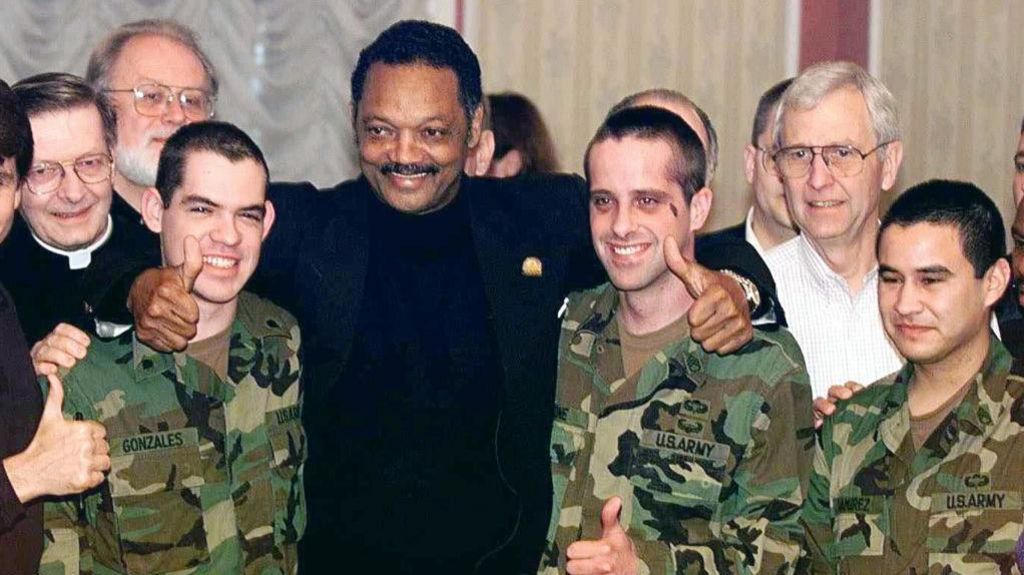
In a remarkable act of private diplomacy that defied official US policy, the late Reverend Jesse Jackson orchestrated the daring liberation of three American soldiers held captive by Yugoslav forces during the Kosovo conflict. The previously undisclosed details of this high-stakes humanitarian mission emerge following Jackson’s passing at age 84.
The incident unfolded in March 1999 when Army Sergeant Andrew Ramirez and his comrades Christopher Stone and Steven Gonzales were captured near the Macedonian-Yugoslav border during a routine patrol. Their capture occurred just as NATO launched air strikes against Slobodan Milosevic’s regime to halt ethnic cleansing in Kosovo.
While the Clinton administration explicitly warned against unauthorized intervention, Jackson partnered with then-Congressman Rod Blagojevich, the sole Serbian-American in Congress, to initiate backchannel negotiations. Despite official State Department objections, the unlikely diplomatic team assembled a multi-faith delegation and flew to Belgrade in late April.
Jackson confronted Milosevic directly, employing what he later described as essential diplomacy where traditional channels had failed. The negotiations reached a critical juncture when the Yugoslav leader offered to release only one or two soldiers. Jackson remained uncompromising, declaring the mission would accept nothing less than all three captives.
The soldiers, completely unaware of these developments, were suddenly escorted from their confinement to encounter an unexpected sight: Jackson standing alongside international news crews. Their emotional release on May 1 culminated in a transfer to Croatia and subsequent evacuation to a US military base in Germany.
Ramirez, who maintained contact with Jackson after leaving military service, expressed profound gratitude for the clergyman’s unauthorized intervention. ‘He did something for us he didn’t have to do,’ Ramirez reflected. ‘I truly believe he did it because he saw somebody in need and thought he could intervene.’