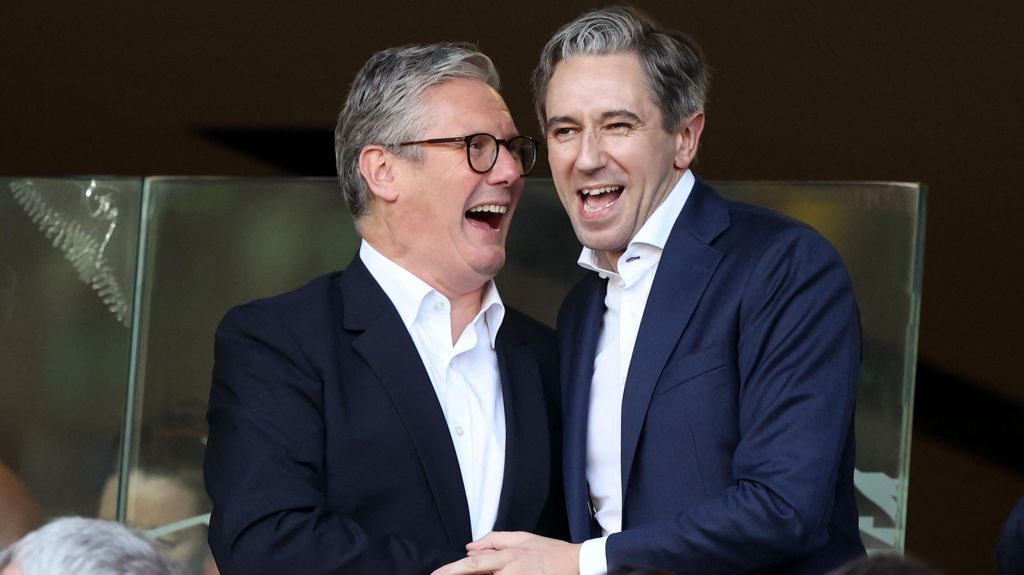
On a sweltering July day in 2024, the rolling grounds of Chequers, the British prime minister’s official countryside retreat, played host to a momentous occasion: the first formal welcome of an international leader by newly installed UK Prime Minister Keir Starmer. His guest was Simon Harris, the freshly elected Taoiseach of Ireland, turning a routine bilateral meeting into a symbolic marker of the new UK government’s foreign policy priorities.
Inside the residence’s Hawtrey Room, the two newly inaugurated heads of government held an informal, warm discussion alongside their most senior advisors. On the UK side, Downing Street Chief of Staff Sue Gray and Cabinet Secretary Simon Case were in attendance, and the conversation veered from formal policy to personal anecdotes. Starmer shared the story of a Donegal Gaelic football jersey he had picked up during his honeymoon in Ireland, noting he still pulls the garment on for local five-a-side matches. Charmed by the story, Harris presented Starmer with a brand-new official Donegal jersey as a ceremonial gift, capping the lighthearted opening to the talks.
Beyond the pleasantries, the core of the meeting centered on mending a relationship fractured by years of Brexit upheaval. Both leaders jointly pledged a full “reset” of British-Irish ties, which had deteriorated dramatically during the years of Brexit negotiations and Conservative-led governments. While former Conservative Prime Minister Rishi Sunak had made tentative efforts to rekindle cooperation, intractable domestic political pressures derailed his efforts. Starmer’s incoming Labour government had long prioritized rebuilding working relationships with key European Union allies, and Ireland’s spot as the first international guest at Chequers sent a clear signal of this commitment. That said, Starmer’s final months in office were already overshadowed by growing domestic controversy over the Peter Mandelson affair, linking the former UK ambassador to convicted sex offender Jeffrey Epstein.
As Starmer neared his planned departure from 10 Downing Street, senior Irish ministers from the two ruling coalition parties, Fianna Fáil and Fine Gael, offered largely positive assessments of his tenure’s approach to Anglo-Irish relations. Speaking to BBC Northern Ireland, ministers who had worked with Starmer and his team over the past two years praised his consistent, firm stance on supporting Ukraine and engaging constructively with the EU, noting he had avoided unnecessary confrontations and refused to engage with provocative rhetoric from former US President Donald Trump. One minister drew a favorable contrast between the struggling British economy Starmer inherited and the stabilized growth seen by the end of his term, while another acknowledged that Brexit had created unavoidable long-term challenges that no prime minister could quickly fix. All agreed that Starmer had worked constructively with Dublin, but Irish officials have voiced growing concerns that incoming prime minister Andy Burnham will be pulled away from Irish affairs by pressing domestic issues, including pressure from the right-wing Reform Party and ongoing economic turbulence.
Burnham, who is on track to succeed Starmer as UK prime minister following Starmer’s recent announcement of his resignation, already has deep existing ties to Ireland. His great-grandfather Edmund “Ned” Burke emigrated from Drogheda, County Louth, to Liverpool in the late 19th century, giving him direct family roots in the country. Burnham has already held multiple formal meetings with current Taoiseach Micheál Martin both in Dublin’s government buildings and in Manchester, where he served for years as mayor. Senior Irish officials also note that key members of Burnham’s inner circle already have deep familiarity with Irish politics: Louise Haigh, a leading figure in Burnham’s political network who served as shadow Northern Ireland secretary during the final stages of Brexit negotiations, already has established relationships with most major Irish political figures, and is widely expected to take a senior cabinet position in the new Burnham administration. Irish political observers note that the policy differences between Starmer and Burnham on Irish affairs are vanishingly small, though they warn that public support for Burnham could erode quickly once he takes office amid broader economic pressures.
The only remaining unresolved sticking point in the modern British-Irish relationship centers on legacy matters from the decades of Northern Ireland’s Troubles. The previous Conservative government passed the 2023 Legacy Act, which included a controversial provision granting conditional immunity to Troubles crime perpetrators in exchange for cooperation with the new Independent Commission for Reconciliation and Information Recovery. Starmer’s Labour government came into power promising to repeal the act and replace it with a new framework aligned with the joint agreement London and Dublin had previously negotiated. The new bill has already passed an initial House of Commons vote stripping out the conditional immunity clause, but Dublin has grown concerned that the full legislation has fallen down the UK’s priority list ahead of the leadership transition. While Irish officials remain hopeful that the recent positive momentum in bilateral relations will continue under the new prime minister, they acknowledge that pressing domestic and national challenges in the UK will almost certainly push Irish affairs down the new government’s list of immediate priorities.