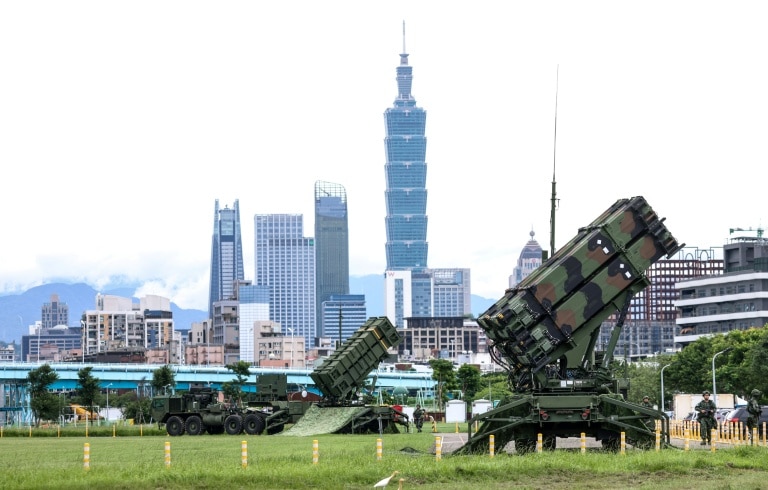
When former U.S. President Donald Trump recently suggested that longstanding American arms sales to Taiwan could be used as a bargaining chip in negotiations with Beijing, it sent shockwaves through global diplomatic circles. For ordinary residents of Taipei, however, the moment has underscored a bleak reality: the island’s security trajectory is ultimately out of their hands.
One week has passed since Trump made the controversial remarks during interviews with Fox News and on Air Force One, and intense speculation continues to swirl over whether decades of consistent U.S. policy toward the democratically governed island could be fundamentally upended. The context of this uncertainty stretches back nearly 50 years, when the United States officially shifted its diplomatic recognition from Taipei to Beijing. Even without formal diplomatic ties, Washington has remained Taiwan’s most critical international security partner and primary arms supplier, a commitment codified in the 1979 Taiwan Relations Act passed by U.S. Congress, which legally requires Washington to provide defensive arms to the island.
Despite widespread anxiety among Taiwanese government officials, who have spent weeks anxiously awaiting Trump’s final decision on a new pending arms package, public reaction on the streets of Taipei has been marked by a quiet, fatalistic calm. Many residents have long held deep reservations about the practical value of additional U.S. weaponry in the face of China’s persistent claims that Taiwan is an inalienable part of its territory, and Beijing’s repeated threats to use force to assert control if necessary.
Nicole Lee, a 46-year-old nurse in Taipei, said she does not believe advanced military hardware would shift the balance of power significantly if a conflict were to break out. “Even if they give us weapons, if we really had to use force against China, I don’t think there would be much we could do,” she explained.
Ben Wu, a 41-year-old delivery driver, echoed Lee’s sentiment, framing U.S. arms sales as little more than a costly “protection fee” for the island. Even with the most advanced weaponry the U.S. can offer, he noted, “it would still be very hard to win” against China’s far larger military force.
To date, Taipei has poured tens of billions of dollars into purchasing advanced U.S. military equipment, including fifth-generation fighter jets, precision high-tech missiles, and reconnaissance drones, all to bolster its defensive capabilities against a potential cross-strait attack. Taiwanese officials have repeatedly reminded the Trump administration of Washington’s binding legal commitments under the Taiwan Relations Act, while top U.S. officials including Secretary of State Marco Rubio and Trade Representative Jamieson Greer have publicly insisted that no shift in longstanding U.S. policy toward Taiwan is underway.
Still, many ordinary Taiwanese remain deeply skeptical of Trump’s approach to the issue, with many arguing that the former president prioritizes U.S. interests above all other considerations, with little regard for longstanding alliances or commitments. Cynthia Kuo, a 29-year-old elementary school teacher in Taipei, described Trump as the “kind of person who just says whatever pops into his head.” “So I feel like whatever decisions he makes, he only makes them if he thinks they’re good for the United States,” she said. “He’s not going to take other countries into account.”
A 78-year-old retiree, who requested anonymity to speak freely, said the only certain takeaway from the current situation is that Trump cannot be counted on as a reliable partner for Taiwan. “He’s totally untrustworthy,” she said. “I often feel that Trump is a hooligan in international politics.”
Across age groups, residents of Taipei echoed a shared sense of powerlessness in the face of the current uncertainty. No matter the outcome, the final decisions on the pending arms package will be made in Washington, and any subsequent response from Beijing will be shaped thousands of kilometers away from Taipei. For 22-year-old university student Matt Lin, that reality makes personal anxiety feel pointless. “I’m not that worried,” he told AFP. “Whether we worry or not doesn’t really change anything.”