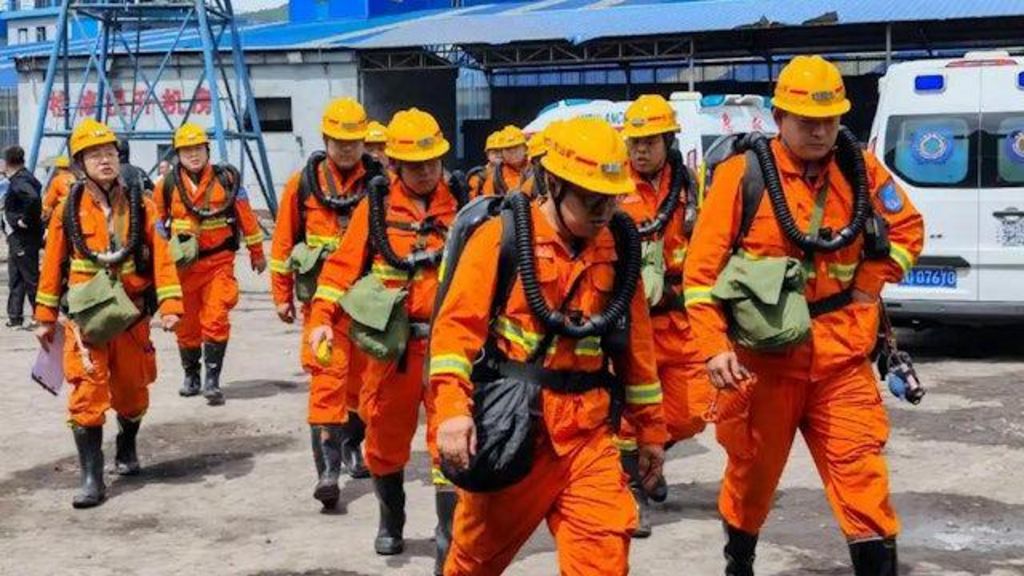
A devastating gas explosion at a major coal mine in northern China’s Shanxi Province has left at least 90 people dead, triggering a large-scale emergency response that has brought hundreds of rescuers to the remote mining site, according to official Chinese state media. The incident occurred at the Liushenyu Coal Mine, a facility operated by Tongzhou Group, at 19:29 local time (11:29 GMT) on Friday, when 247 mining personnel were on shift across the site. In the immediate aftermath of the blast, more than 100 injured workers were transported to local medical facilities for urgent treatment, and search and rescue operations remained active as authorities worked to locate any unaccounted for personnel. Footage released by state broadcasters shows emergency medical teams carrying stretchers through the mine entry, with a fleet of ambulances staged nearby to support evacuation efforts. Chinese President Xi Jinping has issued explicit orders directing emergency teams to spare no resource in treating the injured and searching for any remaining survivors. He has also called for a full, transparent investigation into the root causes of the explosion and formal accountability for any parties found responsible for the incident. Per state media updates, senior on-site management of the Liushenyu Coal Mine have already been taken into custody as investigators work to piece together what led to the blast. While a definitive cause has not yet been announced, preliminary monitoring detected carbon monoxide levels in the mine far exceeding official safety limits; the toxic, odorless gas is one of the most common hazards in underground coal mining operations. China’s national Ministry of Emergency Management deployed 345 trained rescue personnel across six specialized teams to reinforce the local response effort, boosting the scale of the on-site search and recovery operation. Shanxi, one of China’s inland provinces with a historically coal-dependent economy, is widely recognized as the country’s coal mining heartland, supplying a significant share of the fossil fuel that powers China’s industrial and energy sectors. For decades, the region’s mining industry struggled with chronically poor safety standards that led to frequent deadly accidents through the early 2000s. In recent years, national regulators have enacted sweeping reforms to tighten safety protocols, shutter small unregulated mines, and improve working conditions, which has cut the overall frequency of fatal incidents dramatically. Even with these improvements, serious accidents still occur across the sector: in 2023, an open-pit coal mine collapse in northern China’s Inner Mongolia Autonomous Region claimed 53 lives, and a 2009 explosion at a Heilongjiang Province mine killed more than 100 workers. As the world’s largest consumer of coal and top greenhouse gas emitter, China continues to rely heavily on the fossil fuel for energy and industrial production even as it invests in renewable energy capacity at a global record pace. The current disaster underscores the persistent safety challenges that remain even as the country works to modernize its mining sector and transition its energy system.