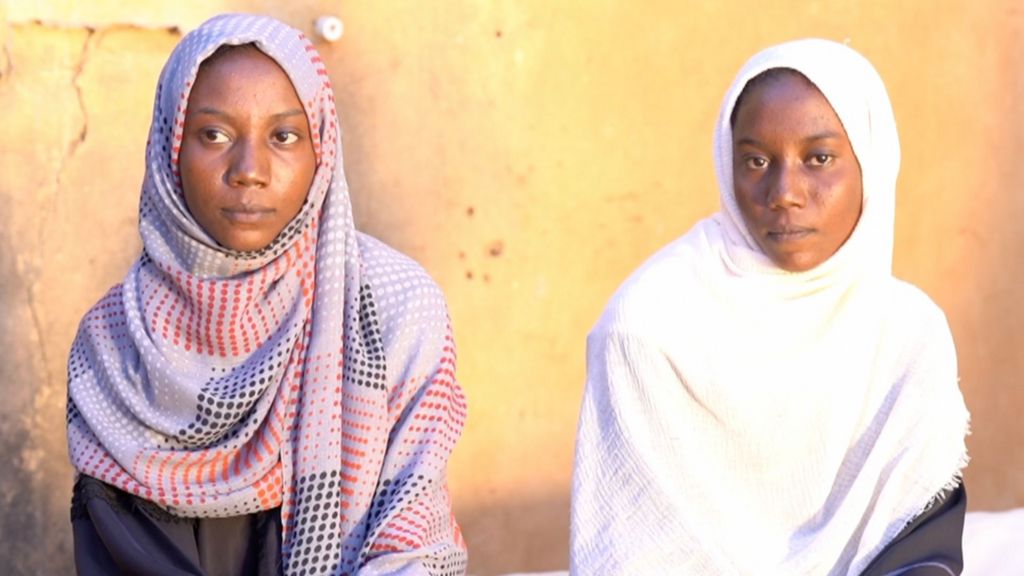
In a harrowing account from Sudan’s civil war, 18-year-old twins Makarem and Ikram survived a devastating artillery attack on their school in el-Obeid, North Kordofan, in August 2024. The sisters were attending separate classes when shells struck the Abu Sitta girls’ school, killing their English teacher and 13 classmates while injuring dozens more.
Makarem sustained serious injuries during the attack, suffering shoulder and head wounds from shrapnel. ‘We took cover beside the wall when a classmate noticed my bleeding shoulder,’ she recalls. In the ensuing chaos, the twins desperately searched for each other amid the destruction, with Makarem eventually transported to hospital by local residents using private vehicles and animal-drawn carts due to the absence of functional ambulance services.
The attack left a permanent physical reminder for Makarem—a small shrapnel fragment embedded in her head that continues to cause periodic pain, particularly during colder weather. ‘The headaches were unbearable initially, requiring constant pain medication,’ she explains.
Despite the trauma, both twins have demonstrated remarkable resilience. Following three months of school renovations, they returned to the same classrooms where their friends and teacher perished. ‘Initially, I couldn’t imagine returning,’ Ikram admits. ‘But seeing my friends come back gave me courage.’ The emotional toll remains evident as she confesses to closing her eyes while passing the attack site to avoid traumatic memories.
The school administration implemented comprehensive support measures, including psychological counseling and medical facilities with beds and nurses to accommodate injured students during examinations. Headteacher Iman Ahmed describes the girls’ determination to continue their education as ‘a form of defiance and loyalty to those who were lost.’
Their story unfolds against the backdrop of Sudan’s devastating conflict, which has claimed over 150,000 lives since April 2023 and created the world’s worst humanitarian crisis according to UN assessments. The strategically vital Kordofan region, rich in oil resources, has become a major frontline in the war between the Sudanese army and paramilitary Rapid Support Forces (RSF).
Regional authorities attribute the school attack to RSF forces, though the group has never acknowledged responsibility for the incident. The conflict has severely disrupted education nationwide, with approximately 13 million of Sudan’s 17 million school-aged children currently unable to attend classes according to UN estimates.
In el-Obeid, educational challenges persist despite the city’s liberation from an 18-month RSF siege in February 2025. Dozens of schools have been converted into shelters for nearly one million displaced persons, creating overcrowded conditions that complicate learning environments.
Despite these obstacles, both twins maintain hopeful outlooks. Ikram now studies English at a local university, inspired by her deceased teacher, while Makarem aspires to become a doctor despite initially falling short of the required exam scores for medical school. ‘The shrapnel made studying difficult—I could only manage one-hour sessions,’ she reveals. Undeterred, she plans to retake her exams, asserting: ‘I believe I will achieve my target score. I am hopeful for the future.’
Neurologist Dr. Tarek Zobier notes that retained shrapnel effects vary case by case, with some patients requiring no intervention while others need surgery for severe symptoms. For Makarem, pain management continues through medication as she pursues her academic ambitions amid ongoing conflict.