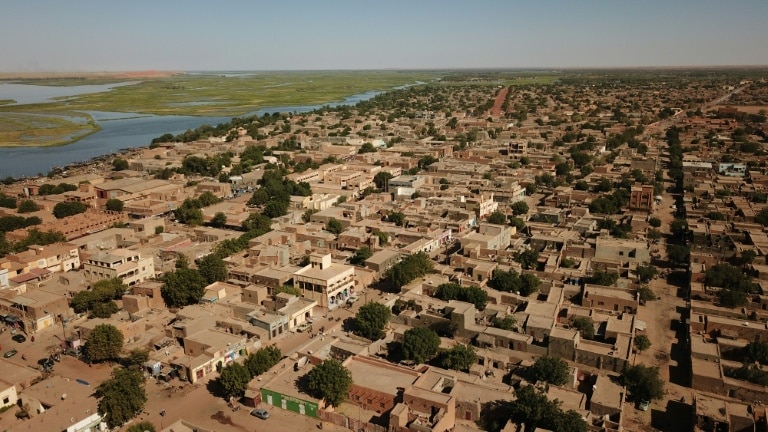
On a violent Saturday across junta-governed Mali, Malian army troops engaged in fierce combat with armed groups the military labels as terrorist organizations, marking a fresh eruption of violence in a West African nation that has been mired in over 10 years of brutal jihadist insurgency. Eyewitness accounts confirmed active fighting broke out not only in Mali’s capital Bamako, but also in several other major population centers across the landlocked country, which has been under military rule following back-to-back coups in 2020 and 2021. An official statement from the Malian military confirmed that unidentified armed groups launched coordinated assaults on multiple strategic sites and military barracks across the capital and interior regions of the country early Saturday morning. To date, no organization has stepped forward to claim responsibility for the coordinated attacks, but the assault aligns with previous efforts by jihadist factions to destabilize the central government: last year, insurgents attempted to shut down the capital by severing its fuel supply lines. Confirmed locations of fighting include the capital Bamako, the northern cities of Gao and Kidal, and the central Malian city of Sevare. Witnesses additionally reported sustained heavy gunfire in Kati, a suburban town on the outskirts of Bamako that serves as the official residence of Mali’s military leader, General Assimi Goita. Local residents of Kati shared imagery on social media platforms showing extensive damage to civilian residential properties, with one resident telling Agence France-Presse (AFP) that locals remain trapped inside their homes amid ongoing clashes. Military helicopters were observed circling low over Bamako, with operations concentrated near the capital’s international airport. An on-the-ground AFP correspondent in the capital reported that city streets were almost entirely deserted, with only sporadic gunfire echoing across empty neighborhoods. Mali sits on vast reserves of gold and other valuable mineral deposits, but it has been locked in a crippling security crisis since 2012, when insurgent violence first erupted. Today, the country faces simultaneous threats from jihadist factions aligned with al-Qaeda and the Islamic State, local organized criminal networks, and separatist movements. Like the military administrations that hold power in neighboring Niger and Burkina Faso, Mali’s junta has cut diplomatic and military ties with its former colonial ruler France and multiple other Western nations, reorienting its foreign and defense policy to build closer ties with Russia. The Goita-led government has also drawn widespread international criticism for its crackdown on press freedom and systematic silencing of opposition political voices, including a full ban on all political party activity. The junta initially made a public pledge to transition power back to civilian rule by March 2024, but in July 2025, it approved legislation extending General Goita’s presidential term by five years, with the provision that the term can be renewed “as many times as necessary” without holding a democratic election. Despite this authoritarian shift, the second administration of U.S. President Donald Trump has moved to open diplomatic channels with the three Sahel juntas, while Togo has positioned itself as a neutral intermediary between Western governments and the three states, which have formally organized themselves as the Alliance of Sahel States. Over the course of the 13-year insurgency, thousands of Malian civilians and security personnel have been killed in attacks, and tens of thousands of residents have been displaced, seeking refuge in neighboring countries such as Mauritania. Russia’s Wagner Group, a private military contractor that had deployed fighters alongside Malian army forces to combat jihadist insurgents starting in 2021, announced it would wrap up its original mission in Mali in June 2025. The group was subsequently reorganized into Africa Corps, a new organization placed under the direct command of the Russian Ministry of Defense. Since September 2025, the Group for the Support of Islam and Muslims (known by its Arabic acronym JNIM), an al-Qaeda-affiliated jihadist faction, has carried out repeated targeted attacks on fuel tanker convoys traveling to Bamako. At the peak of that campaign in October, the capital was brought to a near-complete standstill. After several months of relative quiet, Bamako faced a renewed diesel shortage in March 2026, with all available fuel supplies redirected to meet critical energy sector needs.