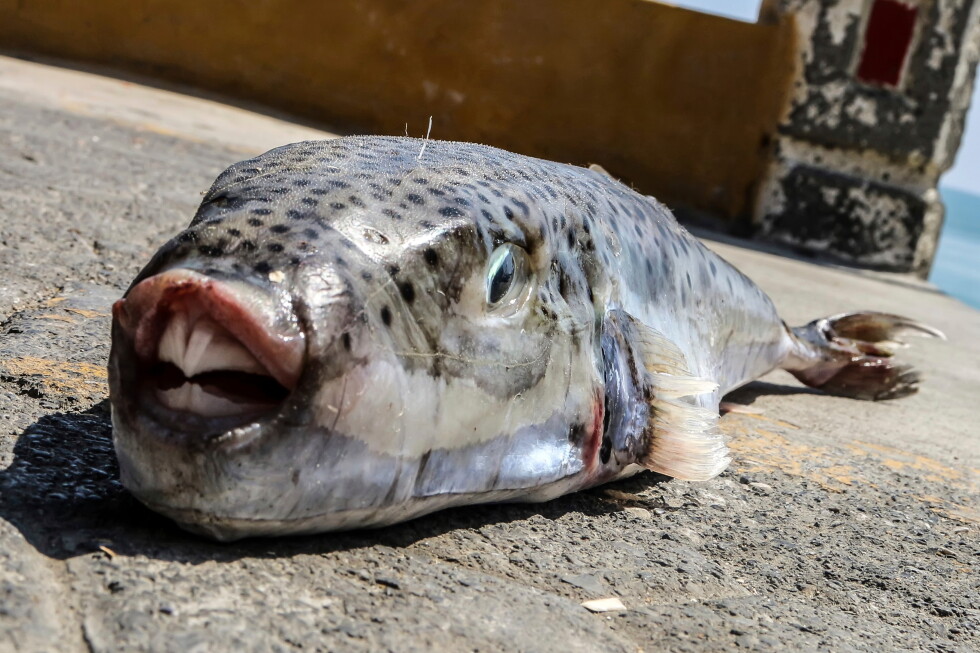
Climate change has triggered an unprecedented biological shift in the Mediterranean Sea, pushing a toxic, invasive species northward into Greek waters—and prompting Athens to roll out an unusual solution to contain the disruption: a cash-for-catch bounty program targeting the dangerous invader.
The species in question is the silver-cheeked toadfish, a member of the pufferfish family native to tropical marine ecosystems. Identified by its streamlined torpedo frame and distinct human-like teeth, the creature carries an extremely potent neurotoxin in its skin and internal organs that can trigger fatal heart failure if ingested by humans.
While Greek authorities have confirmed no sightings of the toadfish in popular resort bathing zones around Greek islands, the invasive species has already caused severe economic damage to fishing communities operating off the coast of Crete and other nearby island groups. Local fishermen report that the toadfish routinely tear through commercial fishing nets to feed on already caught target species, leaving gear destroyed and catches depleted.
Giorgos Kyriakakis, a representative of a Cretan fishermen’s association, explained the scope of the problem in an interview with Greek public broadcaster ERT on Friday. “It’s got to the point where we might go out fishing one day and then spend the next three days fixing our nets,” Kyriakakis said. “They eat our catch and damage our nets — that’s very costly.”
Ecologists trace the toadfish’s arrival in the Mediterranean to two interconnected factors: the species originally entered the sea via the Suez Canal from the Red Sea, and rapidly expanding northward as ocean temperatures rise due to human-caused climate change. The invasion of this toxic species is not unique to Greece; neighboring Cyprus launched an identical cash bounty program earlier this year to address its own toadfish infestation.
Greece’s formal program launched Friday, with the government offering a payout of 5.33 euros per kilogram (equivalent to roughly $2.75 per pound) for every toadfish turned in by fishermen. According to Agriculture Minister Margaritis Schinas, a former vice president of the European Commission, this is the first time Greece has implemented a targeted eradication measure of this kind.
All collected toadfish will be frozen at local government facilities before being incinerated to prevent the neurotoxin from entering the food supply, Schinas confirmed. He also noted that the program, which initially covers only the currently affected island regions, will likely be expanded to all Greek territorial waters in the coming months to stop the species from spreading further.
Public anxiety around the toadfish has grown in recent weeks after Greek fishing crews shared viral videos online showing the species biting through solid objects including soda cans and wooden planks, highlighting the strength of its jaws. In response to rising public concern, the Greek Red Cross issued an official public health advisory, outlining first aid procedures for bite-related bleeding and warning the public of the lethal risk posed by the neurotoxin stored in the fish’s organs.
Despite the valid concerns of fishing communities, medical and tourism stakeholders on Crete have urged the public to avoid overreaction. In a joint statement released Friday by 16 local medical and tourism associations, leaders emphasized that the presence of the toadfish in Mediterranean waters has been documented by scientists for years, and there is no immediate or hidden threat to recreational swimmers.
“Marine predators do not threaten the safety of visitors and residents,” the statement read. “Exaggeration is often a feature of public debate.”