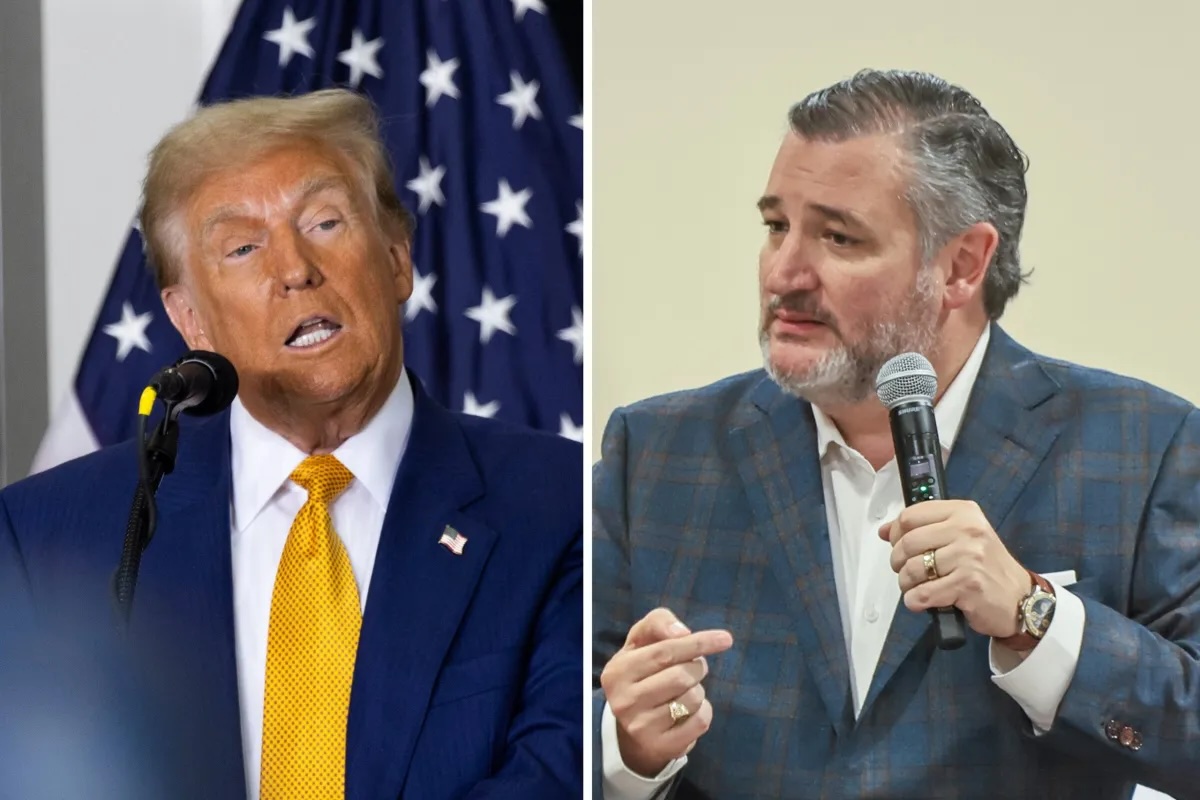
Over the recent weekend, former U.S. President Donald Trump made public that he is actively considering a negotiated agreement to bring an end to the ongoing U.S. war with Iran, a development that has sparked urgent pushback from hardline, pro-conflict factions within the Republican Party.
Per a Sunday report from The New York Times, critical details of the prospective peace deal remain deeply unclear, most notably the future of Iran’s enriched uranium program, whose status is still unresolved. Compounding the uncertainty, official statements from both U.S. and Iranian representatives have offered conflicting accounts of what the agreement would entail, confirming that extensive negotiations still lie ahead before any final pact can be reached.
Even before a full draft of the deal has emerged, three of the Senate’s most prominent Republican Iran hawks moved on Saturday to outline sharp objections to the emerging framework. The lawmakers warned that any agreement that leaves Iran strategically stronger than it was before Trump launched military operations in late February would be unacceptable for U.S. national security.
Senator Lindsey Graham of South Carolina, who repeatedly pressured Trump to launch military strikes on Iran in the lead-up to the war, argued that a deal that allows the Iranian government to retain power and grow its influence over time would only exacerbate existing instability across the Middle East. “If it is perceived in the region that a deal with Iran allows the regime to survive and become more powerful over time, we will have poured gasoline on the conflicts in Lebanon and Iraq,” Graham wrote. He added that an agreement that lets Iran maintain future control over the Strait of Hormuz would supercharge the capabilities of Hezbollah in Lebanon and Iranian-aligned Shia militias operating in Iraq.
Senator Ted Cruz of Texas, another longstanding advocate of hardline policy toward Iran, said he is “deeply concerned” by early details of the proposed deal, singling out the risk of sanction relief for Iran while it retains the capacity to close off the Strait of Hormuz, a critical global oil chokepoint. “If the result of all that is to be an Iranian regime – still run by Islamists who chant ‘death to America’ – now receiving billions of dollars, being able to enrich uranium and develop nuclear weapons, and having effective control over the Strait of Hormuz, then that outcome would be a disastrous mistake,” Cruz said.
Senator Roger Wicker of Mississippi went even further in his rejection of the reported agreement, calling the rumored 60-day ceasefire that would precede final negotiations a fundamental mistake. “The rumored 60-day ceasefire – with the belief that Iran will ever engage in good faith – would be a disaster,” Wicker wrote. “Everything accomplished by Operation Epic Fury would be for naught.”
That claim drew immediate pushback from foreign policy critics of the war, starting with Ben Rhodes, a former deputy national security adviser to President Barack Obama. Rhodes flatly rejected Wicker’s assertion that the U.S. military campaign had achieved any meaningful gains. “Nothing was accomplished by Operation Epic Fury,” Rhodes wrote, “except putting the Islamic Revolutionary Guard Corps in charge of Iran and the Strait of Hormuz.”
Rhodes’ critique was echoed by Stephen Wertheim, a senior fellow at the Carnegie Endowment for International Peace, who wrote that “everything accomplished by Operation Epic Fury is already for naught.”
Ali Vaez, director of the Iran Project at the International Crisis Group, pushed back against the hawks’ core argument that continued military pressure would force Iran to surrender. Vaez noted that hardline policymakers have already secured two wars, sweeping international sanctions, and a naval blockade that has disrupted global energy markets, yet still demand further escalation to achieve their goals. “DC’s Iran hawks got two wars, nearly every conceivable sanction designation, a blockade, threw a wrench in global economy,” Vaez wrote, “and will still claim that just a little more pressure and a touch more bombing will magically yield the concessions they still won’t be satisfied with.”