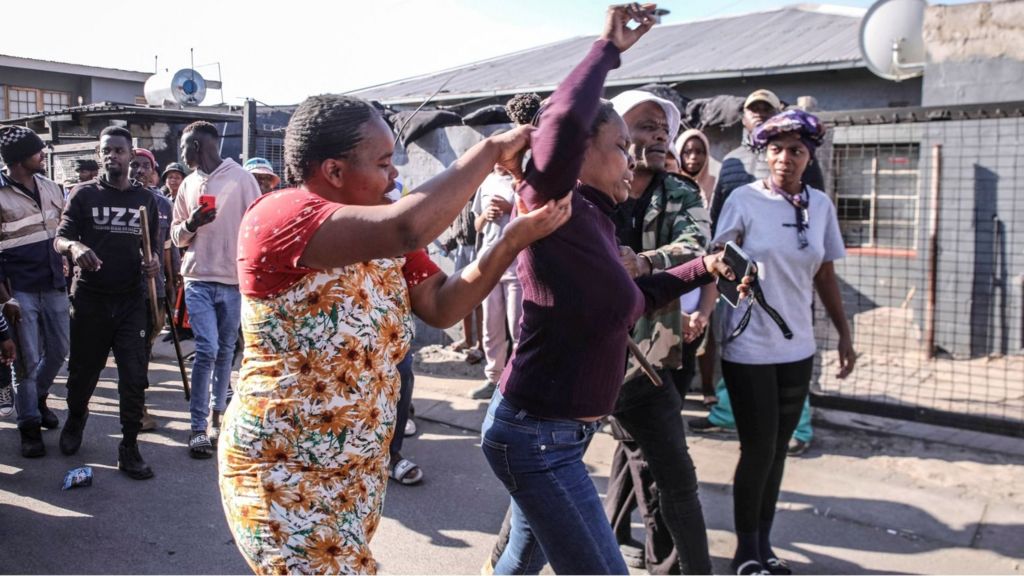
A wave of violent anti-undocumented migrant protests across South Africa has sparked cross-African diplomatic friction and an unprecedented legal challenge filed at the International Criminal Court (ICC) by two Ghanaian activists, plunging the continent into a heated debate over migration governance and state accountability.
The unrest, led by anti-migrant groups that set a 30 June deadline for all undocumented foreign nationals to exit the country, has driven widespread displacement. Protesters have taken extreme steps including door-to-door checks of residents’ migration status to enforce their demands, creating a climate of fear that has pushed tens of thousands of migrants to flee. Demonstrators frame their actions as a response to South Africa’s deep socioeconomic crises, blaming undocumented migrants for soaring unemployment, escalating crime, and the crumbling of public services that millions of South Africans rely on daily.
Disputes over the scale of the displacement highlight growing rifts. South African government data indicates more than 53,000 foreign nationals have been either deported or have left voluntarily in recent weeks. But an independent tally compiled by Agence France-Presse, based on official figures from migrants’ home countries, puts the total number of people who have exited South Africa over the past two months above 160,000, underscoring the far broader reach of the unrest than official counts acknowledge.
Last week, two Ghanaians — Palgrave Boakye-Danquah, a former Ghanaian government spokesperson for governance and security, and Emmanuel Kotin, a counter-terrorism and security analyst — formally submitted a petition to the ICC based in The Hague. The filing argues that the ongoing pattern of targeted violence against migrants meets the legal definition of crimes against humanity, and accuses the South African government of systemic failure to prevent attacks or hold perpetrators accountable. “For years, African brothers and sisters have been killed, beaten and driven from their homes in South Africa,” the pair said in a joint statement. “While we commend individuals in South Africa who have condemned these acts, the pattern, scale and recurrence of the violence raise serious questions about the failure of state authorities to prevent, investigate, and punish these crimes.” As of this report, the ICC has not released any public statement on whether it will move forward with reviewing the petition.
South Africa has forcefully pushed back against the filing, dismissing it as an opportunistic action that fails to meet the ICC’s legal threshold for intervention. The country’s foreign ministry has emphasized that its domestic judicial system is fully capable of investigating and prosecuting any crimes connected to the unrest. South African officials have repeatedly rejected accusations of state inaction, noting that President Cyril Ramaphosa has publicly acknowledged widespread public frustration over unregulated migration but has clearly condemned all violent attacks on foreign nationals, warning citizens against taking the law into their own hands. In an official response, the South African government stated it “categorically rejects xenophobia, racism, homophobia, and intolerance and discrimination in all their manifestations”, adding that upholding respect for the dignity of every person within its borders is both a constitutional obligation and a moral duty.
Tensions between South Africa and Ghana have escalated rapidly in recent weeks. Ghana became one of the first African nations to organize repatriation flights for its citizens caught up in the violence after the latest wave of protests erupted, and has confirmed one Ghanaian citizen was killed in anti-migrant attacks — a claim South African authorities have outright denied. In the weeks since, multiple other African countries including Kenya, Malawi, Nigeria and Uganda have also arranged organized transportation to help their citizens exit South Africa safely.
Over the weekend, leaders from the Economic Community of West African States (ECOWAS) issued a formal condemnation of the attacks, specifically calling out the “despicable treatment of West African citizens” and calling on South African authorities to take immediate, decisive action to end the violence and protect all foreign nationals residing in the country. The United Nations has also joined the international conversation, warning that political and popular leaders are unfairly scapegoating migrants to distract from South Africa’s deep-rooted socioeconomic challenges.
As Africa’s largest economy, South Africa has long drawn migrants from across the continent seeking better economic opportunity, with many crossing the border without formal authorization. Official statistics put the number of documented foreign residents at more than three million, a figure that does not include the undocumented population, whose exact size remains unconfirmed. To address the underlying issues, South Africa has called for continent-wide discussions through the African Union (AU) focused on tackling the root causes of irregular migration across Africa, framing the crisis as a shared continental challenge rather than an isolated South African problem.