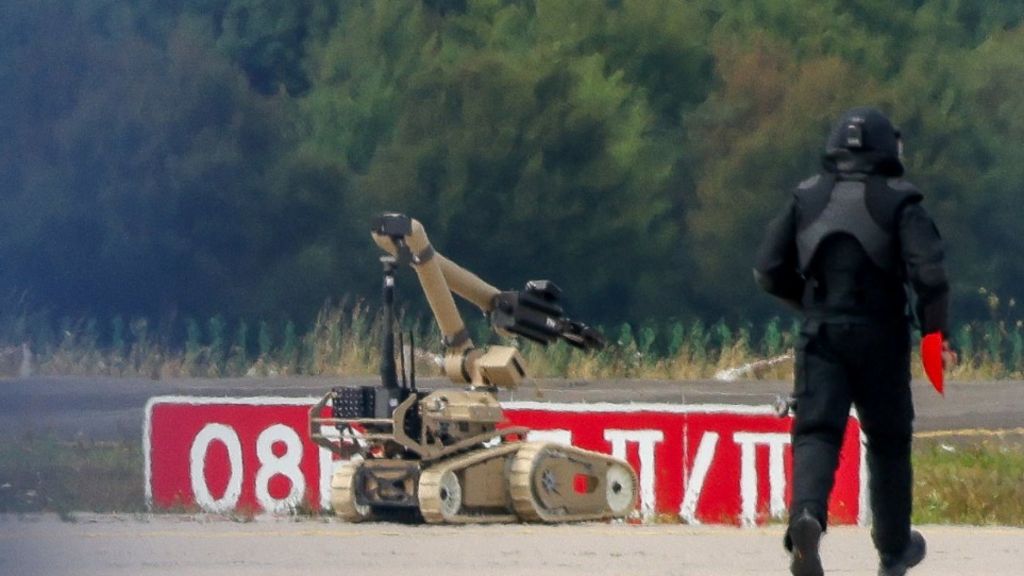
A foiled drone bombing plot at a major German airport has escalated tensions between Berlin and Moscow, pushing Chancellor Friedrich Merz to promise tough action against perpetrators and reaffirm unwavering German support for Ukraine. The incident, which unfolded on August 4 at Leipzig/Halle Airport in eastern Germany, saw an explosive-laden drone discovered parked near Ukrainian cargo aircraft. The device never detonated, investigators later confirmed, because of a malfunctioning detonator. Local law enforcement deployed a bomb disposal robot to safely neutralize the explosives, and preliminary investigations suggest a second unidentified drone may have crashed into a nearby cargo plane shortly before the first device was found. Subsequent German media reports have revealed that investigators have since located a third drone in the area surrounding the airport, and forensic tests detected traces of hexogen, a powerful military-grade explosive, at the site. Leipzig/Halle Airport holds unique strategic significance: it serves as a key logistics hub for German military and NATO ally weapons and supply shipments to Ukraine, hosts the main operations base for Ukrainian carrier Antonov Airlines, and is also a major European hub for global logistics firm DHL. While security analysts have widely pointed to Russian actors as the most likely perpetrators of the August 4 incident, the German federal government has not issued any formal direct accusations, and the Kremlin has repeatedly denied any involvement in the plot or a string of similar unauthorized drone overflights across Germany in recent months. Speaking at a government coalition retreat in Neuhardenberg, Merz delivered a stark warning that all those responsible for hostile attacks targeting German soil would face consequences. “Germany is facing a very real threat, and we are increasingly becoming a deliberate target of these hostile acts,” Merz told reporters. “We cannot ignore the threats that come largely from outside our borders. Attackers are growing ever more ruthless, willing to accept widespread property damage, and even serious injuries or loss of life. Anyone who carries out these attacks will pay a price.” The chancellor also used the appearance to reaffirm Germany’s long-standing commitment to supporting Ukraine amid its ongoing defensive war against Russian invasion, saying the German government would “stay the course” in its military, economic, and humanitarian backing for Kyiv. “The government continues its support for Ukraine with unshakable resolve,” Merz said. “Germany is currently Ukraine’s strongest supporter – this support is not meant to prolong the war, but to create conditions that will force Russia to come to the negotiating table for a just and lasting peace.” In response to the growing threat of drone and asymmetric attacks on German soil, Merz announced the German government is rolling out a sweeping set of new security measures to strengthen domestic defenses. These initiatives include expanded drone detection and interception systems across all critical infrastructure sites, as well as legislative proposals to grant Germany’s domestic and foreign intelligence services expanded authority to launch counterattacks against threat actors, including offensive cyber operations such as hacking the command and control servers used to coordinate attacks. Over the past several months, Germany has recorded a steady rise in unauthorized drone incursions over sensitive national infrastructure, including military installations, major commercial airports, energy export terminals, seaports, and key logistics facilities. German federal police have warned that many of these overflights are believed to be coordinated by Russian intelligence agents, as part of a broader campaign to undermine German security and disrupt Western support for Ukraine.