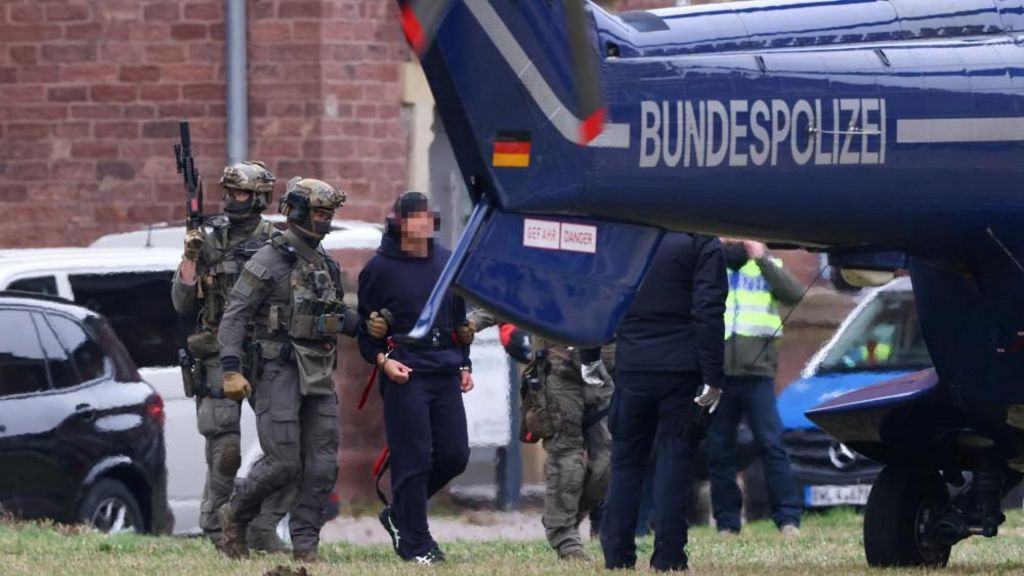
Four years after one of the most high-profile acts of sabotage to shake modern European infrastructure, a Ukrainian national identified as Serhii K will appear in a Hamburg courtroom on Wednesday to face charges connected to the bombings of Russia’s Nord Stream gas pipelines. The opening of the trial marks a major milestone in a years-long international investigation that has tested diplomatic ties between two key wartime allies, Germany and Ukraine.
German prosecutors accuse Serhii K, a serving Ukrainian army officer at the time of the 2022 attack, of coordinating a plot with other Ukrainian military personnel to destroy the pipelines. The alleged goal of the operation, prosecutors claim, was to cut off a major source of revenue that Russia was using to fund its full-scale invasion of Ukraine. Serhii K, who was extradited to Germany from Italy late last year following his arrest in August 2025, has repeatedly denied all charges against him. A second suspect, Volodymyr Zhuravlov, who is currently held in Croatia, also denies the accusations and is fighting extradition to Germany.
The sabotage itself unfolded on September 26, 2022, when explosive charges detonated on the floor of the Baltic Sea off Denmark’s Bornholm island, rupturing three of the four twin pipelines that made up the Nord Stream 1 and Nord Stream 2 projects. In the immediate aftermath of the blasts, Western intelligence agencies leaned toward suspicion of Russian involvement, though no official blame was assigned publicly at the time. Context offered key clues: Russia had already halted gas flows through the operational Nord Stream 1 to Germany just weeks before the attack, while the completed but unactivated Nord Stream 2 had been frozen by the German government shortly before Moscow launched its full-scale invasion in February 2022. Early reports also noted unusual Russian naval activity in the area in the lead-up to the blasts. As the investigation progressed, Russian President Vladimir Putin shifted blame to the United States and the United Kingdom, claiming “the Anglo-Saxons” orchestrated the attack—a charge both countries flatly denied.
After Danish and Swedish authorities closed their separate public inquiries into the attack, German prosecutors narrowed their focus to a group of deep-sea divers who had rented a leisure yacht named the Andromeda out of the northern German port of Rostock. Investigators later confirmed that trace evidence of subsea explosive materials was recovered from samples taken from the vessel. In a key 2025 ruling, Germany’s Federal Court of Justice confirmed that German courts had territorial jurisdiction over the case, holding that the attack qualified as an act that undermined Germany’s internal security, giving prosecutors a legal mandate to move forward with prosecution.
Prosecutors’ official indictment alleges the sabotage plot was conceived and ordered by Ukrainian state agencies, a claim Ukrainian President Volodymyr Zelenskyy has repeatedly rejected, maintaining Kyiv had “nothing to do with” the blasts. German authorities have framed the case as a violation of Germany’s code of crimes against international law, classifying the attack as a war crime carried out via military means against civilian energy infrastructure. The case has exposed quiet frictions between Berlin and Kyiv, even as Germany remains one of Ukraine’s most steadfast military and diplomatic backers amid Russia’s ongoing invasion.
Ukrainian officials have pushed back on the German narrative. Oleksandr Merezhko, chair of the Foreign Affairs Committee in Ukraine’s parliament, noted that the blasts occurred in the midst of an active full-scale war with Russia, arguing that Nord Stream 2 was little more than a strategic asset Moscow had built to prepare its invasion. “It’s one of the versions,” Merezhko told the BBC, adding that Kyiv has no independent confirmation of the German account of the attack. In contrast, Stefan Meister of the German Council on Foreign Relations explained that successive German governments have worked deliberately to depoliticize the proceedings. “They tried to make not a big story out of it, not to give it too much attention, to give it to the institutions, to the judiciary that they will deal with it. This is not a political case. So they tried to depoliticise it,” Meister said.
The path to trial has been marked by conflicting legal outcomes across European Union member states. After Serhii K’s August 2025 arrest in a hotel near the Adriatic resort of Rimini, Italy’s Supreme Court upheld his extradition to Germany. A separate suspect, Volodymyr Zhuravlov, won an extradition challenge in a Polish court in October 2025, where a judge ruled the pipeline attack was not unlawful, arguing that any armed mission organized by Ukraine against the infrastructure was “justified, rational and just” amid the ongoing war. Despite that ruling, Zhuravlov was arrested in Croatia last August on suspicion of participating in the reconnaissance dives required to carry out the sabotage. Croatian courts approved his extradition to Germany last month, though it remains unclear when the transfer will take place, or whether his case will be joined to Serhii K’s trial in Hamburg.
Even amid the diplomatic sensitivity of the proceedings, Merezhko said he does not expect the trial to cause lasting damage to bilateral relations. “It’s in the best national interests of Germany to continue to support us,” he noted, a view that echoes broader analysis of the two countries’ aligned strategic interests throughout the war in Ukraine.