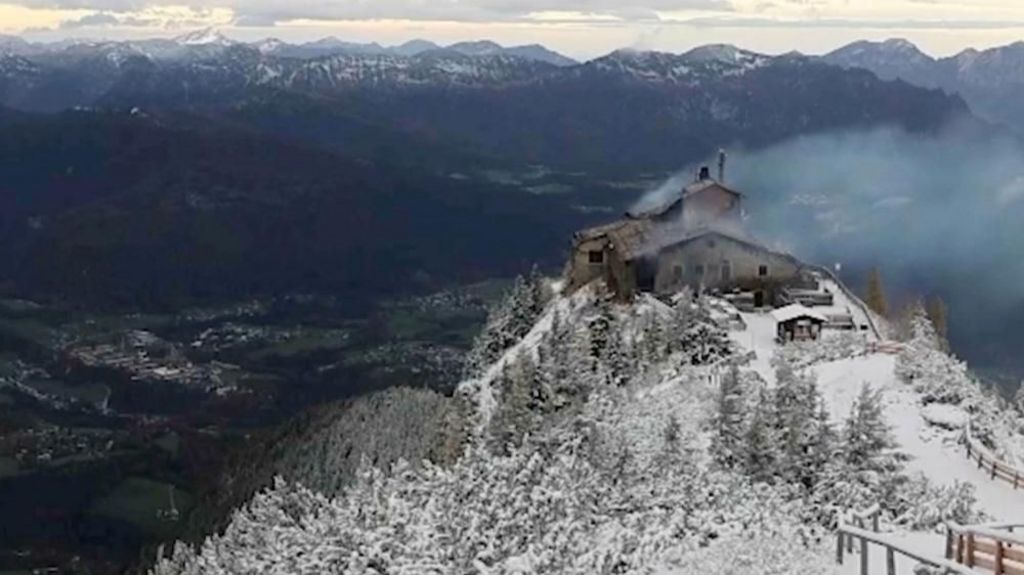
Perched 1,834 meters above sea level on a jagged Alpine ridge overlooking Bavaria’s Berchtesgaden valley, the charred, fire-ravaged remains of the Kehlsteinhaus — better known globally as Hitler’s Eagle’s Nest — have emerged as the epicenter of a deeply divisive national conversation about how Germany confronts its unshakeable historical responsibility for Nazi atrocities. The remote mountaintop retreat, commissioned by the Nazi regime in 1938 as a symbolic prestige project that hosted Adolf Hitler and high-ranking Third Party officials for state receptions, was designated a protected historical monument in the aftermath of World War II, and operated for decades as a popular Bavarian state-owned tourist restaurant, drawing tens of thousands of annual visitors who traveled via scenic mountain buses and a historic brass-and-mirror in-mountain elevator to take in panoramic Alpine views, dine at its high-altitude beer garden, and engage with contextual exhibits tracing the site’s violent fascist origins. That long-running public access came to an abrupt end on the evening of October 23, when a devastating blaze gutted nearly the entire structure in what authorities have classified as a suspected arson attack. A 33-year-old man with a documented history of severe mental illness has been detained in a secure psychiatric facility in connection with the incident, though law enforcement officials have not publicly released additional details about a potential motive. The fire has split historians, local policymakers, and community members sharply into two opposing camps with fundamentally different visions for the site’s future. One faction, led by prominent University of Cambridge Nazi studies specialist Professor Sir Richard J. Evans, argues the fire presents a rare, unplanned opportunity to erase the site entirely: clear all remaining charred rubble, return the Alpine ridge to its unspoiled natural state, and eliminate a landmark that has long drawn unsanctioned admiration from far-right sympathizers. Evans points to precedents set by other Nazi-associated sites across Germany, including the Berlin bunker where Hitler died, which was filled with concrete and paved over to make space for a public children’s playground, as a proven model for neutralizing harmful fascist symbolic sites. But a second coalition, including Bavaria’s state Interior Minister Joachim Herrmann, Arts Minister Markus Blume, and Sven Keller, director of the nearby Obersalzberg Documentation Centre, warns that abandoning the site as an unmanaged, overgrown ruin would create an unregulated, unmonitored space that actively encourages unchallenged neo-Nazi pilgrimage, a risk that has grown exponentially amid the rapid recent resurgence of far-right political movements across Germany and Austria. Keller notes that the 1952 demolition of Hitler’s nearby Berghof summer residence, once believed to erase the site from public memory, failed to remove it from the informal “mental maps” of far-right sympathizers, who continued to seek out the unmarked location for unauthorized gatherings. Leading contemporary history scholar Isabel Heinemann of Munich’s Ludwig-Maximilians-Universität, who also leads the Leibniz Institute for Contemporary History, has outlined a nuanced third path that rejects both full demolition and a one-to-one ideological reconstruction of the original Nazi-era architecture, which she describes as inherently steeped in violent fascist propaganda. Instead, she advocates for preserving the visible charred traces of the recent fire and the surviving original historical fragments of the structure, paired with purpose-built modern architectural additions that clearly mark distinct layers of the site’s complicated 20th-century history, ensuring it remains a dedicated, accessible space for public education about Nazi atrocities. Bavarian officials have confirmed they will pursue a stakeholder-led solution in close consultation with historians, with a binding stipulation that no public taxpayer funds will be allocated to any reconstruction efforts. The debate over the Eagle’s Nest arrives at a moment of heightened national urgency for Germany’s longstanding “Culture of Remembrance” (Erinnerungskultur), as surging electoral support for the far-right Alternative for Germany (AfD) party has sparked fresh conflicts over public memorialization of Nazi victims: just recently, local AfD and conservative Christian Democratic Union councillors in a Saxony town voted to ban the iconic “stumbling stone” brass plaque memorials embedded in sidewalks to honor victims of the Nazi regime. Neighboring Austria has faced parallel reckoning over its own Nazi-era legacy, most notably the years-long debate over the Braunau am Inn house where Adolf Hitler was born, which the Austrian government recently repurposed as a local police station to block planned neo-Nazi pilgrimage, a decision that sparked further debate over the delicate, often fraught balance between honoring historical memory and avoiding the glorification of fascist atrocities.