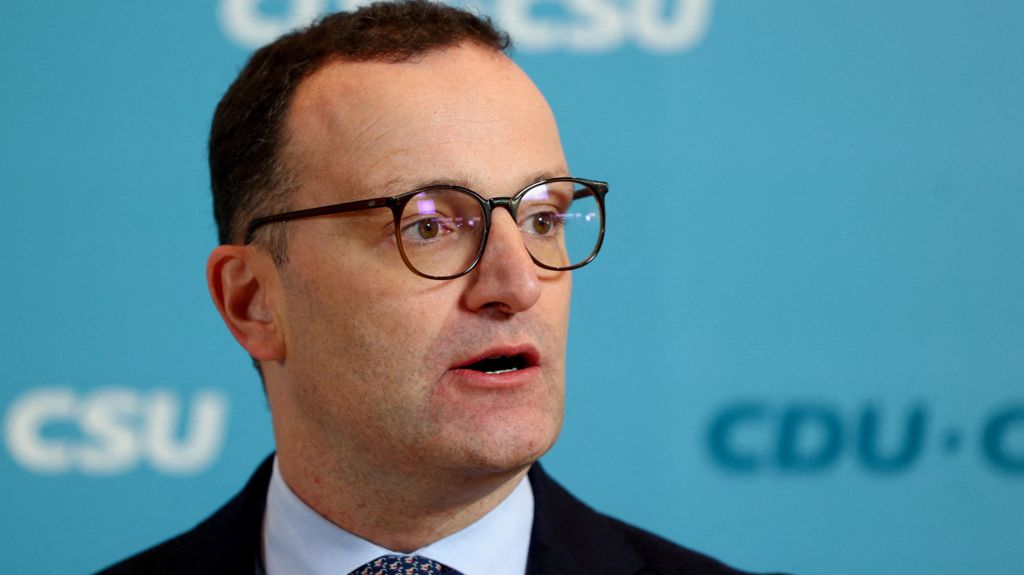
A leading German center-right politician has stepped down from his top parliamentary role following widespread backlash over his use of an international surrogate to welcome a new child, a practice he and his party have long banned domestically.
Forty-six-year-old Jens Spahn, a senior figure in the Christian Democratic Union (CDU) and former parliamentary group leader for Germany’s governing coalition, confirmed earlier this week that he and his husband Daniel Funke had become first-time parents via a surrogate based in the United States. The announcement immediately ignited fierce cross-party criticism, even from within Spahn’s own CDU, over accusations of blatant hypocrisy: surrogacy is strictly prohibited under Germany’s 1990 Embryo Protection Act, a policy that both the CDU and Spahn personally have repeatedly supported for decades.
Under German law, anyone facilitating commercial surrogacy within the country faces up to three years of prison or substantial fines. While raising a child born via surrogacy abroad is not illegal in Germany, the CDU reaffirmed its unwavering support for the full domestic ban as recently as February 2025, arguing that the prohibition prevents the exploitation of women and stops surrogacy from being turned into a profit-driven commercial industry. Critics have also highlighted Spahn’s long public record of opposing surrogacy legalization: during his tenure as German Health Minister in 2020, he rejected calls from the liberal Free Democratic Party (FDP) to loosen the country’s surrogacy restrictions, and as early as 2015, he wrote publicly that “as a gay man and a Christian I find it personally very hard to warm to the idea of a rented womb”.
In an official statement released Saturday, Spahn said he had concluded that his new personal happiness as a parent was fundamentally incompatible with his high-profile political position. “The balancing act between my private decision to have a child through surrogacy and the understandable expectations placed on me as Chairman of our parliamentary group has become greater than I anticipated,” he wrote. Spahn also called for more empathy in public discourse, noting that the “increasing relentlessness in public discourse” had forced him to reflect deeply on his position.
CDU leader and German Chancellor Friedrich Merz publicly backed Spahn’s resignation, calling the decision “right” and “inevitable.” “Credibility is the highest asset in politics,” Merz posted on social media, confirming that the party would immediately launch the process of selecting a permanent replacement for Spahn’s role. Until a permanent successor is appointed, Alexander Hoffmann, leader of the CDU’s Bavarian sister party the Christian Social Union (CSU) parliamentary group, will take over Spahn’s duties on an interim basis. Hoffmann said that Spahn’s choice “deserves the utmost respect,” though many within the party have maintained that the resignation was unavoidable.
Prior to Spahn’s announcement, senior CDU politician Daniel Peters from the state of Mecklenburg-Western Pomerania told German tabloid *Bild* that Spahn’s position had become “no longer tenable,” arguing that it was fundamentally wrong for a senior lawmaker to act one way privately while upholding a conflicting policy as an elected official.
The controversy comes as European nations remain deeply divided over surrogacy policy. Like Germany, Italy, France and Spain all enforce domestic bans on commercial surrogacy. Just this month, France’s highest court, the Court of Cassation, ruled that children born to surrogates abroad must be legally recognized as the children of their intended parents. In contrast, Italy’s right-wing government led by Prime Minister Giorgia Meloni passed a law in 2024 that criminalizes Italian residents pursuing surrogacy even outside the country’s borders. For thousands of German couples, both same-sex and heterosexual, who cannot conceive children on their own, surrogacy abroad has become one of the only accessible paths to building a family.