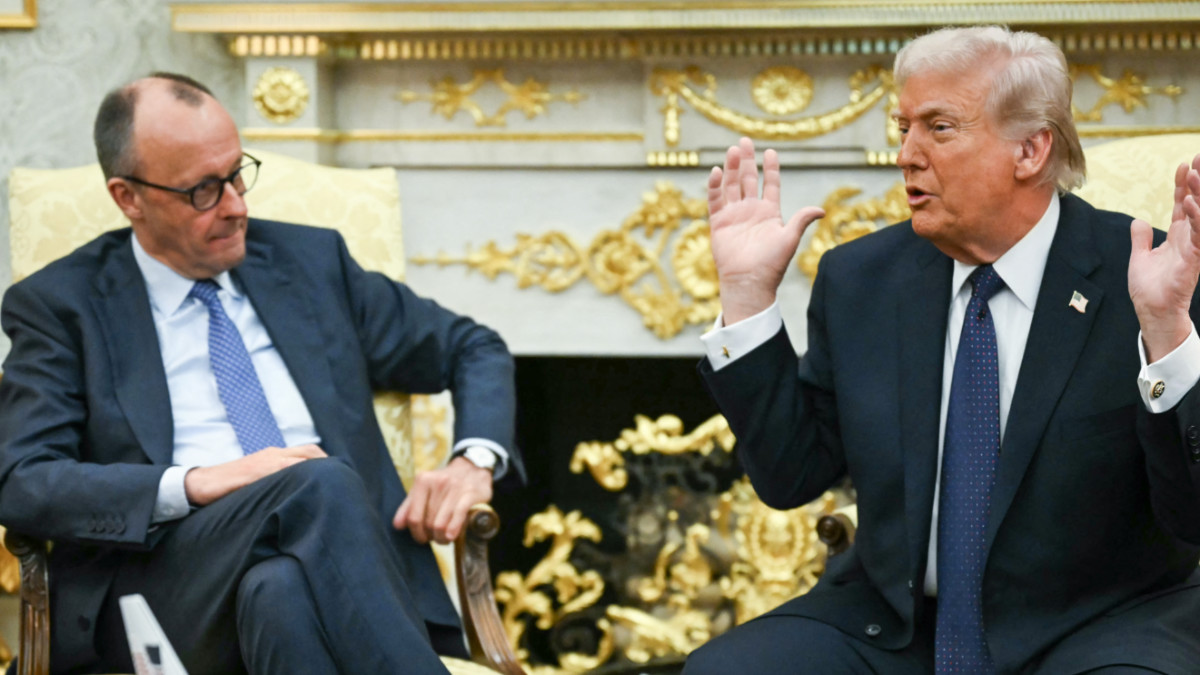
A growing rift is tearing at the foundations of the 76-year-old NATO alliance, after U.S. President Donald Trump escalated threats to impose consequences on member states that refuse to deploy military forces to the Strait of Hormuz amid America’s ongoing war with Iran, with German Chancellor Friedrich Merz publicly pushing back against any potential fragmentation of the bloc.
In a press briefing Thursday, Merz stressed that maintaining NATO unity remains a top priority for Berlin, emphasizing the alliance’s non-negotiable role as the cornerstone of European security. “We do not want — I do not want — NATO to split. NATO is a guarantor of our security, including and above all in Europe,” Merz told reporters. His remarks underscore the unprecedented strain Trump’s push to drag the alliance into a Middle Eastern conflict has placed on the transatlantic security bloc.
Tensions boiled over shortly after Trump held a White House meeting Wednesday with new NATO Secretary General Mark Rutte, with the U.S. president launching a blistering public attack on the alliance in a social media post. “NATO WASN’T THERE WHEN WE NEEDED THEM, AND THEY WON’T BE THERE IF WE NEED THEM AGAIN. REMEMBER GREENLAND, THAT BIG, POORLY RUN, PIECE OF ICE!!! President DJT,” the post read.
Rutte, a former Dutch prime minister who took the alliance’s top job earlier this year, drew widespread backlash earlier this year after referring to Trump as “daddy” in a public remark. When pressed on the comment Thursday, the secretary general framed the choice of wording as a translation error, but did not back away from his warm stance toward the U.S. leader, adding “I like him so much.”
Long labeled a “Trump whisperer” for his consistent approach of appeasing the U.S. president, Rutte faced renewed criticism this week for his response to questions about Trump’s public vow to destroy Iran’s civilization. Asked by CNN for his reaction, the NATO chief declined to criticize the remark, saying only: “I’m not commenting. I support the president.”
Foreign policy analysts argue Rutte’s accommodating stance stems from a desperate bid to preserve the alliance amid broader tensions, as the Trump administration openly toys with cutting off U.S. military support for Ukraine amid Russia’s ongoing full-scale invasion. In comments after the White House meeting, Rutte acknowledged the discussions were tense, describing the talks as “very frank” and “very open” when addressing Trump’s long list of grievances against NATO members. “He is clearly disappointed with many NATO allies, and I can see his point,” Rutte told CNN.
Trump first publicly demanded earlier this year that NATO contribute military forces to joint U.S. operations to seize control of the Strait of Hormuz from Iran. The U.S. president has repeatedly argued that since the U.S. imports very little Gulf energy, with Asian and European economies accounting for the vast majority of the region’s oil and gas exports, those states should take primary responsibility for securing the waterway. “You’ll have to start learning how to fight for yourself, the USA won’t be there to help you anymore, just like you weren’t there for us. Iran has been, essentially, decimated. The hard part is done. Go get your own oil!” Trump wrote in a social media post last month.
The U.S. call for involvement has been met with sharp pushback from multiple major European NATO members, revealing deep divisions within the bloc. Spain has closed its airspace to U.S. warplanes bound for the Middle East, while Italy has denied U.S. military aircraft permission to land at a key Sicilian base en route to the region. According to Trump, France has also barred U.S. planes carrying military equipment to Israel from accessing its airspace. French President Emmanuel Macron has publicly rejected Trump’s push for NATO to join offensive operations in Hormuz, directly calling the proposal “unrealistic.”
The Trump administration’s anger at reluctant members has grown in recent weeks, with senior U.S. officials already signaling breaks with long-standing NATO security commitments. Last week, U.S. Secretary of Defense Pete Hegseth declined to explicitly reaffirm U.S. commitment to NATO’s Article 5, the core collective defense provision that states an attack on one member is an attack on all.
White House Press Secretary Karoline Leavitt doubled down on the administration’s criticism Wednesday, arguing that the Iran war has put NATO to the test — and that the alliance has failed. “NATO allies have turned their backs on the American people,” Leavitt said.
Ian Lesser, vice president of the German Marshall Fund in the U.S., previously told Middle East Eye that the White House’s grievances are largely disconnected from the perspective of most European capitals. “There is a basic concern that Europe is being asked to contribute to and approve of operations they had no role in shaping and a strategy they had no role in shaping,” he explained. “That’s not a good recipe for cooperation.”
Not all European states have rejected the U.S. push, however. The White House has singled out several members that have offered full cooperation, with Greece granting U.S. forces access to its airspace and strategic Mediterranean ports. After the USS Gerald R. Ford aircraft carrier departed the Red Sea following an unexplained fire, the vessel docked for repairs at Greece’s Souda Bay naval base in Crete. Similarly, Romania has allowed the U.S. to use key military facilities for operations targeting Iran, according to a Stars and Stripes report.
A Wall Street Journal report published Wednesday evening revealed the Trump administration is now planning a system of rewards and punishments for NATO members based on their support for the Iran war. The report stated the U.S. could withdraw American troops from uncooperative states and reposition those forces in allied countries that have backed the campaign. Poland, Romania, Lithuania and Greece are expected to see increased U.S. military presence under the plan, while Spain and Germany could face full closure of existing American military bases.
For most European governments, particularly Eastern European states that share a border with Russia, the U.S. military presence on their territory has long been viewed as a critical security guarantee against Russian aggression. Trump has spent years pressing European capitals to increase their own defense spending, arguing the U.S. carries too much of the alliance’s cost burden.