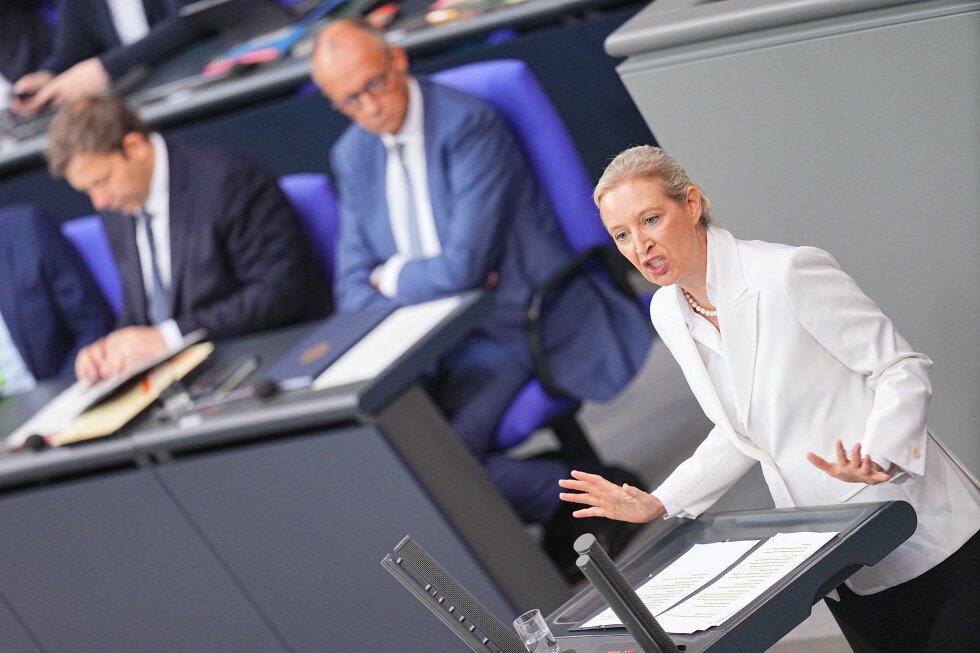
BERLIN – A historic electoral upset by Germany’s far-right Alternative for Germany (AfD) has escalated into a fierce public confrontation in the federal parliament, deepening political turbulence just weeks ahead of two more key regional votes.
Last Sunday, the AfD secured its largest-ever electoral victory in the eastern German state of Saxony-Anhalt, delivering a crippling blow to Chancellor Friedrich Merz’s center-right Christian Democratic Union (CDU), which saw its voter support cut roughly in half. The outcome has cemented the AfD’s rising momentum across eastern Germany, exposing widespread public discontent with Germany’s struggling national coalition government and its failure to reverse years of sluggish economic growth. Unlike the party’s early focus centered almost exclusively on restricting immigration, analysts note the AfD has successfully broadened its appeal to tap into voter anger over a wide range of unaddressed policy failures.
Opening the annual federal budget debate on Wednesday, AfD co-leader Alice Weidel used the upset victory to openly taunt Merz, declaring that Saxony-Anhalt’s voters did not merely punish the CDU – they “pulverized” the party. Weidel argued that Merz’s administration had completely failed to grasp the message sent by voters, adding that “your time has run out anyway. Citizens want a change of policy and they will get it.” She predicted upcoming national elections would deliver a clear governing mandate to the AfD, and pushed back against Merz’s criticism of the party’s Russia and Ukraine stance, accusing the chancellor of escalating unnecessary confrontation with Moscow to distract from his own government’s poor performance.
A combative Merz pushed back sharply against Weidel’s taunts, acknowledging the AfD’s “remarkable” result but noting the party fell just short of the absolute majority it had campaigned for in Saxony-Anhalt. The chancellor insisted the far-right party would never secure a national governing majority, dismissing it as a “destructive force” that poses a fundamental threat to Germany’s democratic and foreign policy commitments.
Merz zeroed in on the AfD’s longstanding opposition to military and humanitarian aid for Ukraine, and its call to lift international sanctions on Russia. He accused the party of a “grotesque inversion of perpetrator and victim” in the war, noting it openly aligns with Russia even after German authorities blamed Moscow for a recent attempted drone attack on Leipzig/Halle Airport. The chancellor also condemned the AfD’s inflammatory “remigration” policy, which calls for mass deportations of foreign-born residents. Merz argued the term is nothing less than a coded reference to ethnic cleansing based on ancestry and skin color, warning that implementing the policy would collapse critical sectors of Germany’s economy including healthcare, hospitality and elder care. While Merz confirmed his governing coalition supports expanding deportations for undocumented residents with no legal right to stay, he drew a clear line between that policy and the AfD’s blanket call for forced expulsion.
The AfD’s landmark victory has already drawn international attention and praise from far-right actors across the globe. Far-right nationalist parties across Europe have celebrated the result, and former U.S. President Donald Trump highlighted the upset in a post Tuesday to his Truth Social platform. Though he did not name the AfD explicitly, Trump wrote that “the Populist Party in Germany just had a really big night. They finally got tired of the absolutely horrible Immigration rules and regulations which have hurt Germany so badly. THEY ARE ON THE RISE, and not going to take it anymore!”
The political showdown comes as Germany prepares for two more regional elections on September 20, to be held in Berlin and the eastern state of Mecklenburg-Western Pomerania. Polling has long shown the CDU is deeply unpopular in Mecklenburg-Western Pomerania, while the AfD already holds strong support in the state, raising fears among mainstream parties of another far-right upset that would further erode the CDU’s standing nationally.