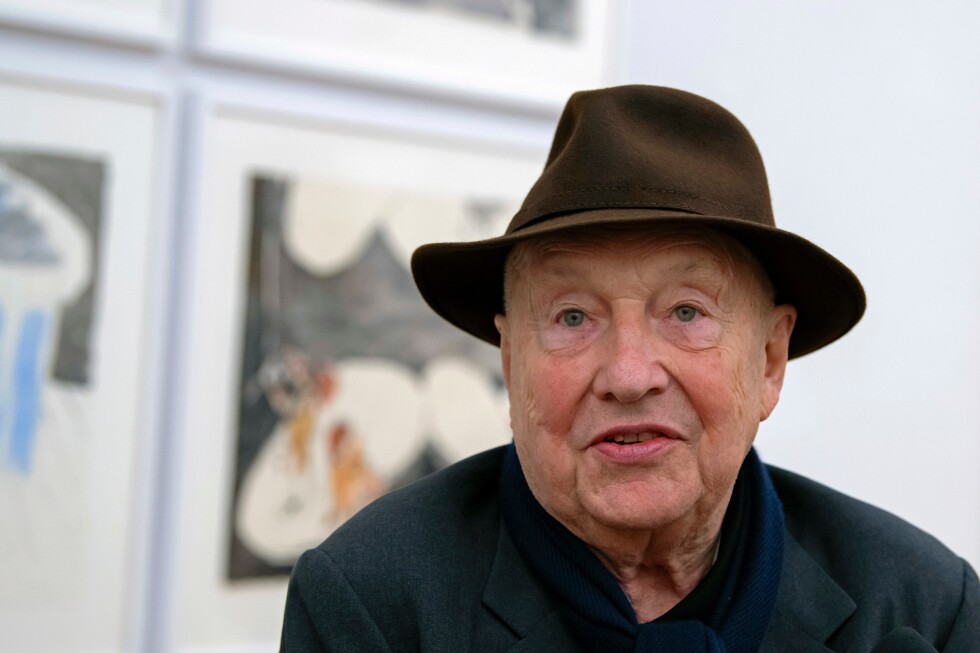
Legendary German Neo-Expressionist master Georg Baselitz, whose provocative, boundary-pushing practice and iconic inverted paintings cemented his legacy as one of contemporary art’s most transformative figures, has passed away at the age of 88. His representative gallery, Thaddaeus Ropac Gallery, confirmed the artist’s peaceful death on Thursday in a statement released on behalf of his family, though no cause of death was disclosed.
Born Hans-Georg Kern in January 1938 in the village of Deutschbaselitz, located in eastern Germany’s Saxony region, the artist adopted the professional name Georg Baselitz in tribute to his hometown. Raised amid the total collapse of German society and landscape following World War II, he fled rising political repression in East Germany for West Germany in 1957, a move that would shape the rebellious, questioning core of his artistic identity. In a pre-85th birthday interview with German news agency dpa, Baselitz reflected on his formative experience, saying, “I was born into a destroyed order, into a destroyed landscape, into a destroyed people, into a destroyed society.”
Baselitz’s career was defined by provocation and innovation from its earliest days. His first solo exhibition in 1963 sparked public outrage when vice squad officers seized two of his works, labeling them pornographic. For this lifelong willingness to upend convention, he was often dubbed an “artist of rage,” and he adopted “contradiction” as his personal artistic motto. By the 1960s, he earned his first major critical acclaim for his “Golden Heroes” series, which drew inspiration from fictional characters in Russian Civil War novels. The series depicted war-ravaged, broken figures in ragged uniforms, distorted with oversized hands and undersized heads, and his 1966 work *Der Hirte (The Shepherd)* quickly became an internationally celebrated staple of the series.
In 1969, Baselitz debuted his most recognizable artistic trademark: the inverted canvas. His first upside-down work, *Der Wald auf dem Kopf (The Forest on its Head)*, flipped the natural imagery of trees on its head, a technique he would revisit throughout his decades-long career to force audiences to abandon traditional modes of seeing and engage with paint and form first. German President Frank-Walter Steinmeier summed up the innovation of this signature approach in a tribute, noting, “Georg Baselitz did not just turn his paintings upside down; he also turned our thinking routines upside down. Having experienced the destruction and suffering of the Second World War as a child, the collapse of all order forced him to question everything around him.”
Rejecting conventional naturalistic painting, Baselitz once mused on his practice in a recent video interview: “Typical painting has never appealed to me. I actually wanted to be more of a black-and-white painter, and above all, I didn’t want to work spatially, perspectively, with shadows and light and such things that arise with the imitation of nature. I must say that throughout my life, I was not aware that I was a painter of color, even though I am constantly told that I have such wonderful colors.” He explained that his core goal as an artist was to “construct my connection to the world, to myself and to my wife,” using the most “simple and ordinary” means possible. The interview was recorded at Venice’s Giorgio Cini Foundation, which is currently running an exhibition of his “Golden Heroes” series through September 27, 2024.
Over his 60-plus year career, Baselitz built an extraordinary body of work spanning painting, sculpture, drawing, and printmaking. Thaddaeus Ropac Gallery honored him in its statement, calling him “a titan of contemporary painting, sculpture, drawing and printmaking” and “one of the most important artists of our time,” whose work reshaped practice for generations of later artists across the global art world. His works are held in the collections of the world’s most prestigious museums, and his pieces regularly sell for millions of dollars at auction. In 2017, German police made headlines when they recovered 15 stolen Baselitz works valued at approximately 2.5 million euros (US$2.9 million). In 2023, a major retrospective titled “Naked Masters” at Vienna’s Kunsthistorisches Museum examined five decades of his career, pairing his controversial nude works — many featuring the artist and his wife Elke — alongside canonical nude paintings by old masters to draw unexpected connections across art history.
Baselitz is survived by his wife Elke and his two sons, Daniel Blau and Anton Kern.