The just-concluded Paris Men’s Fashion Week told a quiet but transformative story: even in a season dedicated to menswear, women are now an inextricable, intentional part of the narrative, reshaping long-held boundaries around gender and clothing. Across runways, the industry’s shift toward gender-blurred design is no longer a niche provocation—it is a core feature of one of luxury fashion’s most high-profile global events, reflecting both changing cultural attitudes and deliberate commercial calculations.
Co-ed runways have become the norm across major houses this season. Women walked alongside men at Amiri and Ami, while at Vetements, female models led the presentation of most “menswear” looks, with Hollywood icon Sharon Stone closing the show in a dramatic pair of thigh-high leather boots. Even outside the show space, the trend is on full public display: last year, pregnant pop icon Rihanna made history as the face of Pharrell Williams’ debut Louis Vuitton menswear campaign, featured on a massive Paris billboard posing with her visible baby bump and a full armful of the brand’s signature handbags.
Fashion insiders emphasize this shift is not a sudden revolution, but the culmination of decades of gradual change. “It’s not something completely new,” explained Joseph McBrinn, an art historian at Ulster University. Women have appeared in menswear presentations for so many seasons that industry veterans barely bat an eye today. Even as Gen Z’s mainstream audience is only now embracing gender-bending style—a trend David Bowie pioneered back in the 1970s—fashion has long operated ahead of popular cultural discourse. Over recent decades, McBrinn noted, the industry has moved “from very binary understandings of gender and fashion to something which is today very fluid,” a shift that directly mirrors how younger generations conceptualize gender identity.
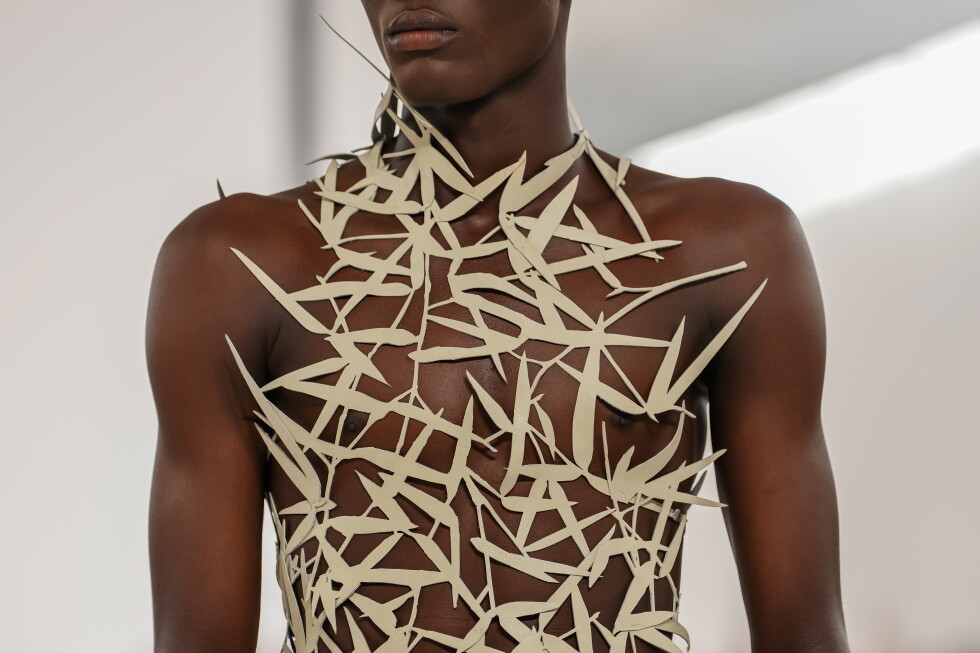
This blurring extends beyond casting to the very design of the clothing itself. Even at brands that maintained an all-male cast for their presentations, like Issey Miyake’s IM Men line, the entire collection read as inherently androgynous. This season’s menswear designs borrowed openly from womenswear tropes: for Dior, where Jonathan Anderson became the first designer to oversee both the brand’s men’s and women’s lines, male models walked the runway in strings of pearls, soft pink garments, and sheer blouses tied with delicate bows at the collar. Anderson told reporters the collection explored how he “connects with the feminine.” At Saint Laurent, which opened this season’s Paris Men’s Week, male models bared their chests in form-fitting second-skin tops, wore leather-cut briefs, and sported transparent shoes pulled directly from the brand’s women’s runway.
Beneath the aesthetic shift, however, industry experts point out that commercial incentives are a major driving force behind the move toward blended gender presentations. Saint Laurent, for example, has not only reimagined its menswear aesthetic: the brand has publicly targeted doubling its menswear sales by 2030, according to industry reports. Many major fashion houses have merged separate men’s and women’s shows into single co-ed presentations, a shift that by the late 2010s moved from a radical statement to a standard calendar strategy—equal parts creative experimentation, logistical convenience, and bottom-line calculation.
Valerie Steele, director of the Museum at the Fashion Institute of Technology, argues that economic logic is often the underpinning of merged runways, not just ideological commitment to gender inclusivity. “I don’t think having men and women on the same runway means a greater belief in nonbinary genders,” she said. “That’s really more of an economic thing.” Hosting one show cuts costs in half, consolidates media attention around a single major event, and allows designers to tell a unified creative story—a particularly attractive advantage for a luxury fashion sector that has faced a period of slowed growth in recent years. The commercial logic is further reinforced by consumer behavior: women have long been major buyers of menswear, a trend that led men’s brand Ami, founded in 2011, to add a womenswear line to its offerings just years after launch.
The history of gender fluidity in fashion stretches back far longer than modern terms like “nonbinary,” experts note. Yves Saint Laurent introduced women’s tailored menswear-inspired suits back in 1966, Bowie blurred gender lines through his performance style in the 1970s, and Jean Paul Gaultier sent male models down the runway in skirts in the 1980s—decades before mainstream discourse caught up to the idea. Veteran fashion critic Suzy Menkes traces the trend even further back: centuries ago, Menkes pointed out, men regularly wore some of the world’s most dramatic, precious, and glamorous jewelry, without any question that such garments were suitable for male dress. It was only in the 20th century that the boundaries of acceptable male fashion narrowed dramatically, setting the stage for today’s gradual reopening of those boundaries.
Yet experts note that the erosion of gender lines has not been equal across the board. Sixty years after women in men’s tailored suits became widely accepted, a man wearing a skirt or heels is still widely framed as a transgressive act. “Women’s bodies are still consumed in ways that men’s bodies are not,” McBrinn explained. Men who cross traditional gender lines, he added, “can still be seen as deviant.”
This tension plays out against a volatile broader cultural context: the rise of combative online masculinity, the spread of “manosphere” influencers, and a growing wave of anti-transgender legislation across many Western countries. Just a few years ago, clothing brand J.Crew sparked intense conservative backlash when it marketed a pink sweater to male consumers, even as major luxury brands including Dior and Paul Smith regularly featured pink garments on their menswear runways. Ironically, the controversy drove sales: industry reports show that sales of pink men’s apparel rose 17% year-over-year during the 2025 spring-summer season.
Some experts warn that the current openness to gender fluidity could face a backlash amid shifting cultural tides. Openness to androgyny in fashion has crested in previous eras—the 1920s, 1970s, and 1990s, Steele noted—only to recede each time. “Everything is moving to the right,” McBrinn said. “Fashion may go back to being much more entrenched within gender binary” within the next five to 10 years, he warned.
Against a global backdrop of rolling back legal protections for LGBTQ+ people, with transgender people at the center of cultural and political fights, the question of gender in fashion extends far beyond the runway. “We are seeing tremendous backlash internationally against trans people,” Steele said. Ultimately, she argued, runway shifts matter less than the everyday changes visible in workplaces, public spaces, and family gatherings. Public acceptance grows when people see androgynous clothing worn by friends, colleagues, and acquaintances in daily life. Slowly but surely, what once read as a radical statement is becoming just another part of everyday fashion: increasingly, they are just clothes.