LIMA, Peru — Peru’s historic presidential runoff election remained locked in a razor-thin deadlock this week, leaving the South American nation without a declared winner just days after voters cast their ballots. With 93% of all ballots fully tallied, conservative contender Keiko Fujimori and nationalist congressional leader Roberto Sánchez are separated by less than 0.2 percentage points, a gap so narrow it has thrown the final outcome into uncertainty. As of the latest count, Fujimori holds 50.095% of valid votes, equal to roughly 8.75 million ballots, while Sánchez trails narrowly at 49.905% with around 8.73 million votes cast in his favor.
Whoever ultimately claims victory will become Peru’s ninth president in just 10 years, a statistic that underscores the deep political instability the country has grappled with for over a decade. Both candidates advanced to the runoff after emerging from an April first round that featured 35 total candidates, where neither broke the 20% support threshold. It took electoral authorities more than a month to confirm the two finalists for the runoff, a delay that already fueled public frustration with Peru’s political process.
Peru’s top election official, Roberto Burneo, has issued a public call for voters and political factions to exercise democratic patience and responsibility as the final counting process wraps up, confirming that the official final result will not be announced for up to 30 days. The slow pace of tabulation is not a product of mismanagement, but rather a legal requirement that mandates every individual ballot and polling station tally sheet be physically transported to one of more than 100 regional processing offices. Adding to the timeline, more than 1.2 million ballots from Peruvian voters living abroad across 63 countries — primarily in the United States and Argentina — must also be shipped to the capital for counting, a logistical feat that extends the process significantly.
Turnout on election day was visibly lower than in previous contests across Lima, even though voting is legally mandatory for all Peruvian citizens between the ages of 18 and 70, with fines of up to $32 for non-compliance. Many polling stations reported no waiting lines at any point during the day, a sign of widespread voter apathy that has defined this election cycle.
For most Peruvians, runaway violent crime — and specifically the growing extortion crisis across the country — is the top issue shaping this election. A 2025 national survey from Peru’s National Institute of Statistics and Informatics found that 84% of urban residents fear they will fall victim to a crime within the next 12 months. Policy analysts trace the rising power of organized criminal networks in Peru to massive profits from decades of illegal gold mining operations in the Andes Mountains and Amazon rainforest, which have allowed groups to expand their influence across the country.
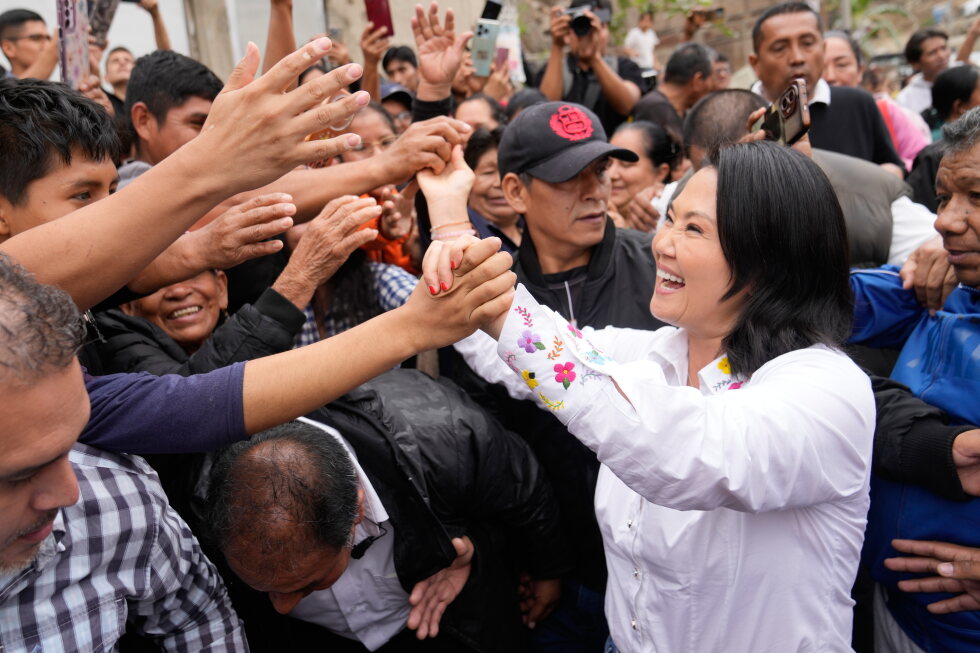
Neither candidate has managed to win broad public trust, however, as both are inextricably linked to disgraced former Peruvian presidents mired in corruption and authoritarian controversy. Fujimori, 51, is the daughter of Alberto Fujimori, the late former president whose 1990s administration was marked by authoritarian rule, systemic corruption, and widespread human rights abuses. She stepped into the role of Peru’s first lady in 1994 after her parents separated, and this marks her fourth bid for the presidency. During her campaign, she has centered her platform on aggressive anti-crime policies, including new surveillance technology to track extortion rings, border militarization, increased deployment of police and military forces in high-crime areas, and mandatory prison labor to require incarcerated people to “repay society” for their crimes. In the sole runoff debate, she defended her father’s legacy, claiming he defeated the violent Shining Path extremist group and promising she would replicate that success against modern criminal groups. Speaking to supporters ahead of the final count, she urged calm, noting “So far, there is no winner in this race.”
On the other side of the race, 57-year-old Sánchez, a former cabinet minister popular with rural and working-class voters, is one of the closest political allies to imprisoned former president Pedro Castillo, who was removed from office amid corruption allegations and widespread chaos during his 16-month term that saw more than 70 cabinet reshuffles. Sánchez often wears a wide-brimmed peasant hat gifted to him by Castillo as a symbol of his alliance. His policy platform focuses on rooting out corruption within the national police force and implementing reforms to allow the military to support civilian security operations. He has also expressed openness to a wide range of pro-growth economic policies and reaffirmed his support for continued Chinese investment in Peru. Speaking to supporters from a hotel balcony in Lima Sunday, he thanked Indigenous communities, farming groups, and working-class backers “who have decided to come and reclaim the government for the people.”
That widespread distrust in both candidates has led many Peruvian voters to opt for blank or spoiled ballots. Magali Quiquia, a 44-year-old food vendor in Lima, told reporters she submitted a blank ballot because neither contender convinced her she could trust them. “Five years ago, I was disappointed by Castillo with his corruption, and … Roberto Sánchez is the same,” she said, adding that “Fujimori hasn’t done anything either” despite her party holding multiple seats in Congress. A pre-runoff poll conducted by Ipsos one week before voting found roughly 3 in 10 voters remained undecided heading into election day, mirroring the deep public disillusionment with the country’s political class.
More than 27 million Peruvians are registered to vote in this election. The winner of the runoff is set to be inaugurated for a five-year presidential term on July 28.