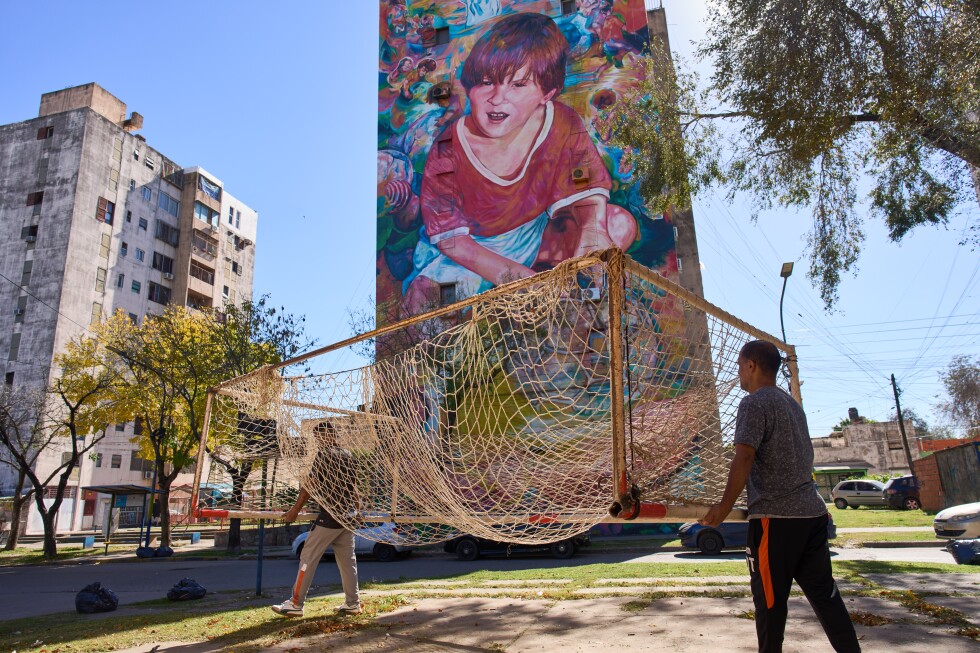
On a crisp afternoon in Rosario, Argentina, a cool breeze drifts off the Paraná River, cutting through the mild autumn chill. Near the riverbank, a group of young soccer players stretch and warm up, the sharp clatter of their small cleats against packed dirt growing louder by the minute, until the referee’s whistle calls them onto the pitch. Each kid laces up in the iconic orange and white striped jersey of Abanderado Grandoli, the unassuming neighborhood club where Lionel Messi’s extraordinary soccer journey first kicked off 34 years ago. From a faded mural on a nearby brick building, a portrait of a young Messi looks out over the field, watching the next generation chase the same dream he started here decades ago.
For the 100-odd young players who train at Grandoli today, the shadow of Messi, Rosario’s most famous son and widely considered the greatest soccer player to ever step onto a pitch, looms large. It’s a legacy that drives every kick and every goal on their small, unpolished pitch. “I watched him play when I was little, and it made me want to play just like him,” said 11-year-old Julián Silvera, who says he spends hours practicing Messi’s signature free kicks after every training session.
Three and a half decades after Messi first laced up cleats here, the final chapter of his historic career is approaching. The 38-year-old Inter Miami captain is widely expected to lead Argentina in his sixth World Cup this year, set to be hosted across the U.S., Mexico and Canada, though he has yet to make an official announcement about his participation. That story all began in this quiet lower-middle-class district of Rosario – Argentina’s third-largest city, a bustling industrial hub that also birthed revolutionary Ernesto “Che” Guevara.
It was 1990 when 5-year-old Messi first came through the club’s gates, brought by his maternal grandmother Celia, who had accompanied his older brother Matías to a youth league match at Grandoli. The origin story of how Messi got on the pitch has since become enshrined in club lore: a 6-year-old age-group seven-a-side match was one player short, and Celia spotted an opening for her small, already remarkably talented grandson. She pressed coach Salvador Aparicio to give the boy a spot on the roster.
“Aparicio didn’t want him to play because he was too young for the age group,” recalled Ezequiel Assales, one of Messi’s original Grandoli teammates who now has two sons playing for the club’s current youth sides. “His grandmother insisted. They finally put him on, and the first thing everyone said was, ‘What a player!’ That’s how it all started.”
Guillem Balagué, the Spanish journalist who penned Messi’s only authorized biography, notes that Aparicio’s hesitation stemmed from more than just age: Messi was already showing early signs of the growth hormone deficiency that would later threaten his career, and the coach feared the match would be too physically rough for the small boy. He placed Messi on the right wing, close to where his grandmother watched from the stands, and told her, “If you see him cry or get scared, we’ll take him out.”
Aparicio, who died in 2008, shared the account of that first match in multiple interviews before his passing. Messi fumbled his first touch on the ball, but on the very next play, he trapped it with his left foot and dribbled past a full string of opposing players. In that moment, the first spark of a legend was lit.
Grandoli is what’s known in Argentina as a “baby fútbol” club, a grassroots training ground for children between 4 and 13 years old. Unlike larger teenage youth academies, these small community clubs do not collect solidarity payments – a cut of transfer fees when their alumni move between professional clubs later in their careers, a key source of revenue for player development clubs across the globe. Instead, they rely entirely on small monthly membership fees from families and ticket sales from match days to keep operating. For Grandoli, Messi’s global fame has opened up an additional stream of income, through advertising partnerships with energy drink and beer brands.
Inside the club’s modest locker room, a glass display case holds the youth trophies won by Messi’s original team, lined with fading photographs from his time at the club. For the young players training here now, the display is more than a tribute – it is a daily source of inspiration.
“He was a different kind of player; you just had to give him the ball and support the rest of the team, and he would do the rest,” Assales recalled. “You could already tell he had an incredible future ahead of him. He’d leave three or four players in his dust every time he touched the ball. We would just wait for rebounds, and more often than not, he’d finish the goal himself.”
As Messi’s goal tally climbed through his Grandoli days, more and more local spectators would crowd the sidelines on weekends to watch the boy fans were already calling the “new Maradona” – a nod to Argentine legend Diego Maradona, who had lifted the World Cup trophy just one year before Messi was born.
“What everyone else got to see when he became a global superstar, we were lucky enough to watch from the very beginning,” said David Treves, who served as Grandoli’s head coach and president for 17 years before stepping down in 2023. “He had incredible speed and unmatched ball control. Back then, the pitch wasn’t the well-maintained grass you see at top academies – it was just packed dirt. His technical skill was so good that you never even noticed his physical limitations.”
At 7 years old, Messi moved on to Newell’s Old Boys, one of Rosario’s most popular professional youth academies. When the club declined to cover the cost of treatment for his growth hormone deficiency – a condition that would have cut his career short before it ever truly began – the Messi family relocated to Spain, where FC Barcelona welcomed the 13-year-old prodigy into its famed La Masia academy and agreed to pay for his medical care.
Over a trophy-laden career that has spanned Barcelona, Paris Saint-Germain, and now Inter Miami, Messi has never returned to officially visit Grandoli. But small, intentional gestures have always tied him back to the club where his career started. Most famously, Messi points to the sky with his index finger every time he scores a goal – a quiet tribute to his grandmother Celia, who died in 1998, and who he has repeatedly credited with pushing him to start playing soccer.
After leading Argentina to victory in the 2022 Qatar World Cup, Messi shared a heartfelt message on social media that summed up his decades-long journey: “From Grandoli to the Qatar World Cup, almost 30 years have passed. Nearly three decades in which the ball has given me many joys and also some sorrows. I always dreamed of being a World Champion and I didn’t want to stop trying.”
That message has become a core part of the club’s identity today. The phrase “From Grandoli to the Qatar World Cup” is emblazoned on the jerseys of every youth player who takes the pitch here. As the referee blows the final whistle on a recent May training match, the kids rush off the field toward the club’s snack bar, drawn by the smell of hot french fries and fresh chicken cutlet sandwiches.
With the 2026 World Cup fast approaching, Grandoli’s young players – just like the rest of Argentina – are waiting eagerly for Messi to lead the defending champions one last time. For these kids who train where it all began, Messi’s legacy is already permanent.
“There will never be anyone like him,” said 11-year-old Valentín Enríquez. “I feel sad because the best player on the national team is leaving.”