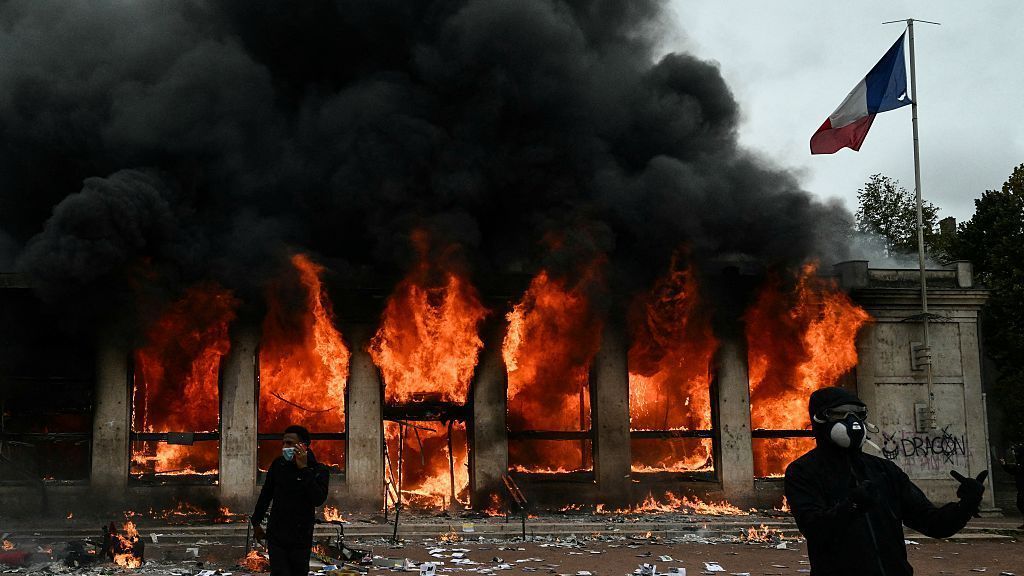
Fresh violence that tore through French cities during nationwide anti-austerity and cost-of-living protests last weekend has triggered sweeping restrictions on demonstrations and a massive bolstered police deployment ahead of a planned second national protest day this coming Saturday. The unrest, which left historic buildings damaged, businesses looted, and public spaces vandalized across the country, has prompted President Emmanuel Macron’s administration to draw a hard line against unauthorized gatherings while facing growing questions over security preparedness.
Last Saturday, October 17, an estimated 550,000 people across France joined marches organized by labor unions, the yellow vest (gilets jaunes) movement, and student groups. The demonstrations were rooted in widespread public anger over skyrocketing fuel prices, soaring living costs, and deteriorating conditions in French public schools. While the majority of participants protested peacefully, the day was overshadowed by rioting, arson, and looting that left multiple landmarks and commercial properties destroyed.
One of the most high-profile acts of violence targeted Lyon’s city tourism office, which is housed in a historic 19th-century building. Protesters set the structure on fire, an act Lyon Mayor Grégory Doucet described as “a tragedy.” Further damage was recorded in the central city of Limoges, where rioters set fire to Limoges City Hall, engulfing the building’s iconic clock tower and a large section of its roof in flames before the structure partially collapsed. Two suspects have been arrested in connection with an attempted murder targeting police officers who were inside the city hall when the fire broke out: a man in his 30s was detained first, followed by a 66-year-old suspect on Thursday. In Paris, rioters occupied sections of the iconic Place de la République, leaving the landmark public space heavily vandalized.
In the wake of the violence, France’s Interior Minister Laurent Nuñez formally offered his resignation after admitting his department had vastly underestimated the scale of the protest, forecasting only 200,000 attendees compared to the actual 550,000 participants. President Macron rejected the resignation, instead ordering Nuñez to lead a review of public safety protocols, hold rioters accountable, and improve security for upcoming gatherings.
As authorities prepare for this Saturday’s planned new wave of protests, multiple cities have already implemented full bans on all public demonstrations. Lyon, France’s third-largest city, was among the first to announce a blanket prohibition on all protests in the city center this weekend. “In light of the mobilisation that is circulating and in view of the events of 17 October, the prefect has decided to prohibit by decree any demonstration in the city of Lyon this Saturday,” the Rhône prefecture confirmed in an official statement. Toulon on France’s southern Mediterranean coast, the northwestern city of Rouen, and eastern city Grenoble have all issued identical full protest bans.
Partial curfews targeting youth movement and large public gatherings have also been implemented across a swathe of major cities this week, including Marseille, Bordeaux, Nice, Lyon, and Lille. President Macron outlined the new national framework for protests in comments this week, clarifying that only authorized labor union demonstrations would be permitted, and these will be rerouted to alternative pre-approved paths designed to protect local businesses and critical infrastructure. “When they’re not union organisations, wherever possible, they’ll be banned,” Macron stated. The French president also accused radical far-left groups of organizing “political and even seditious acts” that aim to destabilize the French Republic, adding that the government’s top priority is restoring calm across the country.
To enforce the new restrictions, the French government has promised a “massive” deployment of law enforcement, with 20% more officers on the streets compared to last weekend’s mobilization. At least 2,500 people have been arrested across France in connection with the unrest since last weekend, and Macron held an emergency coordination meeting with senior intelligence officials and cabinet ministers on Thursday to finalize security plans for Saturday. Prime Minister Sébastien Lecornu has reaffirmed the commitment to a heavy police presence, though some rank-and-file officers have told French media that many frontline personnel lack specialized training for managing large, chaotic crowd operations.
Paris authorities have already moved to ban multiple protest marches planned by the yellow vest movement, which was a key organizer of last weekend’s demonstrations. The unrest comes as Macron enters the final months of his second presidential term, with national presidential elections scheduled for April and May of 2025, placing heightened political pressure on the administration to regain control of public safety ahead of the vote.