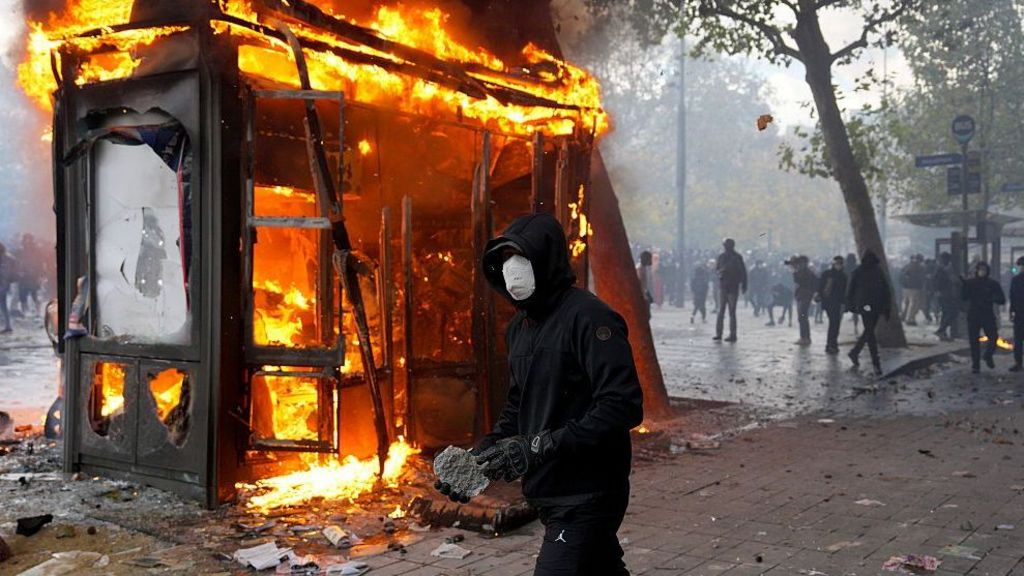
After a chaotic weekend of widespread rioting, arson and looting that swept across French cities and towns, the French government has moved to grant local mayors new authority to implement targeted curfews, as authorities work to regain public order and tally the staggering human and economic cost of the unrest.
Prime Minister Sébastien Lecornu announced the new powers following an emergency crisis meeting held Monday, noting that curfews can be rolled out “where they need” to protect civilian lives and local businesses. The prime minister did not exclude the possibility of declaring a national state of emergency if the violence continues, and has outlined a package of support for communities and workers impacted by the disorder.
Marseille, France’s second-largest urban center, was quick to enact new restrictions, implementing a ban on all public gatherings between 12 p.m. and 8 p.m. to prevent further unrest. ABC reporter James Waterhouse was on the ground in Paris over the weekend, documenting widespread property damage and ransacked storefronts that left iconic public spaces like Place de la République resembling war zones.
The unrest traces its initial roots to student-led protests over deteriorating school conditions that began last month, but demonstrations quickly expanded to encompass a broad set of public grievances, including rising fuel costs, soaring cost of living, and declining standards across key public services. By the weekend, an estimated 550,000 people had joined peaceful protests across the country, but the demonstrations were hijacked by groups of violent agitators.
Witnesses reported that groups of rioters, many clad in black clothing and masked to avoid identification, set fire to vehicles and buildings, and looted retail and commercial spaces in Paris, Marseille and dozens of smaller communities across the nation. In Paris alone, police deployed tear gas and stun grenades against crowds Sunday, while protesters pelted officers with bottles and rocks, per reports from Agence France-Presse. One protester lost a hand after being struck by a police crowd-control grenade during the clashes, the news agency confirmed, alongside an unconfirmed number of additional protester injuries.
One of the most shocking incidents of the weekend unfolded in the central French city of Limoges, where rioters set fire to the city’s ornate 19th-century town hall. The blaze gutted the historic building, causing its clock tower and roof to collapse. Local resident Gerrard described the scene as devastating, saying “It’s awful and unbelievable. We are very sad and I think it will be a long time to put it back as it was before.”
Official figures confirm that more than 2,500 people have been arrested in connection with the violence nationwide, and roughly 1,000 police officers have sustained injuries during clashes. Interior Minister Laurent Nuñez, who previously acknowledged that police had “lost control” of unrest in some cities, offered his resignation Sunday, but President Emmanuel Macron rejected the offer. The Élysée Palace said Macron turned down the resignation due to “the need for continued command of law enforcement” amid the ongoing crisis. Currently, around 200 investigators are reviewing hundreds of hours of CCTV footage to identify and apprehend the ringleaders behind the coordinated violence.
For businesses, the damage is already catastrophic. Alain Di Crescenzo, head of France’s Chambers of Commerce and Industry (CCI), told French broadcaster RTL that more than 2,000 shops and commercial operations were directly impacted by the weekend’s violence. He estimated total damage will reach hundreds of millions of euros.
To support affected communities, Lecornu announced the government will allocate immediate recovery funding to help rebuild damaged areas, with the cost ultimately recovered from the individuals convicted of orchestrating or participating in the violence. “There will be a law that will be put in place to find ways of making sure that those who have damaged properties will have to pay,” the prime Minister said. The government has also established a special partial unemployment fund for workers who are unable to perform their jobs due to riot damage and unrest.
President Macron has publicly drawn a clear line between peaceful demonstrators and violent agitators, saying Sunday that there must be a distinction between the “legitimate demands” of those protesting peacefully and “those who destroyed, smashed and looted.”