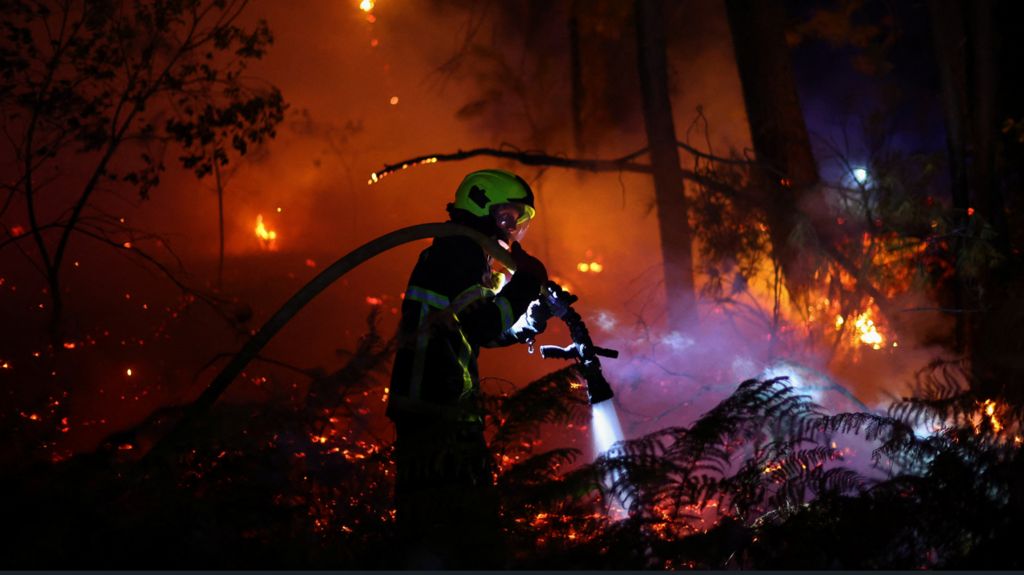
As extreme fire activity accelerates across Western Europe, a new wave of mass evacuation has been ordered in southwestern France, where the country’s decades-worst wildfire crisis continues to spiral out of control. On Friday, local authorities ordered 55,000 additional residents and visitors to leave six towns located south of Bordeaux in the Gironde region, marking one of the largest single evacuation phases of the ongoing disaster. The wildfire emergency that began spreading across the continent a week ago has hit France and Spain the hardest, with a cumulative total of more than 330,000 people displaced by fast-moving flames across both nations.
For France, the current outbreak stands as one of the most devastating forest fire events since the conclusion of World War Two. So far, more than 42,000 hectares of forest and vegetation have burned in this active wave alone, and the total burnt area across the country has already hit 98,000 hectares since the start of 2026. Firefighting commanders on the ground say the unpredictable behavior of the flames has made containment efforts extremely difficult. “The fire has generated its own winds, even creating powerful whirlwinds,” explained Captain Nicolas Braz, a senior leader of the French firefighting response. “It is completely erratic and impossible to manage with standard tactics.”
Unusually parched vegetation and sustained strong winds have created ideal conditions for the blaze to expand rapidly. The spread has forced the closure of a 60-kilometer stretch of the A63 motorway, a major transport route connecting France to northern Spain. French Interior Minister Laurent Nunez warned in an interview with La Tribune published Sunday that full containment will be a lengthy process, and that displaced residents will not be able to return to their homes until the fire is fully under control. In response to the escalating crisis, France has deployed military reinforcements to support frontline firefighters, with troops tasked with clearing dry brush and constructing strategic fire breaks to slow the spread of flames. President Emmanuel Macron has released a public statement affirming that the French state will support all affected communities, saying the nation will “rebuild” and that his administration will remain committed to the response effort “for as long as is needed.”
The wildfire crisis is equally severe across the border in Spain, where fast-moving blazes continue to push deeper into populated regions. More than 90,000 people have already been evacuated from fire-prone areas surrounding Madrid and Ávila. Late Saturday, evacuation orders were issued for at least eight additional municipalities near Toledo, though the exact number of residents required to leave has not yet been confirmed by authorities. Forecasters are predicting another day of extreme conditions on Sunday, with high temperatures and very low humidity that will likely enable further rapid fire expansion.
Isabel Díaz Ayuso, regional president of Madrid, called the current outbreak the “worst fire in the history of the region.” Spanish Prime Minister Pedro Sánchez has acknowledged that the country faces a prolonged period of challenge, saying “complex times ahead” for response and recovery. Tragically, the disaster has already claimed its first confirmed life: authorities in the València region announced Sunday that one man has died in a wildfire burning in the area.