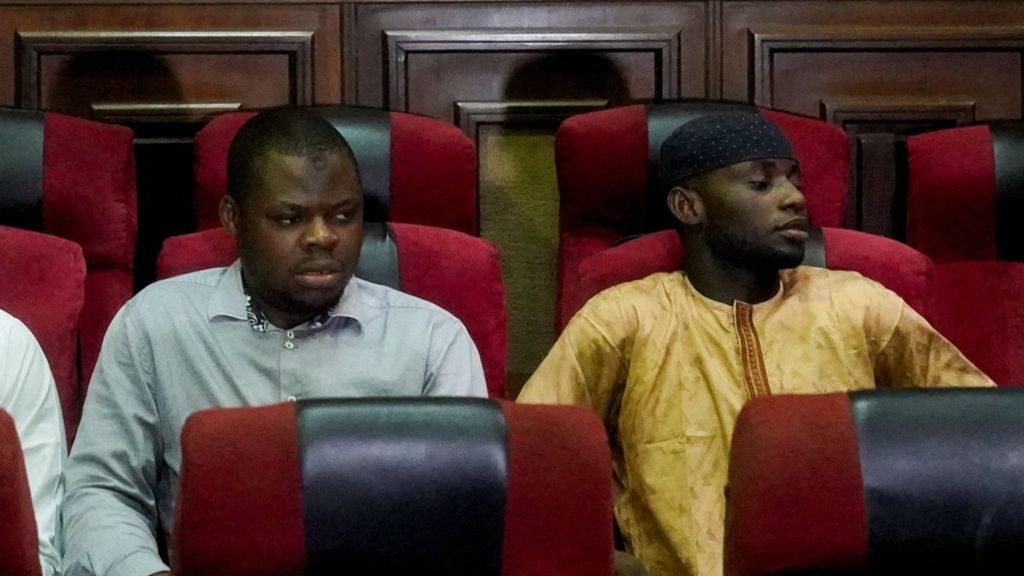
In a landmark ruling that has drawn national attention, a Nigerian court has handed down death sentences to four men convicted of involvement in the 2022 deadly attack on St Francis Catholic Church in Owo, Ondo State, a mass shooting that killed 41 worshippers and wounded more than 100 others during an ongoing Pentecost service. A fifth defendant accused of funding the attack was cleared of all charges due to a lack of sufficient evidence.
The convicted men — Idris Abdulmalik Omeiza, Al Qasim Idris, Jamiu Abdulmalik, and Abdulhaleem Idris — were also handed an additional 20-year prison sentence on separate charges of belonging to a banned terrorist organization, according to the ruling delivered at the Abuja-based court by presiding judge Emeka Nwite. Under Nigerian law, all death sentences require formal presidential assent before execution can proceed, and the country has not carried out any executions in several years.
Justice Nwite noted in his judgment that the prosecution’s evidence against the four convicts remained unshaken and uncontradicted throughout the entire cross-examination process. After the high-profile trial launched in August 2025, the judge ordered an accelerated hearing to deliver a timely ruling. He confirmed that prosecutors had met the legal standard of proving guilt beyond a reasonable doubt, with multiple eye-witnesses to the attack testifying in court. One key witness was a woman who survived the attack but suffered catastrophic injuries: both of her legs were amputated below the knee, and she lost her left eye in a dynamite blast set off by the attackers. One witness also confirmed she was able to identify two of the defendants as direct participants in the shooting.
The four men were convicted on all nine criminal counts laid out by prosecutors, which included membership in a terrorist organization, conspiracy to commit murder, and directly carrying out the mass killing. Following the ruling, lead prosecutor Ayodeji Adedipe released a statement affirming that justice had been served for the 41 worshippers killed in cold blood. However, defense counsel for the convicted men announced they would file an appeal against the verdict and sentences, noting that their clients had alleged torture during detention — including claims of being hung from the ceiling, repeated beatings, and electric shock abuse to their genitals.
The fifth defendant, Momoh Otuho Abubakar, who was accused of coordinating funding for the attack by allegedly receiving two transfers totaling 800,000 Nigerian naira (equivalent to roughly £440 or $590) from a still-at-large suspect before distributing the funds to the attackers, was fully discharged and acquitted. Abubakar testified during the trial that the funds in his bank account came from legitimate farming operations and his local cooperative society, and he denied ever transferring any money to the four other defendants.
The 2022 Owo church attack was a turning point that sparked national outcry over Nigeria’s worsening security crisis. In the years following the attack, the country has continued to face a rising tide of violent attacks targeting religious sites across multiple states. The case has also drawn international attention: former U.S. President Donald Trump has publicly criticized Nigeria for failing to adequately protect Christian communities from jihadist violence. On Christmas Day, U.S. military forces carried out airstrikes targeting two jihadist group camps in northwestern Nigeria, issuing a threat that more strikes would follow if attacks on civilians continued.
Claims that Christians are facing a targeted genocide in Nigeria have gained traction in right-wing political circles in the United States, but independent organizations that track political and insurgent violence in the country note that the majority of victims killed by jihadist groups in Nigeria are actually Muslim. The Nigerian federal government has repeatedly rejected claims that the country engages in or permits targeted persecution of Christian communities.