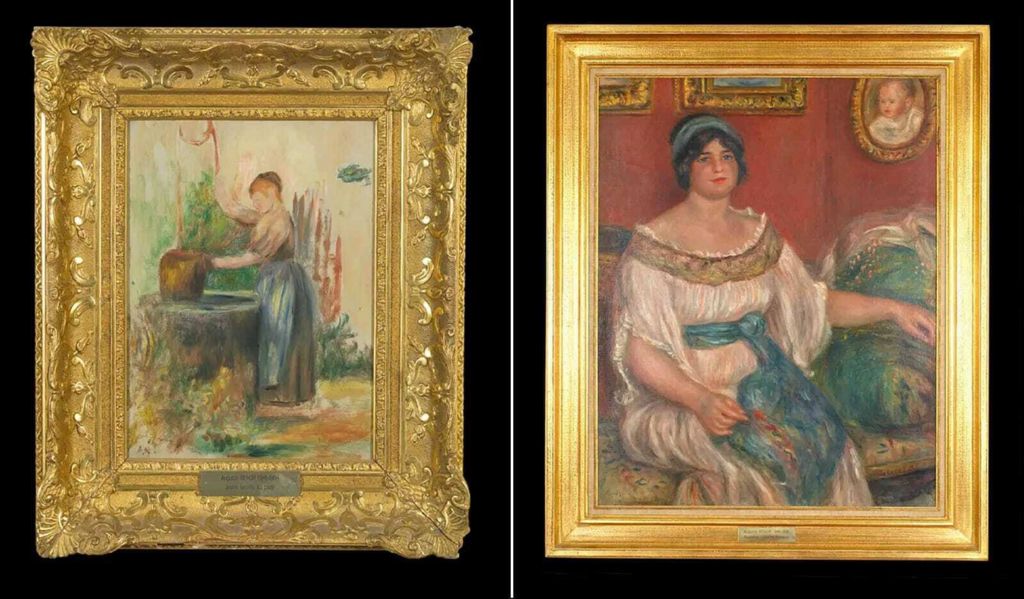
In a brazen early-morning break-in that has sent shockwaves through Europe’s cultural heritage community, four original Pierre-Auguste Renoir paintings were stolen from the small Renoir Museum in Cagnes-sur-Mer, southern France, this week. Only two of the valuable works have been recovered, after the two thieves abandoned them in the museum’s grounds during their hasty escape.
Local mayor Bryan Masson, who has been fronting updates on the investigation, confirmed that the incident unfolded just before 6 a.m. local time on Tuesday. The alarm system triggered at 5:48 a.m., and law enforcement officers responded within five minutes of the alert, a rapid response that forced the suspects to flee before they could secure all four stolen pieces.
Close-circuit camera footage captured the perpetrators’ methodical approach: they first cut through a perimeter fence to access the museum’s gardens before moving inside to cut through the mounting structures holding Renoir’s paintings in their frames. According to Masson, the pair were clearly prepared for a targeted heist: they arrived equipped with helmets, gloves, tactical clothing, an electric cutting knife and a hacksaw, indicating premeditation and advance planning. Investigators have also recovered two zip-up bags left at the scene, which they believe belonged to the suspects and were intended to transport the stolen art.
Of the four stolen works, two 19th and early 20th century pieces — *Portrait of Madame Pichon* (1895) and *Coco Lisant* (1905) — were abandoned mid-escape and recovered undamaged in the museum garden. Two other works remain at large: 1910’s *Portrait of Madame Colonna Romano* and 1886’s *Jeune fille au puits*. Each of the four paintings carries an estimated market value of €9 million (approximately $10.4 million), though the mayor emphasized that as irreplaceable works by one of the founders of Impressionism, their cultural value is impossible to quantify. Unlike ordinary contraband, these famous pieces cannot be openly sold on the legal art market, leading investigators to suspect the heist was carried out for an unscrupulous private collector or organized art crime network.
The Renoir Museum is a small, culturally significant institution housed in the iconic Impressionist painter’s final residence, where he lived until his death in 1919. Opened to the public in 1960, the museum holds 12 original Renoir works alongside a collection of the artist’s personal effects, including his easel, custom wheelchair, personal correspondence and original photographs. For the coastal town of Cagnes-sur-Mer, the museum is a core part of its local heritage and identity. Masson put it plainly: “Attacking the Renoir Museum is attacking a part of the history and heritage of Cagnes-sur-Mer.”
This heist is far from an isolated incident. It marks the latest in a growing string of high-profile art thefts across Europe in recent months. Just one month prior, four Renaissance paintings were stolen from a museum in Sicily, Italy, and last October, a brazen break-in at Paris’s Louvre Museum saw priceless French crown jewels stolen. The wave of targeted art thefts has reignited urgent conversations about gaps in security at small and regional European museums, many of which operate on tight budgets that leave cultural heritage vulnerable to increasingly sophisticated organized criminal groups.
In the wake of the theft, Masson issued a stark warning to national cultural authorities: “Beyond Cagnes-sur-Mer, this incident should serve as a warning about the protection of our museums, which now face a new form of organised crime targeting works of art.” He called on the French central government to allocate additional funding to regional and local museums to upgrade security infrastructure, helping them fend off what he described as “increasingly organised and determined criminals” targeting European cultural heritage.