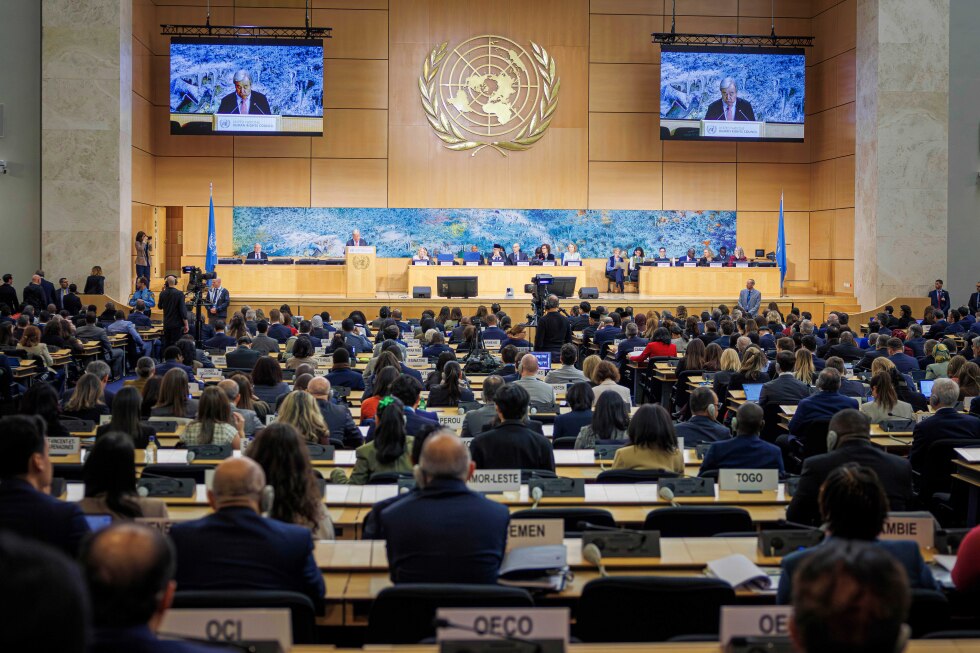
UNITED NATIONS — Just four contenders will take part in this week’s public confirmation hearings for the next United Nations Secretary-General, a drastically smaller field than the 13 candidates that competed for the post during António Guterres’ 2016 selection. The race comes as the global body grapples with deep great power divisions that have crippled its core peace and security mandate, a stark shift from the more collaborative global landscape a decade ago.
The first day of hearings, scheduled for Tuesday, will open with Michelle Bachelet, the former two-term President of Chile and former UN High Commissioner for Human Rights. Bachelet is one of just two women in the race, and one of three candidates hailing from Latin America — the region widely expected to claim the top post under the UN’s longstanding regional rotation tradition. Following Bachelet’s three-hour question-and-answer session with ambassadors from all 193 UN member states will be Rafael Mariano Grossi, an Argentine diplomat who has served as Director General of the International Atomic Energy Agency since 2019. On Wednesday, the lineup continues with Rebeca Grynspan, the Costa Rican former vice president who currently leads the UN Conference on Trade and Development, and closes with Macky Sall, the former President of Senegal.
Political analysts and UN watchers point to two major factors that have shrunk the candidate pool: the unprecedentedly polarized 2026 geopolitical landscape, and the declining global influence of the United Nations itself. A decade ago, the UN was riding high off diplomatic wins including the landmark Paris Climate Agreement and the adoption of the 17 Sustainable Development Goals, agreements that cemented the organization’s role as the central forum for global cooperation. Today, deep rifts between major powers have left the UN Security Council — the body tasked with maintaining global peace and security — deadlocked on nearly every major ongoing conflict, from the war in Ukraine to the Gaza crisis to escalating tensions in Iran. The organization has been sidelined from efforts to resolve these crises, eroding faith in its ability to deliver meaningful change.
Richard Gowan, UN program director at the International Crisis Group, explained that shifting calculations have also discouraged potential candidates from entering the race. In 2016, many long-shot candidates joined the race simply to raise their own international profiles, as losing carried little diplomatic cost for the contenders or their nominating governments. “There was no real cost associated with losing,” Gowan noted. Today, however, candidates and their backers are far more cautious: misstepping or offending one of the Security Council’s five permanent veto-wielding powers — the United States, Russia, China, Britain, and France — can carry tangible diplomatic consequences. “There is a feeling that if a candidate puts a foot wrong and offends Washington or Beijing, it could cause real diplomatic damage,” he said.
The selection process follows the framework laid out in the UN Charter, which gives the 15-member Security Council the power to recommend a candidate, who is then approved by the full 193-member General Assembly. This structure gives the five permanent members outsize influence and veto power over the final selection. By longstanding informal tradition, the top post rotates between world regions. Guterres, a former Portuguese prime minister who is finishing his second five-year term on December 31, represents Europe; he succeeded South Korea’s Ban Ki-moon (Asia), who followed Ghana’s Kofi Annan (Africa). This rotation has left Latin America widely expected to get the turn this cycle, even as Eastern Europe — which has never held the post — continues to push for consideration.
All four candidates taking part in this week’s hearings will face questions about their vision for the UN, their approach to ongoing global crises, and plans to reform the struggling institution. The road to nomination has already held unexpected twists for the contenders: Bachelet, 74, was initially nominated by her home country Chile, Brazil, and Mexico, but Chile’s new far-right President José Antonio Kast withdrew his government’s support shortly after taking office in March, leaving her backed by Brazil and Mexico. Grossi, 65, and Grynspan, 70, both secured nominations from their home countries, Argentina and Costa Rica respectively. Sall, 64, was nominated by Burundi, but has failed to secure an endorsement from his home country Senegal or the African Union, the 55-nation regional bloc which remains divided on his candidacy. A fifth candidate, former UN children and armed conflict representative Virginia Gamba of Argentina, was nominated by the Maldives, but the island nation withdrew her nomination in late March without providing a public explanation.
Despite the small candidate pool, pressure to select the first woman to lead the United Nations remains strong. Guterres, who has made gender equality a core priority of his administration, has backed the push, as have Britain and France. Two global advocacy groups, 1 for 8 Billion and GWL Voices — a network of nearly 80 senior female global leaders — have also mounted a public campaign for a woman secretary-general. GWL Voices co-founder and president Susana Malcorra, a former Argentine foreign minister who ran for the post in 2016, has led the effort.
However, Bachelet, the highest-profile female candidate, already faces organized opposition from the United States. In a late March letter to Secretary of State Marco Rubio, 28 Republican members of Congress called on the Biden administration to veto Bachelet’s candidacy, labeling her a “pro-abortion zealot intent on using political authority to override state sovereignty in favor of extreme agendas.” When U.S. Ambassador to the UN Mike Waltz was asked about Bachelet at a recent Senate Foreign Relations Committee hearing by Republican Sen. Pete Ricketts, one of the letter’s signatories, Waltz declined to confirm whether the U.S. would formally oppose her, but acknowledged he shared the lawmakers’ concerns.
Gowan noted that expectations of a female candidate winning shifted dramatically following Donald Trump’s return to the White House. “Before that, there was a feeling that this time a woman had to win, but now a lot of diplomats assume that Washington will insist on a male secretary-general on principle,” he said. “I am not sure that is necessarily correct.” While more candidates could still join the race before the Security Council holds its traditional informal straw polls to narrow the field, analysts expect the current four candidates to remain the main contenders for the top post.