Since Donald Trump first descended the gilded escalator of Trump Tower to launch his 2016 presidential bid, hardline immigration restriction has stood as the unshakable core of his political brand, with his opening campaign speech framing Mexico as a source of uncontrolled drug trafficking and violent crime spilling across the southern U.S. border. Though many of his first-term efforts to curb migrant flows were blocked by judicial pushback, his second term has operated under a far more permissive legal landscape, supported by a conservative-leaning Supreme Court and tens of billions in congressionally allocated funding for border enforcement. The immigration debate remains a top-tier priority for voters ahead of the 2026 midterm elections, widely framed as a public referendum on the Trump administration’s performance nearly two years into its return to power.
During the final two years of Joe Biden’s presidency, southern border migrant encounters surged to historic highs, topping 4.5 million combined in 2023 and 2024 as unprecedented numbers of displaced people traveled north seeking safety and economic opportunity. The Biden administration did implement late-stage restrictions on asylum claims and expedited removals for undocumented arrivals to push monthly numbers lower, but the chaotic, headline-grabbing scenes of makeshift migrant camps in border cities like El Paso, Texas, persisted until Trump retook office in January 2025. Within months of his second inauguration, border encounters plummeted to a tiny fraction of their peak levels, and by November 2025, a BBC on-the-ground visit to El Paso found the city’s once crowded public spaces, previously occupied by thousands of migrants released on parole to await immigration hearings, largely quiet and cleared of encampments.
To deliver on his repeated promise to build what he calls the “most secure border in U.S. history,” the Trump White House has deployed a coordinated, aggressive multi-pronged strategy: effectively freezing in-person asylum claims at the southern border, formally ending the long-controversial “catch and release” policy that allowed non-criminal detainees to remain in the U.S. while their cases proceeded, deploying thousands of active-duty military troops to border regions, and applying sustained diplomatic pressure on the Mexican government to intercept migrant caravans before they reach U.S. territory. “President Trump promised the American people a secure border, and the data proves he delivered,” Homeland Security Secretary Markwayne Mullin stated in an October 16, 2025 official release. “The results could not be clearer: strong enforcement works.”
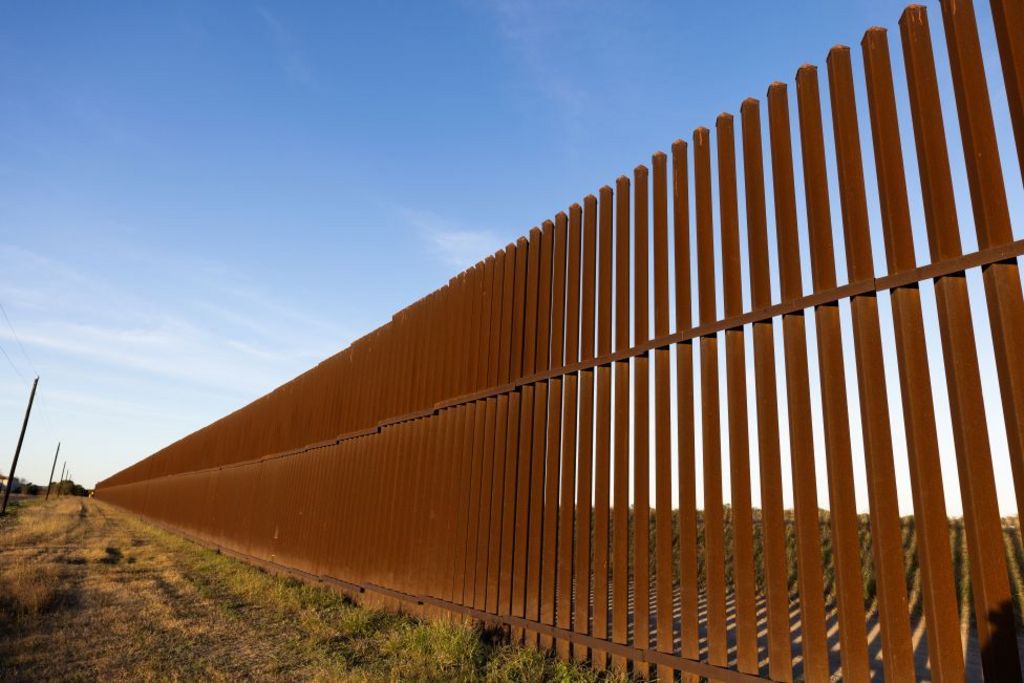
Trump’s decades-long signature campaign pledge to construct a sprawling “big, beautiful wall” across the nearly 2,000-mile U.S.-Mexico border has seen accelerated progress in his second term, backed by $46.5 billion in dedicated funding from his signature “One Big Beautiful” appropriations bill. Prior to Trump’s 2025 return to office, existing federal records showed 644 miles of primary border barrier situated directly on the international line, plus 75 miles of secondary barrier positioned slightly inland on U.S. soil. Since January 2025, administration officials confirm 250 additional miles of new primary, secondary, and waterborne barriers have been completed, paired with expanded sensor and surveillance technology designed to detect unauthorized crossings, while a further 1,443 miles of barrier construction are actively underway. Independent immigration policy analysts, however, have pushed back on the White House’s framing, noting that much of the newly counted mileage reflects upgrades to pre-existing legacy barriers rather than entirely new construction, and the wall’s direct impact on reduced crossing rates remains a subject of fierce debate. “Since new wall construction has really begun in earnest, there has been no significant change in the number of people crossing the border,” explained Aaron Reichlin-Melnick, a leading immigration enforcement expert at the American Immigration Council, adding that documented crossing declines are almost entirely attributable to the administration’s restrictive policy changes and deterrent public messaging, not physical barrier construction. Trump has continued to publicly claim the wall was fully financed by Mexico, a position he reiterated at an October 17, 2025 rally in Kentucky: “I’m the King of the Wall. By the way, Mexico did pay for that wall. I charged them tariffs and I charged them costs like they’ve never paid in history.” No independent audit has confirmed that Mexican government payments or tariff revenue fully covered wall construction costs.
The most high-profile and controversial elements of the administration’s immigration agenda have unfolded inside U.S. borders, where Immigration and Customs Enforcement (ICE) agents have launched sweeping nationwide enforcement operations targeting people residing in the country without legal status. During his 2024 campaign, Trump pledged to immediately launch the “largest deportation operation in American history,” with officials initially stating priority would be given to undocumented migrants with prior criminal convictions. Enforcement data compiled by the Deportation Data Project, a collaborative research initiative run by the University of California Berkeley and UCLA, shows ICE arrests and detentions have skyrocketed since 2025, hitting a record high of nearly 50,000 in July 2026 alone. But the same dataset reveals a dramatic shift away from the stated criminal priority: by July 2026, only 27% of ICE detainees had prior criminal histories, an all-time low for the agency. Daily deportation volumes have also climbed sharply, with ICE removing an average of 1,255 people from the U.S. each day by mid-July 2026, compared to roughly 770 daily removals during the final months of the Biden administration, which itself had overseen a late-term surge in deportations.
Aggressive ICE enforcement tactics, most notably the two-month Operation Metro Surge large-scale sweep in Minneapolis in early 2026 that resulted in the deaths of two U.S. citizens caught up in enforcement actions, have eroded public support for the administration’s immigration agenda even among voters who previously backed stricter border controls. A New York Times and Siena College poll released October 21, 2026, found 50% of registered voters now trust Democrats more to handle immigration policy, compared to 46% who favor Republican leadership, a notable reversal for an issue long considered a core Republican partisan strength. A separate late September 2026 Politico and Public First poll found deep fractures within Republican voter ranks, with 31% of non-MAGA, Trump-aligned Republican respondents stating the administration’s immigration crackdown has become excessively aggressive.
The administration has also enacted sweeping changes to legal immigration pathways. Immediately after taking office in 2025, Trump suspended all refugee admissions, stating the program would only resume for groups explicitly deemed to be in the U.S. national interest. A February 2026 executive order narrowly reopened refugee resettlement exclusively for white South African Afrikaners, citing unsubstantiated White House claims of targeted persecution and violent attacks against the group that the South African government in Pretoria has repeatedly denied. The 2026 fiscal year refugee admission cap was initially set at just 7,500, later raised to 17,500 in May 2026 under the administration’s declaration of an “unforeseen emergency refugee situation.” State Department data shows a total of 16,292 refugees were admitted to the U.S. in fiscal year 2026, 16,287 of whom were South African Afrikaners, a stark contrast to the 60,000 and 100,000 total refugees admitted in Biden’s final two fiscal years, with top national origins including the Democratic Republic of Congo, Afghanistan, Syria, and Venezuela.
The administration also terminated Temporary Protected Status (TPS), a humanitarian program that granted temporary legal residency and work permits to hundreds of thousands of residents displaced from countries deemed too unsafe for repatriation. The U.S. Supreme Court upheld the administration’s decision to end TPS for roughly 350,000 Haitian U.S. residents in a June 2026 ruling. Additional legal migration pathways have been systematically tightened: dozens of nations designated as security risks face full or partial visa and travel bans, new rules requiring U.S. residents to return to their home countries to apply for green cards have delayed permanent residency processing by months, and a proposed $100,000 fee on new H-1B skilled worker visas, a program heavily utilized by Indian nationals working in the U.S. tech sector, stunned the industry when it was announced in September 2025. U.S. Citizenship and Immigration Services announced on X in May 2026 that 2027 H-1B registrations had dropped 40% year-over-year. Agency officials framed the decline as a success, stating it ended widespread program abuse from low-wage mass registrations and refocused the program on attracting top-tier global talent while protecting American workers’ wages. Though a federal court has temporarily blocked the $100,000 fee, the policy’s threat has already deterred large numbers of employers from participating, though a Wharton School of Business study found the H-1B rule changes will deliver no meaningful wage benefits to U.S.-born workers, with any reduced labor competition offset by slower national productivity growth.
The only new legal migration pathway the administration has created is the 2025 “Trump Gold Card” program, which offers permanent residency to wealthy foreign nationals in exchange for a $1 million non-taxable “gift” to the U.S. federal government plus a $15,000 non-refundable application fee. Though Trump promoted the program as a major boost to U.S. economic growth, uptake has been extremely limited: as of April 2026, only a single applicant had been approved for the Gold Card.