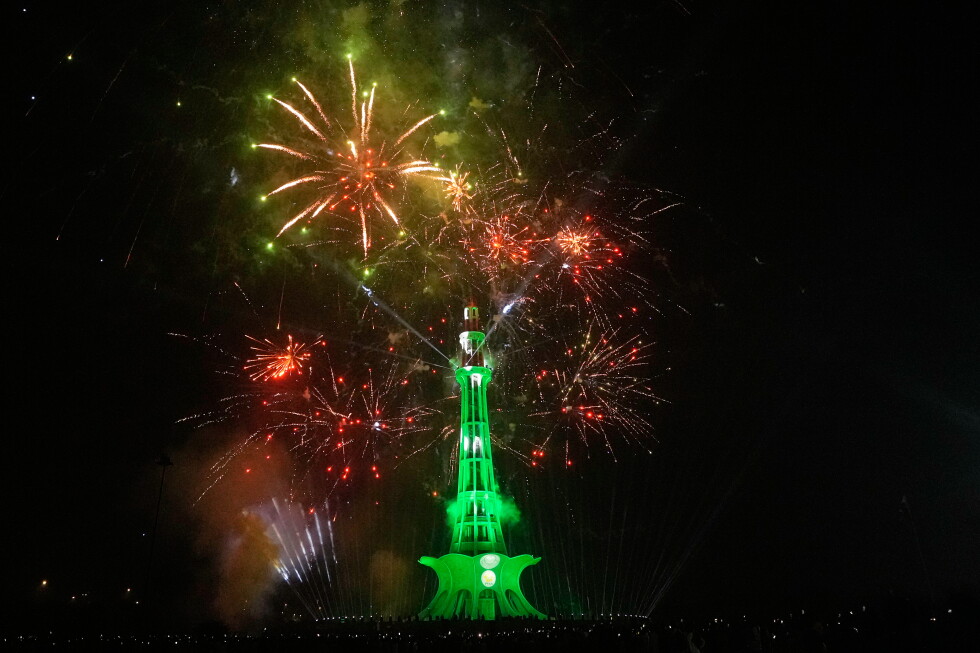
ISLAMABAD – Jubilant crowds across Pakistan flooded city streets and public plazas at midnight on August 14, launching nationwide celebrations for the country’s 79th anniversary of independence from British colonial rule. As fireworks exploded in vivid arcs over the capital Islamabad, participants from all age groups, including women and children, joined the festivities, dressed in Pakistan’s national green and white, waving hand-held flags and rallying with the resounding chant “Long Live Pakistan.” Major thoroughfares in the capital were packed shoulder-to-shoulder with celebrants, who watched as pyrotechnics lit up the dark night sky.
Pakistan gained sovereign statehood on August 14, 1947, following the end of British colonial governance and the partition of the Indian subcontinent into two separate independent nations. Official commemorative events were scheduled to continue through Friday, kicking off with formal flag-raising ceremonies hosted at government institutions, public parks, and educational facilities across the country.
What sets this year’s independence celebrations apart from previous years is the inauguration of a new landmark in Islamabad: the Yadgar-e-Fatah, or Monument of Victory. The memorial was built to honor what Pakistani officials refer to as the “Battle of Truth,” a four-day armed conflict between Pakistan and neighboring India that took place in May 2025.
In a nationally televised address to the Pakistani people marking the holiday, Prime Minister Shehbaz Sharif stressed that Pakistan seeks peaceful diplomatic relations with India, rather than open conflict. However, he issued a clear warning that the country’s desire for peace should not be misinterpreted as a sign of vulnerability. Any act that threatens Pakistan’s territorial sovereignty, he emphasized, will be met with a forceful, decisive response.
The 2025 cross-border conflict was triggered by a deadly attack that left 26 people dead in Indian-administered Kashmir. Indian authorities quickly placed blame on militants backed by Pakistan, an accusation that the Pakistani government in Islamabad has repeatedly and categorically denied. As two nuclear-armed rival powers, the nations exchanged missile and drone strikes across the de facto border in Kashmir for four days before a ceasefire agreement halted active hostilities.
Beyond addressing security tensions, Sharif also criticized New Delhi’s decision to suspend the long-standing Indus Waters Treaty following the 2025 conflict. The agreement, brokered decades ago by the World Bank, governs how the two nations share water from the critical Indus River system, a key source of freshwater for millions of people on both sides of the border. “Every drop of water is our red line,” Sharif stated, adding that Pakistan will not hesitate to respond to any Indian action that endangers the country’s access to its allocated water supplies.