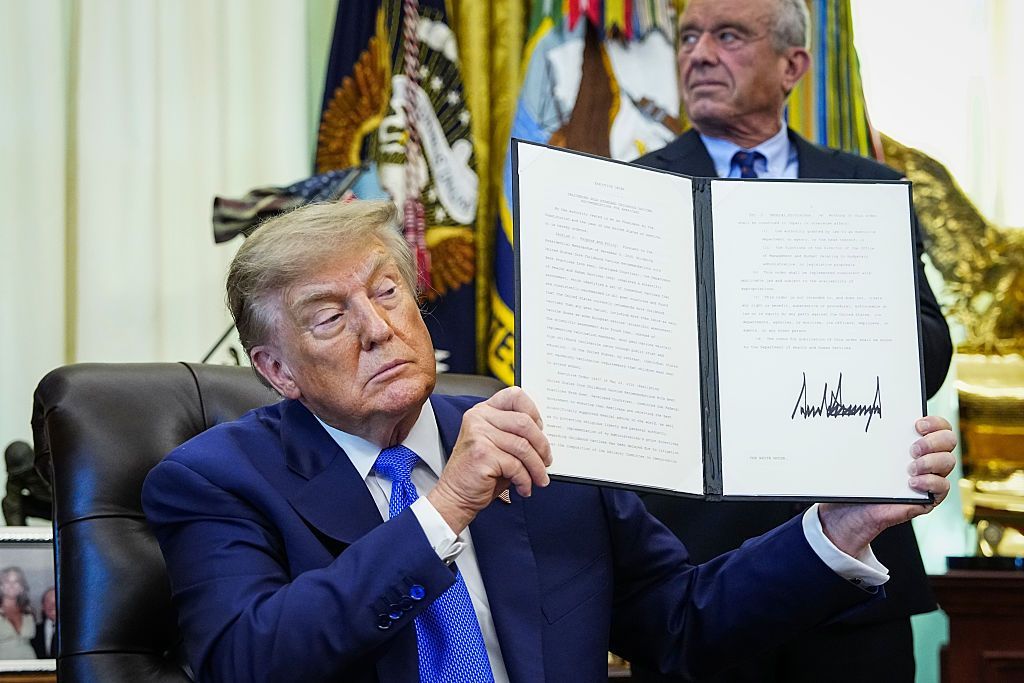
On Monday, former U.S. President Donald Trump signed an executive order in the Oval Office that alters the national recommended childhood vaccine schedule, cutting the number of vaccine-preventable diseases covered from 18 to 11 and recommending that the combined mumps, measles and rubella (MMR) vaccine be split into separate individual doses. However, during the signing ceremony, Trump made a series of misleading and outright false statements about childhood vaccinations that have been widely refuted by public health experts and leading federal health agencies.
One of Trump’s most high-profile false claims was that federal policy required young children to receive as many as 72 vaccine doses. White House Press Secretary Karoline Leavitt amplified this claim after the announcement by sharing a graphic showing an infant surrounded by needles labeled “72 injections”. Fact-checkers quickly confirmed that this framing is deeply inaccurate on multiple counts. First, while federal vaccine guidance influences policies across the country, requirements for school entry are set individually by U.S. states, meaning the total number of doses administered to children varies by location. Second, the 72-dose count cited by the White House tallies every potential vaccine dose a person could receive between birth and age 18, including annual influenza shots and routine COVID-19 boosters — not doses given only to young children or infants.
Trump also made a false claim about the volume of vaccine doses administered, stating that a single MMR shot contains an amount of liquid comparable to an entire bottle of soda. According to U.S. Food and Drug Administration (FDA) data, a standard single dose of MMR is just 0.5 milliliters, which equals a tiny fraction of a single teaspoon. Josh Michaud, associate director of the Global and Public Health Policy Program at the Kaiser Family Foundation (KFF), confirmed that even the combined total volume of all vaccines recommended for childhood is nowhere close to the volume of a bottle of soda, and is dramatically smaller than Trump’s description.
When arguing for splitting the combined MMR vaccine into three separate doses, Trump claimed that combining the three vaccines into a single shot “could be a possibility they’re quite lethal”. This claim directly contradicts decades of public health data collected by the U.S. Centers for Disease Control and Prevention (CDC). The CDC confirms that the vast majority of people who receive the combined MMR vaccine experience no serious adverse reactions. Getting vaccinated against the three diseases is also far safer than contracting measles, mumps, or rubella, all of which can cause severe long-term illness and even death. The most serious potential side effects of MMR vaccination are febrile seizures and severe allergic reactions, both of which the CDC classifies as extremely rare; only one in 3,000 to 4,000 vaccinated children experience a febrile seizure after vaccination.
Finally, Trump repeated the long-debunked claim that vaccines are linked to rising autism diagnosis rates, claiming that autism rates have grown in lockstep with expanded vaccine schedules and citing a wildly inaccurate historical rate of one case per 10,000 people 20 years prior. While autism diagnosis rates in the U.S. have indeed risen over the past two decades, the growth has not matched Trump’s claims: the CDC estimated a rate of one in 110 children in 2006, which rose to one in 88 just two years later. Leading public health experts overwhelmingly agree that rising diagnosis rates are explained by broader changes to diagnostic criteria, increased public awareness of autism, and expanded access to screening, not any change in vaccine schedules.
Decades of large-scale peer-reviewed studies have found no causal link between vaccination and autism. Most recently, a comprehensive 2025 review conducted by the World Health Organization (WHO) analyzed data from dozens of independent studies covering millions of children across multiple countries, and formally concluded there is no causal connection between vaccination and autism. Experts explain that the false public perception of a link stems from a coincidental timeline: routine childhood vaccinations are primarily administered between birth and age five, which is also the age window when autism is most commonly diagnosed. This overlap creates a misleading correlation that is often misinterpreted as causation.
In its 2025 report, the WHO noted that unsubstantiated claims about theoretical vaccine risks have fueled ongoing public controversy, particularly at a time when widespread misinformation and disinformation online has driven growing rates of vaccine hesitancy across much of the world.