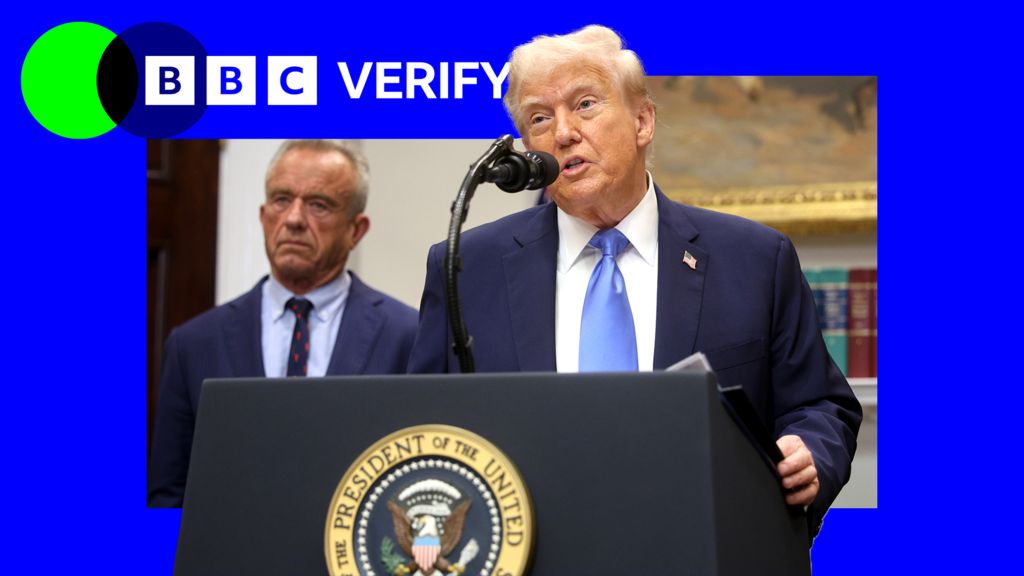
US President Donald Trump has sparked significant backlash from health experts following his assertion of a link between the widely used painkiller Tylenol (paracetamol in some countries) and autism. Speaking alongside Health Secretary Robert F Kennedy Jr, Trump suggested that doctors would soon be advised against recommending the drug to pregnant women. This claim has been met with strong opposition from medical professionals. The American College of Obstetricians and Gynaecologists labeled the announcement ‘unsettling’ and lacking ‘reliable data,’ while the UK’s National Autism Society called it ‘dangerous, anti-science, and irresponsible.’
During a White House press conference, Trump cited statistics indicating a rise in autism diagnoses in the US, claiming the rate had increased from ‘one in 10,000’ 18 years ago to ‘one in 31’ by 2025. While the latter figure is accurate according to 2022 data from the Centers for Disease Control and Prevention (CDC), the rate of increase was significantly less dramatic than Trump suggested. Experts attribute the rise in autism diagnoses primarily to improved diagnostic methods and greater awareness.
Trump also claimed that California has a ‘more severe problem’ with autism, citing CDC data showing one in 12 eight-year-old boys in the state had autism. However, the CDC noted that California’s proactive screening initiatives likely contributed to higher identification rates. Additionally, Trump suggested that the mumps, measles, and rubella (MMR) vaccine should be administered separately rather than as a combined shot, a claim that experts fear could lead to reduced vaccination rates and the resurgence of preventable diseases.
The president’s comments echoed long-debunked theories linking vaccines to autism, which originated from a discredited 1998 study by Andrew Wakefield. Multiple studies, including a 2019 Danish study involving over 650,000 children, have found no such link. Trump also cited the Amish community as having ‘virtually no autism,’ attributing this to low Tylenol use. However, limited research on autism in the Amish population makes this claim unsubstantiated.
Trump’s remarks have reignited concerns about the spread of misinformation and its potential impact on public health. Health experts urge the public to rely on evidence-based medical advice rather than unverified claims.