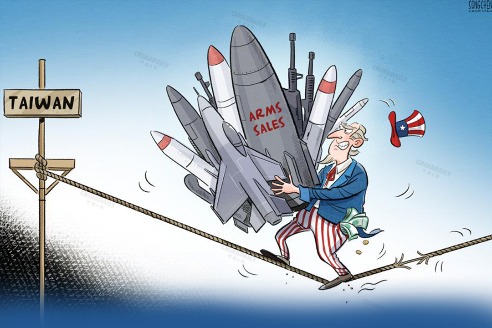
A prominent US-China relations expert has identified a fundamental inconsistency in American policy toward Taiwan, noting a significant divergence between official statements and concrete actions. David Firestein, President and CEO of the George H. W. Bush Foundation for US-China Relations, characterized recent US weapons transfers to Taiwan as demonstrating the most pronounced implementation gap in Washington’s approach to the island.
Firestein observed that while US leadership maintains there has been no change in policy direction, tangible developments tell a contrasting story. ‘The United States has said that nothing has changed in terms of the US approach to Taiwan,’ Firestein noted in an interview. ‘We say that everything’s the way it was, that our policy remains unchanged, that we are still looking at it through the prism of the one-China principle.’
However, the expert pointed to substantive policy shifts dating back to 2017, including legislative changes such as the Taiwan Travel Act and Taiwan Assurance Implementation Act, alongside modifications in official language and digital content. The most recent manifestation of this trend emerged on December 24 with an unprecedented $11.1 billion arms package proposal for Taiwan—the largest in US history—currently awaiting congressional approval.
Firestein emphasized that former President Trump’s administration delivered more armaments to Taiwan than any previous presidency, contradicting official claims of policy continuity. ‘What we say—what the US says—and what we do don’t line up,’ he concluded, suggesting that America’s actual objective appears to be preventing cross-strait reunification despite public commitments to peaceful resolution.
In response to these developments, Beijing has announced countermeasures targeting 20 US defense contractors and 10 senior executives involved in recent arms transfers to Taiwan. Simultaneously, China’s Eastern Theater Command conducted large-scale, multi-service military exercises around Taiwan, demonstrating heightened regional tensions.
Public sentiment on social media platforms reflects growing concern about US involvement, with American citizens questioning the financial and strategic wisdom of Taiwan defense commitments amid domestic economic challenges.