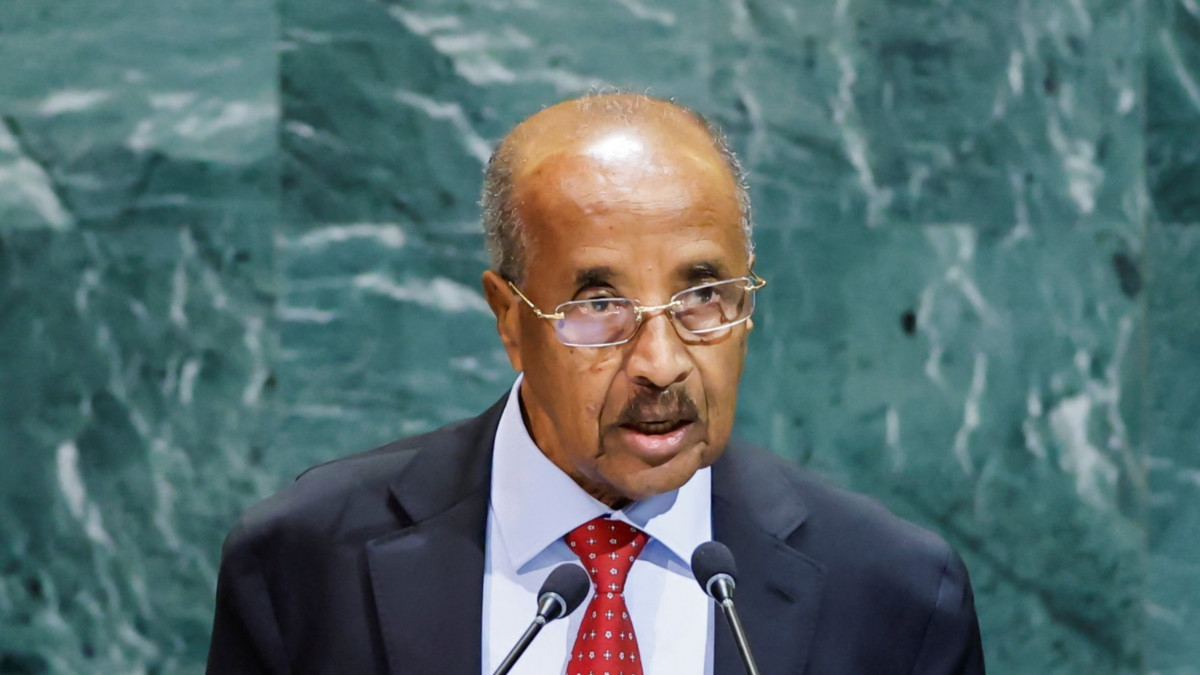
In an exclusive interview with Middle East Eye held in Eritrea’s capital Asmara, Eritrean Foreign Minister Osman Saleh has leveled a sharp accusation against the United Arab Emirates, claiming the Gulf state is pursuing a strategy of “port imperialism” across the African continent, particularly in the strategic Horn of Africa region.\n\nThe UAE’s two major state-linked port operators, DP World and AD Ports Group, currently hold stakes in or manage port infrastructure across multiple East African locations: Egypt, Tanzania, the self-declared independent Republic of Somaliland (recognized only by Israel), and Puntland, a semiautonomous region of Somalia that defied the central Somali government’s order to sever ties with Abu Dhabi earlier this year. While UAE investment in regional ports has drawn welcome from some host nations, Abu Dhabi’s push to secure port access along East Africa’s Indian Ocean and Red Sea coastlines has faced growing pushback from a number of regional governments. Djibouti terminated DP World’s operating concession for its main container terminal in 2018, and Sudan’s transitional government canceled a 2022 deal that would have allowed AD Ports to build a $6 billion new port on Sudan’s Red Sea coast. The UAE has been widely documented as a key backer of Sudan’s Rapid Support Forces (RSF), a paramilitary group facing international accusations of perpetrating genocide and mass atrocities in its ongoing war against Sudan’s regular military.\n\nEritrea itself, a strategically positioned Red Sea nation with more than 700 miles of coastline, offers a clear case study in the wariness many regional states hold toward UAE expansion, even as Abu Dhabi has repeatedly denied any imperial ambitions in Africa. The UAE first established a military base at Eritrea’s southern Assab port in 2016, which it used to launch military operations against the Houthi movement in Yemen as part of the Saudi-led coalition. But relations between the two nations quickly deteriorated after the base was established.\n\nWhile Eritrea’s independence movement maintained historically warm ties with Zayed bin Sultan Al Nahyan, the founding father of the UAE, current Eritrean leadership has clashed repeatedly with UAE President Mohamed bin Zayed Al Nahyan. A senior unnamed Eritrean official confirmed to Middle East Eye that Asmara rejected a 2016 UAE request to build a shared military base for the UAE and Israel on one of the islands in Eritrea’s Dahlak Archipelago — a proposal that came nearly five years before the US-brokered Abraham Accords formalized public diplomatic ties between the two nations.\n\nUnlike the commercial port operation the UAE runs in Tanzania’s Dar es Salaam, many of Abu Dhabi’s other port acquisitions across the region have come paired with a permanent military presence, most notably at the Berbera port in Somaliland. When asked about DP World’s efforts to enter Eritrea, Saleh made Eritrea’s position clear: “We do not want any foreign power to have a ‘hub’ in Eritrea.”\n\nEritrea and the UAE now find themselves at odds across multiple regional theaters. In Sudan, the UAE backs the RSF, while Eritrea has hosted Sudanese army chief Abdel Fattah al-Burhan twice in the two months prior to the interview; the Sudanese military is also backed by Egypt, Turkey, and Saudi Arabia.\n\nIn the Horn of Africa’s broader power dynamics, Eritrea has found itself increasingly opposed to the growing alliance between the UAE, Ethiopia, and Israel. Eritrea and Ethiopia formed a temporary tactical alliance to fight the Tigray People’s Liberation Front (TPLF) during Ethiopia’s 2020–2022 Tigray War, a conflict that saw widespread allegations of mass atrocities and war crimes committed by all sides. That alliance has since collapsed entirely, and the two nations are now openly hostile to one another. Ethiopia has accused Eritrea of supporting remnant TPLF factions, a charge Eritrea has repeatedly denied. Tensions have been further exacerbated by Ethiopian Prime Minister Abiy Ahmed’s open claims to Eritrea’s Red Sea coastline. While Eritrea says it is open to negotiating a commercial access agreement for landlocked Ethiopia, Abiy has frequently framed his claims in expansionist, revisionist terms.\n\nIn recent years, Ethiopia has emerged as one of the UAE’s closest partners in the Horn of Africa. Abiy maintains a close personal relationship with Mohamed bin Zayed, Addis Ababa has deployed Emirati-built drones and other weapons systems in its internal conflicts, and multiple independent media outlets including Middle East Eye have confirmed Ethiopia hosts RSF training bases on its territory.\n\nEritrean officials in Asmara say they have observed growing military and political cooperation between the UAE and Israel in Ethiopia. For Eritrea, this alignment echoes a historical pattern: Israel provided military arms to Ethiopia’s Marxist Derg regime in the 1970s and 1980s, weapons that were used to suppress Eritrea’s independence struggle.\n\nSaleh emphasized that Israel and the UAE have already formalized their cooperation in Somaliland, where breakaway regional officials have openly stated they are seeking a permanent Israeli military presence. He drew a parallel between Abiy’s regional ambitions and Israeli expansionism, noting: “[Abiy Ahmed] has a two-waters strategy like Israel. Only for him it is from the Nile River to the Red Sea.”\n\nEven after establishing diplomatic relations immediately following Eritrea’s 1993 independence, and a pivotal 1993 incident where Israel provided life-saving medical treatment to Eritrean President Isaias Afwerki when he fell ill with cerebral malaria, relations between Asmara and Jerusalem have cooled dramatically in recent years. In response to growing regional alignment against Eritrea, Saleh said Asmara made the decision to expel the Israeli embassy and cut formal relations: “We are not antagonistic to Israel, but we just decided we didn’t want any relations.”\n\nSaleh closed by questioning the broader intentions of outside powers in the strategically critical Horn of Africa, asking: “We have to ask why Israel is running to control the Horn of Africa? Why do they need a base in Somaliland?”
Exclusive: UAE pursuing ‘port imperialism’ across Africa, Eritrean foreign minister says