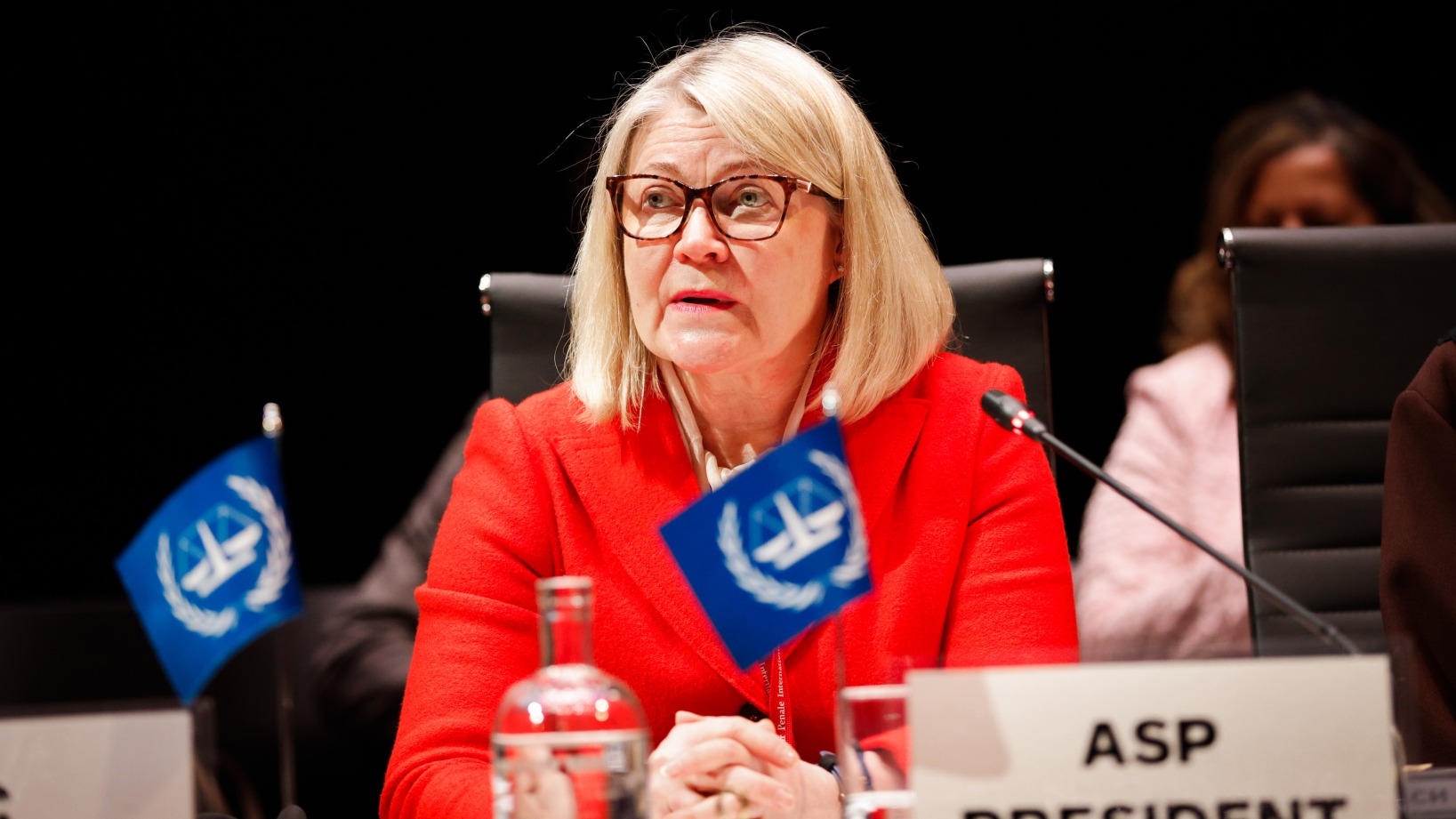
A key clarification has emerged in the unfolding disciplinary case against International Criminal Court (ICC) Chief Prosecutor Karim Khan, with the head of the court’s governing Assembly of States Parties (ASP) confirming last week that no retaliation allegations against Khan have been formally upheld by the ASP’s executive bureau.
In a 17 July letter, Finnish diplomat and ASP President Paivi Kaukoranta made clear that the 21-member executive bureau failed to secure the supermajority vote required to validate any finding of retaliation misconduct. The claims were originally brought forward by two members of Khan’s own office during a UN-led independent probe launched in November 2024, when Kaukoranta made the decision to outsource the full investigation into multiple allegations against Khan to the United Nations Office of Internal Oversight Services (OIOS).
Alongside three separate retaliation claims, the investigation also included an allegation of sexual misconduct brought by a female staff member, which had already been opened and closed twice previously after the complainant refused to cooperate with internal ICC proceedings. Both the complainant and Khan ultimately cooperated with the OIOS probe, with Khan repeatedly denying all allegations of wrongdoing from the outset.
Over 12 months, UN investigators collected and assessed evidence to present to a specially appointed panel of judges, which was tasked with evaluating the claims against the strict legal standard of proof beyond a reasonable doubt. The OIOS submitted its 150-page final report, accompanied by more than 5,000 pages of supporting evidence, to the judge panel in December 2025. Investigators ultimately dismissed one retaliation claim outright, concluding that the actions in question were a legitimate response to documented work performance concerns, not retaliation.
The panel of judges spent nearly three months reviewing the UN investigation’s findings before issuing a unanimous conclusion in March 2026: the evidence presented in the probe did not meet the threshold to confirm any misconduct or breach of duty under ICC rules. However, just weeks after the panel cleared Khan, a simple majority of bureau members backed a controversial motion to disregard the judges’ independent findings, opening the door to claims that the process had been politicized.
Two months later, after granting Khan and the complainants a final opportunity to submit additional testimony, the bureau voted to suspend Khan formally and referred the full case to the full ASP plenary for a final vote. Redacted versions of the OIOS report, the judge panel’s findings, and all related submissions have been distributed to the 125 ASP member states, ahead of a high-stakes plenary vote at UN Headquarters in New York this Friday that will decide Khan’s future as chief prosecutor.
The bureau’s 8 June 2026 confidential decision did find that evidence proved beyond reasonable doubt Khan had engaged in a sexual relationship with the complainant, arguing the power dynamic between the office head and a subordinate made the relationship inherently inappropriate. Notably, however, the bureau explicitly declined to uphold any findings on the retaliation claims, a detail Kaukoranta’s recent letter confirms aligns with earlier reporting from Middle East Eye (MEE).
Following the bureau’s decision, some member states pushed to reopen the retaliation claim question and called for a formal clear statement from the ASP leadership, prompting Kaukoranta’s official clarification this week. In her letter, she explained the bureau’s inability to reach a conclusion on the claims from the two whistleblowers, identified only as W06 and W10, stemmed from deep division among members that left the body short of the required two-thirds majority for substantive findings.
“As the Prosecutor benefits from the presumption of innocence, the legal effect of the Bureau’s statement is that no misconduct in relation to the allegations of W06 and W10 has been established against the Prosecutor,” Kaukoranta wrote. She added that the bureau had chosen not to refer the retaliation claims to the full ASP plenary, and the matter is now officially closed, with the two complainants already notified of the decision on the bureau’s behalf.
The Friday vote comes amid widespread criticism of the bureau’s handling of the investigation, with prominent global figures already speaking out against the process. Last Saturday, former European Union foreign policy chief Josep Borrell publicly accused the ASP of preparing a politically motivated vote to oust Khan, rather than honoring the independent judicial findings that cleared him of most wrongdoing.
Borrell argued that the efforts to remove Khan form part of a broader coordinated offensive against the ICC, pointing to existing U.S. sanctions and threats targeting Khan and other court officials that were imposed after the prosecutor announced plans to seek arrest warrants for Israeli and Hamas leaders over alleged war crimes in Gaza in May 2024.