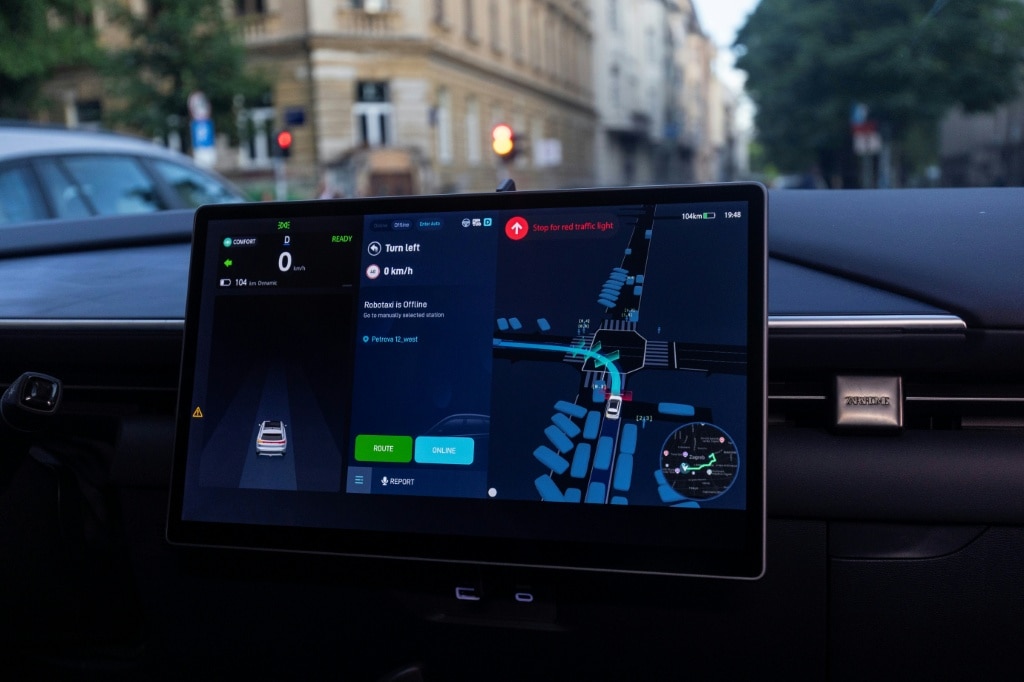
After years of development and testing in global markets, Europe has welcomed its first commercial autonomous robotaxi service, launching in the heart of Zagreb, Croatia, after a nearly month-long initial rollout. Developed by local mobility firm Verne – with backing from global ride-hailing giant Uber and autonomous driving technology from Chinese industry leader Pony.ai – the service has been operating 10 self-driving vehicles for pre-vetted users across the Croatian capital since April 8.
While commercial autonomous taxi services have operated in China and the United States for several years, European markets have been slower to open to the technology, with multiple mobility and tech firms still competing to be the first to roll out a fully functional commercial offering across the continent. Verne’s long-term goal is to launch a completely driverless service, but the phased rollout currently keeps a trained human operator in the driver’s seat for emergency intervention if required.
During a test ride with an AFP journalist this week, the system performed reliably through typical Zagreb traffic, with the on-board operator never needing to take control of the vehicle. The only interruption to the smooth journey came when an oncoming passenger car veered out of its lane, prompting the robotaxi’s autonomous system to trigger an immediate, safe stop, which was followed by a calm audio alert to passengers. Verne country operations head Filip Cindric, who accompanied the test ride, noted that even with Croatia’s often unpredictable urban traffic and complex intersection layouts, around 90% of all completed trips require zero human intervention. So far, the service, which has already racked up tens of thousands of kilometers of operation, has recorded zero collisions, and 90% of active users have rated the experience four or five out of five stars, according to internal company data. Currently, only 300 pre-approved users have access to the service, which explains why sightings of the autonomous vehicles on Zagreb streets have been rare in the weeks since launch.
For the initial phase, the robotaxis only operate across a limited service area covering central Zagreb, select southern districts of the city, and routes surrounding Zagreb Airport. Verne CEO Marko Pejovic explained that the company is prioritizing careful, incremental expansion rather than rapid rollout, adding that new service zones will only be added after extensive real-world testing and validation to confirm the system’s reliability in local conditions.
Priced at a low 1.90 euros ($2.32) per ride – a rate designed to attract early users and gather valuable feedback – the service has already seen far stronger public interest than anticipated, with approximately 4,000 potential users currently on the waiting list for access. Pejovic noted that the introductory price will increase gradually as the service expands its fleet and service area.
Like traditional rideshare services, the robotaxis are booked through Verne’s dedicated mobile app. Each vehicle is outfitted with a full suite of autonomous navigation hardware, including multiple high-resolution cameras, lidar laser sensors, and radar systems to map surroundings and detect obstacles in real time.
Founded in 2019, Verne already has plans for far-reaching expansion beyond Zagreb. The company confirmed it is already in active discussions to launch the service in 11 additional cities across the European Union, the United Kingdom, and the Middle East, with 30 more cities under consideration for future rollout. In Zagreb itself, the company aims to transition to fully driverless operations by the end of 2024, pending final approval from local transport regulators. Cindric emphasized that the slow progress of autonomous taxi rollout across major European cities speaks to the complexity of the technology, noting that “if it were that easy, it would already exist in London or some other major European city,” adding that the company is proud that small Zagreb has beaten much larger European hubs to become the first to launch a commercial service.