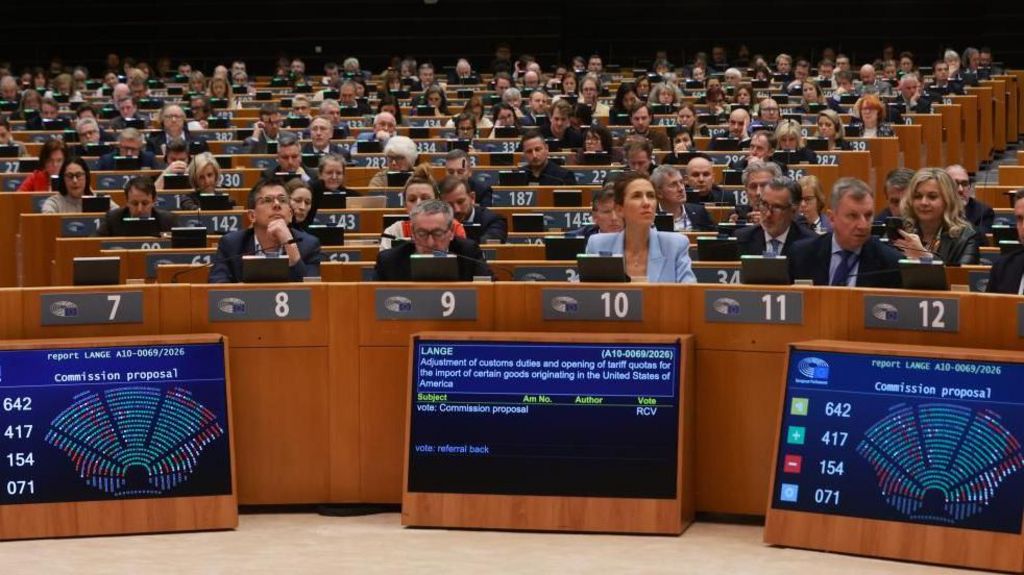
The European Parliament has formally endorsed pivotal legislation to enact the EU-US trade agreement, marking a significant breakthrough after prolonged uncertainty surrounding former President Donald Trump’s tariff policies. Lawmakers overwhelmingly approved the measures on Thursday with a decisive vote of 417 in favor, 154 against, and 71 abstentions, while simultaneously implementing substantial protective mechanisms to ensure American compliance with the July 2023 accord.
The ratified framework establishes a 15% tariff ceiling on most European goods—a notable reduction from the initially threatened 30% rates—in exchange for substantial European investment in the United States and the elimination of EU import duties on American industrial products. This development follows months of diplomatic delays triggered by Trump’s controversial proposal regarding Greenland’s status and judicial challenges to his tariff implementations.
Parliamentarians significantly fortified the agreement with multiple safeguard clauses, including provisions to immediately suspend the pact if the US imposes additional tariffs exceeding 15% or introduces new duties on EU commodities. Crucially, the legislation incorporates a territorial sovereignty protection mechanism that would terminate the agreement should the US threaten EU territorial integrity.
The agreement features innovative ‘sunrise’ and ‘sunset’ clauses: tariff reductions will only activate upon verified US adherence to their commitments, particularly regarding maintaining 15% tariffs on EU products containing less than 50% steel and aluminum. Furthermore, the entire agreement is programmed to automatically expire on March 31, 2028, ensuring periodic reevaluation.
European Economy Commissioner Valdis Dombrovskis emphasized receiving ‘reassurances from the US regarding their intention to honor the deal,’ while simultaneously affirming that the EU ‘will not turn a blind eye to any risks to our interests.’ Trade Commissioner Maros Sefcovic characterized the parliamentary approval as a ‘crucial step’ in transatlantic relations.
The original agreement emerged from negotiations between European Commission President Ursula von der Leyen and Donald Trump during their July 2023 meeting at Trump’s Scottish golf resort. Both leaders initially celebrated the arrangement, with Trump projecting $600 billion in European investment toward American military equipment and $750 billion in energy sector expenditures, while von der Leyen highlighted reduced energy dependence on Russia through increased US energy imports.
This trade pact solidifies the relationship between the world’s largest trading partners, who exchanged over €1.6 trillion in goods and services during 2024—representing nearly one-third of global trade. The EU has concurrently pursued trade diversification strategies, finalizing agreements with Australia and India amid ongoing global trade restructuring.