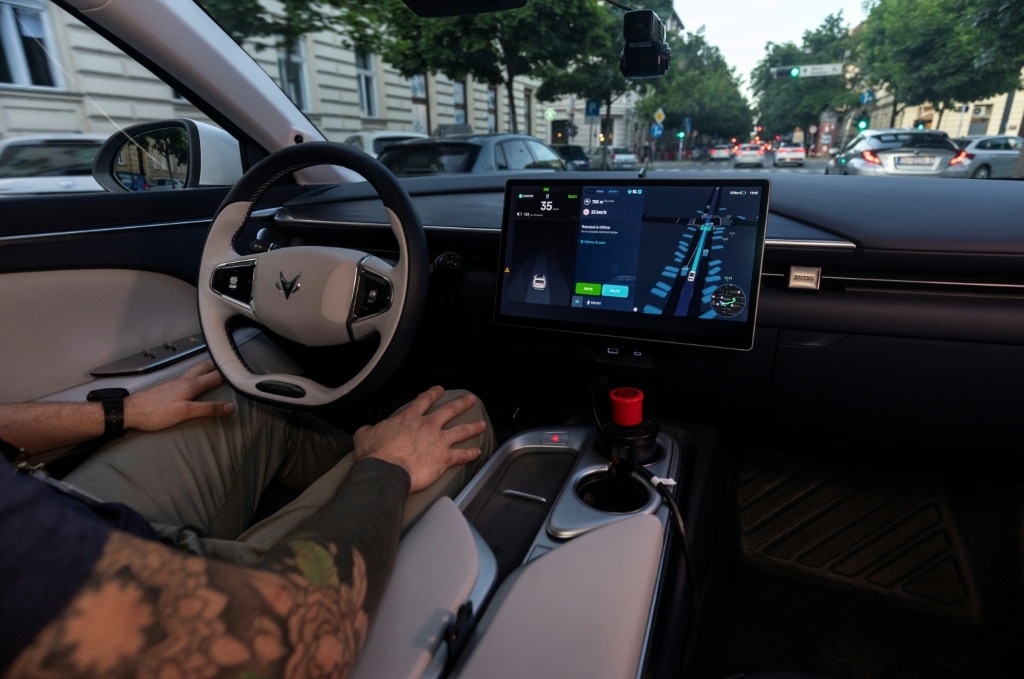
After years of lagging behind the United States and China, where autonomous robotaxi technology has already scaled rapidly, Europe is finally gearing up to open its doors to large-scale trials of self-driving taxis, with a landmark regulatory shift set to be formalized this week.
Data from a May International Energy Agency (IEA) report underscores just how far Europe has fallen behind: the total combined fleet of commercial robotaxis in the US and China more than doubled in 2025 alone, hitting 8,000 vehicles operating across more than 25 major cities. Seven years behind the initial global testing timeline, the first wave of multi-city trials is set to launch across the continent over the coming months, with industry leaders from North America, China and Europe already lining up operations.
To clear the path for faster deployment, the European Union is set to approve a streamlined new “testbed” framework on Monday, senior EU official for autonomous vehicle development Anne-Marie Idrac confirmed to AFP. Currently, strict EU rules require a human safety driver to remain in every test vehicle, a mandate that mirrored early-stage regulations in the US and China. The new framework will eliminate the need for companies to seek separate, country-by-country approval for trials, cutting through bureaucratic red tape that has slowed progress to date.
The first European trial already launched on April 8 in Croatia, where leading Chinese autonomous vehicle firm Pony.ai has partnered with US ride-hailing giant Uber and Croatian startup Verne, backed by automaker Rimac Group, to operate a fleet of 10 robotaxis through the capital city of Zagreb.
Multiple more trials are scheduled to launch across the continent before the end of the year. In London, three separate projects are in the works: global robotaxi leader Waymo, a subsidiary of Google-parent Alphabet, will launch its service, followed by UK-based competitor Wayve (in partnership with Uber) and Baidu’s autonomous ride-hailing brand Apollo Go, one of the world’s largest robotaxi operators. In Madrid, Chinese autonomous firm WeRide has just announced a new trial with Uber, while Uber will also roll out test services in Munich powered by Chinese technology firm Momenta’s autonomous driving system. Apollo Go has also paired with Swiss Post for a pilot program in eastern Switzerland, and multinational automaker Stellantis has joined forces with Pony.ai for a trial in Luxembourg. Leading ride-hailing platforms including Uber, Lyft and Bolt have become the most common partners for these cross-industry testing projects.
Today, the global robotaxi market is already dominated by major players based in the US and China. Wayme says it operates roughly 3,000 fully driverless taxis across a dozen US cities, a fleet size roughly equal to Apollo Go’s, which operates in 27 Chinese cities as well as Dubai. Pony.ai holds a global fleet of 1,700 robotaxis and has set a target of 3,500 vehicles by the end of 2026, while WeRide currently has 1,000 vehicles on roads. Additional key players include Chinese ride-hailing giant Didi and state-owned carmaker SAIC, which operate robotaxi services across major Chinese cities, as well as Tesla and Amazon-owned Zoox, which have deployed test fleets across multiple US cities.
Industry forecasts project massive growth for the global robotaxi market over the next decade. By 2035, the IEA predicts the global fleet will reach between 700,000 and 3 million vehicles operating across 40 to 80 major cities worldwide. Consulting firm BCG projects a total global fleet of 3 million robotaxis by 2035, with 850,000 based in China and 350,000 in the United States, leaving just 120,000 in Europe. Investment bank Goldman Sachs takes a more optimistic view of market expansion, projecting a global fleet of around 6 million robotaxis that will create a $415 billion global industry by mid-decade.
For Europe, two long-standing factors have slowed the rollout of robotaxis to date: strict regional safety regulations and Europe’s deeply established culture of high-quality public transit, according to autonomous vehicle specialist Herve de Treglode. Even so, de Treglode predicts commercial robotaxi services could launch as soon as 2027 in ready markets like London and Madrid. Unlike in Europe, where testing has proceeded in slow, fragmented fits and starts, de Treglode noted that the US and China have pursued a far more aggressive rollout strategy: companies deploy to one neighborhood at a time, remove safety drivers once testing is complete, and scale commercial services with massive ongoing investment.
Even as the EU clears regulatory barriers, Europe’s robotaxi rollout stands at a critical crossroads, with a key disagreement over where services should deploy. Private companies are overwhelmingly eager to launch robotaxi services in dense, highly profitable urban centers, but many policymakers are pushing for services to prioritize underserved suburban and rural areas, where robotaxis could fill gaps in existing public transit networks.
“It’s high time we came up with a strategy,” Laurence Debrincat of the Paris regional transport authority said last month, advocating for investment to expand service outside of dense city cores. Thomas Matagne, founder of French ridesharing firm Ecov, summed up the core choice facing European regulators: “Should we leave the sector to the market, at the risk of concentrating it in densely populated areas? Or should the government invest to roll out (robotaxis) in the general interest?”