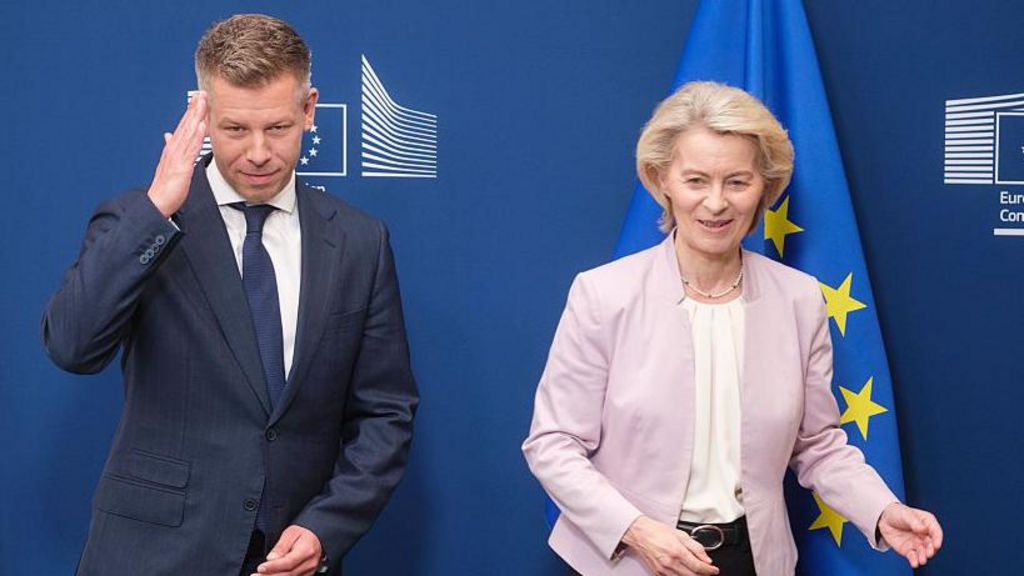
Less than three weeks after taking office following a landslide electoral victory over long-time incumbent Viktor Orbán, Hungary’s new prime minister Péter Magyar has secured a landmark agreement with the European Union that will release €16.4 billion in previously frozen bloc funding, contingent on Budapest delivering a series of long-delayed governance and anti-corruption reforms.
European Commission President Ursula von der Leyen announced the deal after meeting with Magyar, framing the agreement as a tangible vote of confidence in Hungary’s new political direction. She praised the incoming administration for sending clear, strong signals of change to the European community, noting that a perceptible “wind of change” is already sweeping across the Central European nation after years of strained relations between Brussels and Orbán’s nationalist Fidesz government.
The full €16.4 billion package splits into two core tranches: €10 billion from the EU’s Covid-19 economic recovery fund, which Magyar’s administration had raced to unlock before an approaching August deadline, and an additional €6.4 billion from EU cohesion funds earmarked for improving Hungary’s economic and social infrastructure. The funding had been frozen by Brussels for years over widespread allegations of democratic backsliding and systemic corruption during Orbán’s 12-year tenure. Unlocking these funds was the central campaign pledge of Magyar’s relatively new Tisza Party in last month’s parliamentary election, which the party won with a two-thirds legislative supermajority.
Von der Leyen emphasized that the agreement came after Magyar’s government rebuilt fractured trust between Budapest and Brussels, adding that the EU would not cut corners on holding the new administration accountable for meeting its reform commitments. She highlighted concrete early steps already taken by Magyar’s team that demonstrate a clear break from Orbán-era policies: Hungary has now joined the European Public Prosecutor’s Office, revised controversial public procurement legislation, and opened a review of the so-called public interest trusts that Orbán’s government used to transfer public institutions including hospitals and universities to the control of loyalist allies.
“We can already see strong signals that Hungary is turning the page,” von der Leyen said, confirming that Hungarian university students will also regain full access to the EU’s Erasmus student exchange program. The program had been suspended for Hungarian institutions in 2022 after Orbán’s government brought more than 20 universities under the control of the politically aligned public interest trusts.
Magyar framed the agreement as a “historic breakthrough” for Hungary, noting that the total funding equals 13% of the country’s entire annual state budget. Just two days before the announcement, he acknowledged, there was no guarantee a final deal could be reached, with negotiations only launching a few weeks prior to the final agreement.
The prime minister outlined that the funding will be directed to core public sectors: €1.5 billion will go toward upgrading Hungary’s national electricity grid with a focus on expanding solar and wind energy capacity, while €2 billion will be allocated to purchasing new intercity passenger trains. The remainder will support improvements to healthcare, education, and transport infrastructure across the country.
In a sharp rebuke of his predecessor, Magyar accused Orbán of lying to the Hungarian public for years about the root cause of the frozen funding. “The real reason was that corruption was at an incredible rate in Hungary,” he said, adding that his administration had long proven that restoring EU funding only required committing to targeted anti-corruption rules and measures to end systemic cronyism. “These steps and just a few weeks were enough to conclude a political agreement about these incredibly important funds,” he added.
The deal comes as Orbán’s political future hangs in the balance. The former prime minister stepped down from his parliamentary seat last month and has announced plans to rebuild Fidesz ahead of a party congress in June that will decide whether he retains his position as party chairman. However, his path to a return to the premiership appears effectively blocked: last week, Tisza, leveraging its two-thirds legislative majority, tabled a constitutional amendment that would cap a prime minister’s total tenure at eight years, a rule that would bar Orbán from holding the office again even if his party returns to power.