A new organized Eritrean opposition movement targeting the long-standing government of President Isaias Afwerki has set up one of its key international coordination hubs in a southern Tel Aviv warehouse, according to an exclusive investigative report from Israeli newspaper Haaretz.
Calling itself Brigade Nhamedu, the group says it is building a unified global political structure to mobilize the large community of Eritrean exiles scattered across the world, with the end goal of returning to Eritrea to dislodge Afwerki’s administration. The movement recently held a global vote that brought together Eritrean diaspora communities across 17 countries to select a 51-member international governing council. Approximately 1,300 Eritreans based in Israel cast their ballots last month in the central Israeli city of Nes Ziona, as part of that electoral process. Since the council’s formation, it has held weekly virtual and in-person sessions to map out strategy, covering everything from fundraising and diplomatic outreach to plans for establishing a forward operating base in neighboring Ethiopia and maintaining secure communication with dissident activists inside Eritrea, the report confirms.
Brigade Nhamedu is headed by veteran Eritrean dissident Beyene Gerezgiher, who operates out of Ethiopia’s capital Addis Ababa, with specialized departments covering finance, diplomatic engagement, community organizing, and military planning already structured within the movement. “Behind us are masses of people ready to fight for their country,” Gerezgiher told Haaretz in an interview, adding that the movement already has embedded sources inside Eritrea, including among senior civilian government and military officials. Haaretz noted that it could not independently verify this claim of insider access. Gerezgiher also emphasized broad public discontent within Eritrea, stating “We know the masses are waiting for us, especially in Asmara,” Eritrea’s capital city.
The emergence of this organized opposition base on Israeli soil comes amid a sharp downward spiral in diplomatic relations between Asmara and Tel Aviv. The two countries established formal diplomatic ties immediately after Eritrea gained independence from Ethiopia in 1993 – the same year that Afwerki was evacuated to Israel for life-saving medical treatment after contracting severe cerebral malaria. But relations have cooled steadily over the decades, culminating in Israel’s decision to close its embassy in Asmara in 2022.
In an interview with Middle East Eye earlier this month, Eritrean Foreign Minister Osman Saleh clarified that Asmara had deliberately chosen to cut formal ties with Israel. “We decided we didn’t want their [Israeli] embassy here,” Saleh said. “We are not antagonistic to Israel, but we just decided we didn’t want any relations.” He also questioned Israel’s expanding strategic ambitions in the Horn of Africa, particularly its growing security and economic partnership with the breakaway region of Somaliland. “We have to ask why Israel is running to control the Horn of Africa. Why do they need a base in Somaliland?” he asked. A separate anonymous senior Eritrean official told Middle East Eye that Asmara rejected a 2016 request from the United Arab Emirates to build a shared Israeli-Emirati military facility on an island in Eritrea’s Dahlak Archipelago.
Afwerki, now 82 years old, has held uninterrupted power in Eritrea since independence in 1993. The country has not held a national election in nearly three decades, its post-independence constitution has never been enacted, and all independent domestic media outlets have been shut down by the government. The regime’s policy of indefinite compulsory national service is widely documented as the primary driver of mass emigration, with an estimated two million Eritreans now living as refugees or asylum seekers outside their home country. Brigade Nhamedu’s core organizing strategy centers on uniting these fragmented diaspora communities into a cohesive political force capable of challenging the Asmara government.
Two Eritrean exiles who have built new lives in Israel lead the movement’s operations in the country: Atakliti Abraham Michael and Mulue Sultan. Michael told Haaretz that his dissident activism has already had devastating personal costs for his family, who remained in Eritrea after he fled. One of his sons was imprisoned for two years before successfully escaping Eritrea, he said, while his 14-year-old youngest son remains in state detention and is set to be conscripted into the military once his sentence is completed. “First of all, I’m fighting to get back to my children,” Michael said. “We have our national story, but each person also has his own personal story.” Sultan, who arrived in Israel as an asylum seeker in 2008, added that even Eritreans who have established stable lives abroad overwhelmingly hope to return home once the political situation changes. “No one wants to be a refugee forever, everyone wants to go home,” he said.
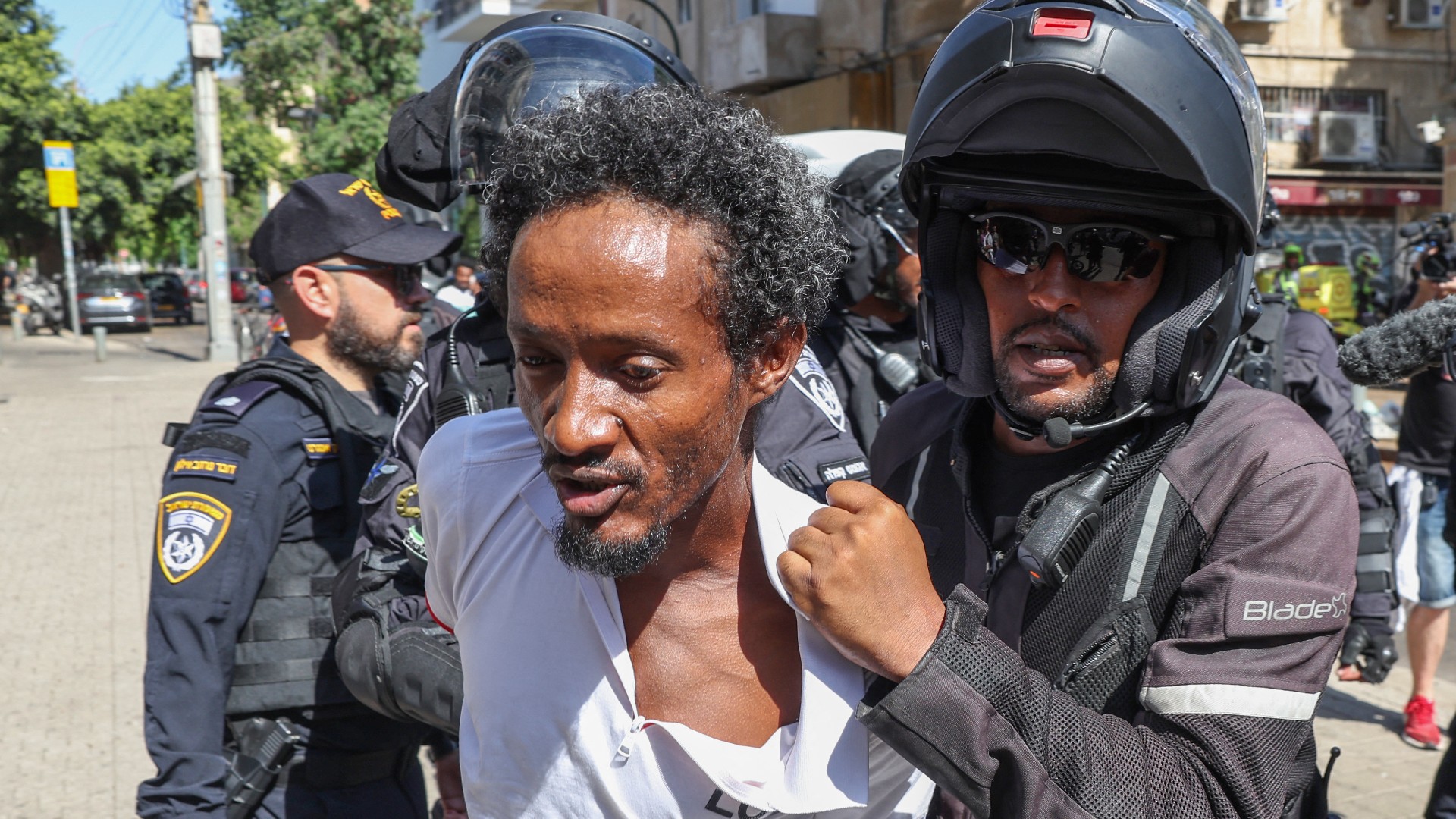
Brigade Nhamedu rose to global prominence following a wave of violent confrontations between pro-government and opposition Eritrean communities across multiple countries over the past two years. In September 2023, large-scale clashes broke out in Tel Aviv around a pro-government event organized by the Eritrean embassy. A May 2025 United Nations report cited by Haaretz records that at least nine Eritreans, from both the pro- and anti-government camps, have been killed in violent clashes within Israel since that incident.
Dawit Teferi, Brigade Nhamedu’s Washington-based finance director, said the movement did not anticipate the outbreak of violence and regrets the loss of life. He added, however, that the clashes exposed the depth of political anger among Eritreans abroad and accelerated efforts to build a formal, structured opposition movement. Teferi has already traveled to Washington to court support from members of the U.S. Congress and senior Biden administration officials, arguing that the U.S., Israel, and Gulf Arab states all have clear strategic interests in backing a new friendly government in the strategically located Red Sea nation.
Gerezgiher acknowledged that informal outreach to Western and regional powers has not yet resulted in official recognition for the movement, and stressed that Brigade Nhamedu cannot achieve its goals without sustained international backing. He confirmed that the movement has not yet recruited a armed fighting force, but is actively preparing for a moment when it can enter Eritrea to confront the government. “We’re ready for the right moment,” he said. “And I think we’re close to it. Very close.”