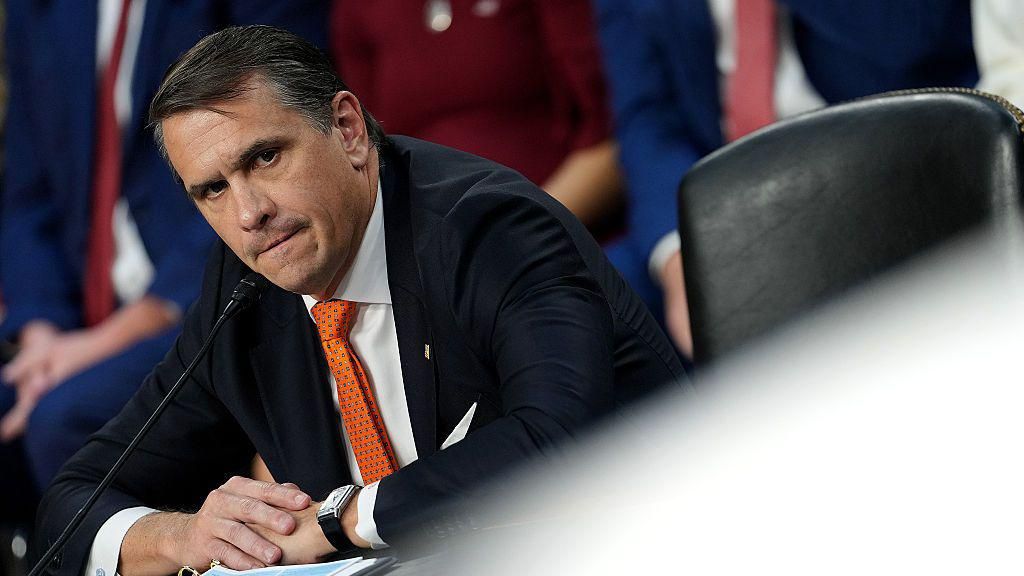
Acting United States Attorney General Todd Blanche faced his first round of Senate confirmation questions this week, as he vies for a permanent appointment to the nation’s highest law enforcement role. The hearing came on the heels of a series of political upheavals: former AG Pam Bondi was dismissed by President Donald Trump amid widespread backlash over the Justice Department’s handling of the Jeffrey Epstein document release, and a federal judge had just voided a controversial tax settlement between Trump, his business empire and his family, and the Internal Revenue Service (IRS) a day before Blanche took the hot seat. Throughout the session, lawmakers from both parties pressed Blanche on three core contentious issues: his longstanding professional ties to Trump, the fate of the scrapped IRS settlement, and ongoing missteps in the Epstein files release. Below are the five most significant moments from the high-stakes hearing.
First, Blanche addressed persistent questions over whether he would maintain independent control of the Justice Department, separate from the political interests of the president who appointed him. Ahead of the 2024 election, Blanche served as Trump’s personal defense attorney in three of the four major criminal cases the former and now current president faced, including leading the legal team during Trump’s high-profile New York hush-money criminal trial. Trump has openly pledged to exact “retribution” against his political opponents during his second term, and has repeatedly pressured the Justice Department to pursue prosecutions against high-profile critics, including former FBI Director James Comey and New York Attorney General Letitia James. When Louisiana Republican Senator John N. Kennedy, a generally loyal ally of the Trump administration, asked Blanche if he counted Trump as a personal friend, the acting AG pushed back. “I’m his lawyer — was his lawyer. And now I’m the deputy attorney general,” Blanche said. “I met him as his criminal defence attorney, I’m not sure there’s very many people who have ever had a criminal defence attorney who calls that person their friend.”
Second, Blanche committed that a controversial provision of the now-voided IRS settlement would never go into effect. The struck-down deal included two contentious terms: full immunity from future IRS audits for Trump, and the creation of a $1.7 billion (£1.2 billion) “anti-weaponisation fund” designed to compensate individuals who claim they were unfairly targeted by government agencies. The proposal sparked bipartisan outrage on Capitol Hill, with lawmakers from both major parties demanding answers on whether the fund would move forward even after the judge’s ruling. Republican Senator Mike Lee pressed Blanche to confirm the fund would be scrapped entirely, asking: “You have no reason to believe that the so-called weaponisation fund will continue because of the settlement, agreement, is that correct?” Blanche responded clearly: “I am confident it will not.” Fellow Republican Senator Thom Tillis went further, demanding the administration issue formal written confirmation that the initiative was permanently abandoned.
Third, Blanche publicly apologized to survivors of Jeffrey Epstein for redaction errors in the release of the late convicted sex offender’s case files, the most politically explosive issue facing the Justice Department since Trump returned to office. After massive public pressure, Congress ordered the Justice Department to release more than six million pages of internal documents from the federal investigation into Epstein’s crimes. But the slow pace of release and overly broad redactions have drawn fierce criticism from lawmakers and survivors alike, with a dozen survivors attending Wednesday’s hearing wearing shirts printed with images of the heavily redacted files to protest the department’s handling of the process. Senate Judiciary Committee Chairman Chuck Grassley, the panel’s top Republican, pressed Blanche on multiple failures: “problematic redactions”, “insufficient effort” on following unclosed investigative leads, refusal to meet with survivors, and the controversial recent transfer of Epstein’s accomplice Ghislaine Maxwell to a lower-security prison. Blanche argued that processing millions of documents in a compressed timeline was a “Herculean task”, noting that his team reviewed six million pages to apply what they deemed appropriate redactions. He did, however, acknowledge mistakes: “There were mistakes that were made, and so approximately 1% of the redactions had to be fixed. We had dozens of lawyers on call.” When Democratic Senator Richard Blumenthal asked if he would apologize directly to survivors for the department’s missteps, Blanche agreed. “I will absolutely say that any mistake that we made should not have been made,” he said. “And I very much … I very much apologise.”
Fourth, Blanche broke with Trump on a key constitutional question, confirming that Trump is ineligible to run for a third presidential term in 2028, a position that contradicts open speculation from Trump and some of his allies. The 22nd Amendment to the U.S. Constitution explicitly bars any person from being elected president more than twice. When Democratic Senator Chris Coons of Delaware asked Blanche, a trained lawyer, to rule on the question of constitutional eligibility, Blanche gave a straightforward answer: “I don’t believe he is, no.” Trump has previously said he would “love” to seek a third term, though he has ruled out running for vice president as a constitutional loophole, and has publicly praised top potential 2028 Republican contenders Vice President JD Vance and Secretary of State Marco Rubio as suitable successors.
Fifth, the hearing saw flashes of the aggressive courtroom style Blanche honed as Trump’s defense attorney, even as he adopted a generally more measured tone than his predecessor Bondi, who repeatedly clashed with lawmakers during her own congressional appearances. While Blanche mostly responded to sharp questioning with technical, lawyerly answers, he pushed back hard against two Democratic senators over their lines of questioning. When Rhode Island Senator Sheldon Whitehouse asked about FBI Director Kash Patel’s professional fitness for the role, Blanche retorted: “That’s an extraordinarily obnoxious question, Senator.” Later, he clashed with New Jersey Senator Cory Booker, who interrupted Blanche mid-answer during questioning about the department’s review of the proposed mega-merger between media giants Paramount and Warner Bros. Discovery. “You don’t even let me answer, man,” Blanche exclaimed, with the rest of their exchange remaining tense.
Going into the next phase of the confirmation process, most Republican committee members appear ready to back Blanche’s nomination despite lingering criticism of his handling of the Epstein files. Tillis, who was seen as the most undecided Republican on the committee, signaled he would likely support Blanche after receiving confirmation the anti-weaponization fund would not move forward. The only remaining question mark is Texas Republican Senator John Cornyn, another skeptic who has not yet signaled his position. The Senate Judiciary Committee will hold a vote in the coming days to decide whether to advance Blanche’s nomination to the full Senate, where the entire chamber will cast a final vote on whether to confirm him as the permanent attorney general.