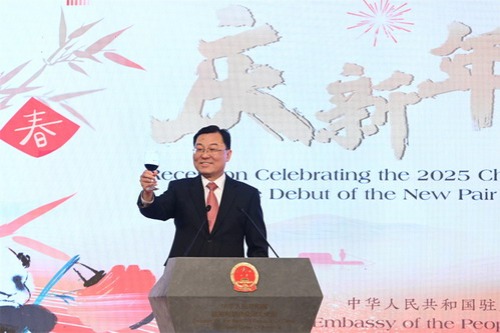
In a significant diplomatic address, China’s Ambassador to the United States Xie Feng has issued a compelling call for Washington to fundamentally reassess its strategic approach toward Beijing. Speaking at a Chinese New Year reception attended by nearly 700 dignitaries, including Republican Senator Steve Daines, House representatives, and White House officials, the ambassador challenged prevailing American political narratives that frame China as an inevitable adversary.
The ambassador’s remarks came against the backdrop of recent high-level diplomacy, including a phone conversation between President Xi Jinping and President Donald Trump that Ambassador Xie characterized as instrumental in ‘recalibrating’ bilateral relations. He emphasized that head-of-state diplomacy serves as the ‘compass and anchor’ of the relationship, providing crucial strategic guidance that has maintained overall stability despite periodic tensions.
Central to Xie’s address was the argument that zero-sum competition represents a dangerous anachronism in contemporary international relations. He articulated that stabilizing Sino-American relations in 2026 requires nothing less than a paradigm shift in strategic perception—from viewing China’s development as a threat to American prosperity to recognizing it as a positive contribution to global stability. ‘During the tariff war,’ Xie noted, ‘many American friends found upon further reflection that China-US cooperation not only is indispensable for both our countries but also brings precious stability and certainty to a turbulent world.’
The ambassador identified Taiwan as the ‘first red line that must not be crossed,’ reiterating China’s unwavering commitment to the One-China principle as enshrined in the three Sino-US Joint Communiques. He warned that the primary threat to cross-strait peace originates from ‘Taiwan independence’ separatist activities and dangerous provocations, while urging Washington to faithfully honor its diplomatic commitments.
Striking an optimistic note, Xie highlighted emerging positive trends in American public sentiment, citing a Chicago Council on Global Affairs poll indicating 53% of Americans favor friendly cooperation with China—a preference particularly pronounced among younger generations. He pointed to contemporary cultural exchanges including ‘pickleball diplomacy’ and the viral ‘Becoming Chinese’ social media trend as evidence of deepening people-to-people connections.
The ambassador specifically referenced President Xi’s ‘50,000 in Five Years’ initiative to bring American youth to China, while noting the overwhelming popularity of China’s 240-hour visa-free transit policy for US citizens. In a reciprocal appeal, Xie called on Washington to remove administrative ‘bottlenecks’ in visa processing, border entry, and direct flight availability to facilitate greater interpersonal exchange.
Looking forward, the ambassador outlined a dual-track framework for cooperation—strengthening traditional economic ties while expanding collaboration on emerging global challenges including artificial intelligence, biomedicine, and law enforcement areas such as counternarcotics and combating transnational crime. The reception culminated in a special concert blending Eastern and Western musical traditions, symbolizing the potential for harmonious cultural integration.