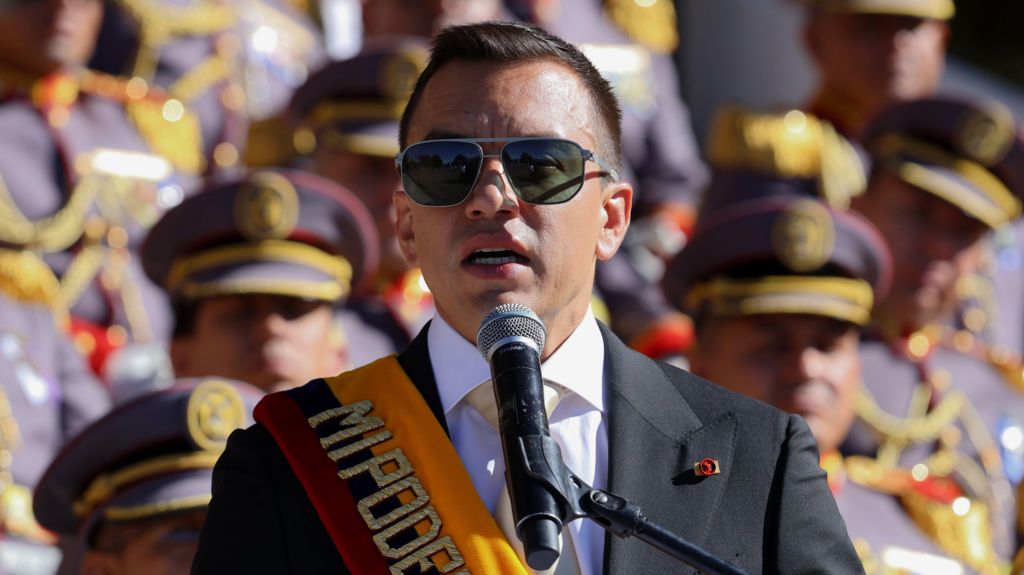
As Colombia prepares to select a new president in Sunday’s highly contested general election, a major diplomatic dispute has erupted between Bogotá and Quito, after Colombia’s foreign ministry formally accused Ecuadorian President Daniel Noboa of deliberate interference in the country’s domestic democratic process.
The controversy centers on a meeting Noboa held Friday with right-wing Colombian presidential candidate Abelardo de la Espriella, during which Noboa announced he would roll back all tariffs on Colombian imports starting June 1. Noboa framed the conversation as a dialogue with an incoming administration, claiming the pair had secured formal agreements on bilateral trade coordination and cross-border security cooperation, including the repatriation of Ecuadorian fugitives hiding in Colombian territory.
Colombia’s foreign ministry rejected Noboa’s framing of the tariff rollback as a goodwill gesture in a Saturday statement, calling the action blatant meddling that violates core international principles of state sovereignty and non-intervention. “This interference by a foreign leader in the democratic process of another nation is a clear violation of non-intervention norms, a direct threat to our national sovereignty, and an attack on our democratic system,” the statement read.
The origins of the tariff dispute stretch back to January 2026, when Ecuador began progressively implementing import tariffs on Colombian goods, arguing that Bogotá had failed to effectively secure their shared 700-kilometer border. Ecuador’s strategic location, wedged between Colombia and Peru — the world’s two largest cocaine producers — has turned the country into a major transit hub for illicit drug shipments, making cross-border cartel activity a top political priority for Noboa’s administration. The Petro government in Bogotá has denied the border security allegations and previously retaliated with reciprocal economic measures after the tariffs were first imposed.
Sunday’s election comes at a moment of deepening political polarization in Colombia, after the election of left-wing President Gustavo Petro, the first leftist head of state in modern Colombian history, broke decades of dominance by centrist and conservative technocratic leadership. Petro is constitutionally barred from seeking re-election, and the race has narrowed between his chosen successor, left-wing candidate Iván Cepeda, and de la Espriella, the leading right-wing contender. Most pre-election polling puts Cepeda narrowly ahead, but no candidate is projected to win an outright majority on Sunday, forcing a run-off vote scheduled for June 21.
The election outcome is expected to reshape Colombia’s international alliances and its national strategy to combat rising gang-related violence, which has reached multi-decade highs across the country. Cepeda has pledged to continue Petro’s flagship “total peace” policy, which seeks negotiated political settlements with armed insurgent and drug-trafficking groups, though the talks have stalled in recent months as violence has reignited across rural and urban areas. By contrast, de la Espriella and other right-wing candidates have promised a full military crackdown on cartels, mirroring the hardline approach Noboa has adopted in Ecuador. Noboa deployed 75,000 police officers to Ecuador’s four most violence-plagued provinces in March, but the policy has so far coincided with a sharp spike in the country’s national murder rate.
The diplomatic row also lays bare deep ideological divides across Latin America. Noboa is a close ideological and political ally of U.S. President Donald Trump, and has joined the U.S.-led regional alliance targeting transnational drug cartels. Petro, by contrast, has had repeated high-profile clashes with the Trump administration over issues including drug policy and U.S. intervention in the region. Following the U.S. capture of former Venezuelan President Nicolás Maduro in January 2026, Petro remains one of the few remaining left-wing leaders in the region unaligned with the Trump administration’s ideological agenda.
Both Trump and Petro have publicly acknowledged the possibility of U.S. military intervention in Colombia after Trump revived the Monroe Doctrine, claiming the U.S. should hold sole decision-making power over Western Hemisphere affairs. Trump has since shifted his focus to Cuba, openly discussing plans to topple the country’s communist government, which he has claimed is “ready to fall”.
Colombia’s election campaign has already been marred by violence: one candidate was assassinated in a shooting last summer, and last week de la Espriella addressed a rally in Medellín while standing behind bulletproof glass, a stark reminder of the security risks facing candidates. While Cepeda has echoed Petro’s stance that Colombia should not become a “vassal state” to the U.S., observers note that long-standing bilateral anti-drug cooperation between the two nations has persisted even through the height of diplomatic tensions between the Petro and Trump administrations.