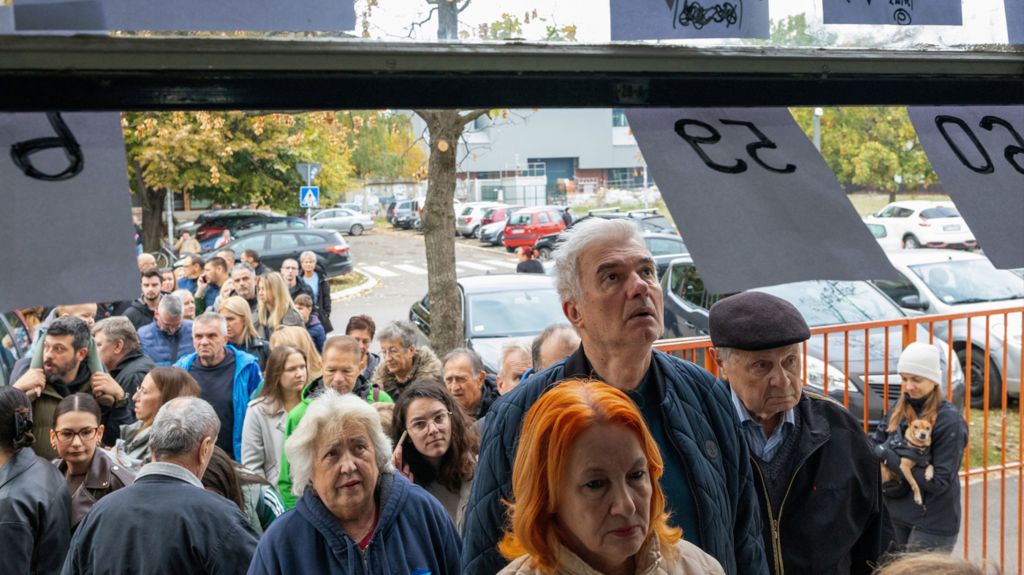
Voters across Serbia and its global diaspora turned out in unprecedented numbers on election day, as a youth-driven anti-corruption movement mounted a formidable bid to end the 12-year grip of right-wing populist Aleksandar Vučić and his Serbian Progressive Party (SNS) on national power. By 2 p.m. local time, preliminary official data showed 46% of registered electors had already cast their ballots – nearly 1 million more voters than the midday turnout recorded during the country’s December 2023 parliamentary poll, putting the nation on track for one of the highest participation rates in its democratic history. The snap election was called by Vučić earlier this year, against a backdrop of two years of sustained mass student protests sparked by the 2024 deadly canopy collapse at a Novi Sad train station that killed 16 people. The tragedy became a widely cited symbol of systemic official corruption, gross negligence and state capture by ruling party loyalists, galvanizing broad public anger that coalesced into the grassroots Student List opposition coalition. The movement’s policy platform centers on rooting out officials who authorized violent crackdowns on peaceful demonstrators, ousting partisan appointees from the leadership of all state-owned enterprises, and stripping the country’s public broadcaster of long-documented political interference. Vučić and the SNS have repeatedly rejected all allegations of corruption and deliberate manipulation of national media outlets. Long queues snaked outside polling stations from Serbia’s largest urban hubs including Belgrade and Novi Sad to small rural towns, as well as at overseas voting sites in Ljubljana, Munich, Los Angeles, Chicago and Paris, where voters waited for hours in heavy rain to cast their ballots. Local media analysts note that a final turnout rate of 65% or higher would strongly favor the Student List’s electoral prospects, as the movement has mobilized large numbers of young, first-time voters who historically sat out previous elections. Polls are scheduled to close at 8 p.m. local time, with partial preliminary results expected to be released roughly two hours after voting concludes. Tensions ran high across the capital on election day, with police sealing off streets surrounding the headquarters of the Republic Electoral Commission. Nearby, drivers waiting at traffic lights rolled down their windows to blast the popular folk anthem “I Want Three Kisses” – a deliberate reference to the Student List’s third position on the national ballot, prompting groups of young passersby to dance in the streets in celebration of their civic engagement. Vučić, who served two consecutive terms as Serbia’s president and is constitutionally barred from running for a third, is leading the SNS campaign in a bid to return to the prime minister’s post he vacated in 2017. The long-time leader retains a loyal base of support among large segments of the electorate, who credit him with delivering over a decade of steady economic growth, sweeping national infrastructure upgrades, and a pragmatic foreign policy that balances Serbia’s bid for European Union membership with a refusal to impose sanctions on Russia over its ongoing invasion of Ukraine. His campaign pledges include across-the-board hikes in public sector salaries and state pensions, plus expanded investment in the country’s public healthcare system. SNS campaign posters plastered across urban centers feature imagery of clasped hands belonging to healthcare workers, farmers, construction laborers, educators and parents, with Vučić’s campaign messaging framing the party as the force of stable, proven continuity for the nation. In response to widespread public concerns over potential electoral fraud by the ruling party, the Student List has deployed no fewer than two independent election observers to every one of Serbia’s 8,210 domestic polling stations. Multiple unverified videos circulating on social media on Sunday morning purported to show instances of pre-filled ballot papers – a practice commonly referred to as “chain voting” – being prepared in a private cafe in the southern city of Niš, which staff quickly hid after noticing they were being filmed. There have also been scattered verified reports of physical assaults on independent election monitors and accredited journalists at several polling locations across the country. “We are witnessing a completely unique experiment in contemporary European political history,” former Serbian deputy prime minister and long-time anti-nationalist opposition figure Žarko Korać told the BBC. The Student List’s 250 parliamentary candidates were selected directly by student-led assemblies at the country’s public university faculties, rather than through traditional party nomination processes, and include doctors, actors, academics, professional athletes and civil society leaders, headed by Novi Sad University professor Ilija Srdanović. “These are people who largely do not know each other, and the wider public has little clarity on their individual political stances, so there is huge uncertainty over whether they could form a functional governing cabinet if they secure a majority,” Korać explained. “On the other hand, if Vučić claims a late-night victory this evening, I am fully convinced the student movement will refuse to accept that outcome as legitimate.” Korać also warned that a razor-thin contested result, with both camps declaring themselves the rightful winners, could trigger weeks or even months of prolonged political instability, noting that many mid-ranking SNS loyalists currently in senior state positions may defect to the opposition if preliminary results point to a Student List win. Additional concerns have been raised about the reliability of Serbia’s electoral register, which lists 6.45 million registered voters in a country with a total national population of just 6.53 million, with voting rights extended to ethnic Serb residents of Kosovo and dual Serbian citizens living in neighboring Bosnia and other regional states.