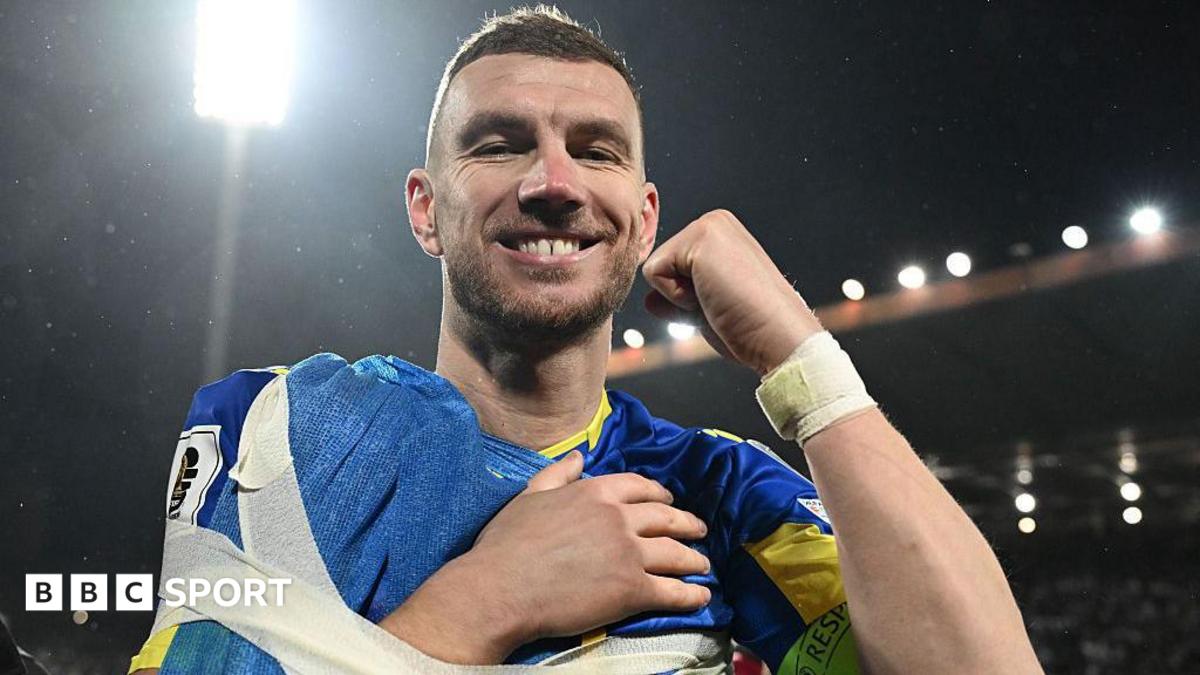
For 40-year-old football legend Edin Dzeko, a career brimming with silverware—including two Premier League titles won with Manchester City, plus honours earned across stints with Inter Milan and Wolfsburg—may end up being remembered most for a quiet, iconic moment of grit: immediately after Bosnia-Herzegovina knocked Italy out on penalties to secure only the second World Cup qualification in the nation’s history, Dzeko celebrated gently, his arm strapped in a sling from injury.
That image, observers say, encapsulates everything Dzeko has stood for across nearly two decades carrying the hopes of a nation still healing from the devastating scars of the 1990s Bosnian War. “His career is connected to the country’s own image—resilience, persistence and proving people wrong,” explains Bosnian journalist Sasa Ibrulj. Drawn into an even 2026 World Cup group alongside Canada, Switzerland and Qatar, Dzeko’s final tournament as a player is poised to open an exciting new chapter for Bosnian football.
Dzeko’s own story of survival begins amid the chaos of war. When the Bosnian War broke out in 1992, he was just six years old. Around 80,000 Bosnian Muslims lost their lives in the conflict, and the Srebrenica Genocide—perpetrated by Bosnian Serb forces—stands as the worst mass killing in Europe since the Holocaust. Dzeko’s family stayed in Sarajevo through the nearly four-year siege, where Serbian snipers targeted civilian residents including children. After their family home was destroyed, Dzeko moved in with his grandparents, cramming 15 family members into a 35-square-meter apartment. “It was very hard. We were stressed every day in case somebody we knew died,” Dzeko recalled in a past interview with The Guardian. As a young boy, he often played football on a local pitch—one day his mother forced him to stay home, a decision that saved his life: a shell struck the pitch that same day, killing several children playing there.
After the war ended, Dzeko launched his professional career at local Sarajevo club Zeljeznicar, where he was underestimated early on. His lanky frame earned him the local nickname “Kloc”, meaning “lamp-post”, and club executives jumped at the chance to sell him to Czech side Teplice for just €25,000. What followed was a historic top-flight career: Dzeko became the first player in history to score at least 50 goals in the Premier League, Bundesliga, and Serie A. Even as he rose to global superstardom, he never turned his back on his roots. He has donated repeatedly to fund renovations at Zeljeznicar, and became Bosnia’s first UNICEF ambassador in 2009. “People remember that he did not come from privilege or from a powerful football system,” Ibrulj says. “What makes him different is that people in Bosnia have never experienced him as distant or untouchable.” Mirza Trbonja, a close friend of Dzeko’s, told AFP that the star never turns down autographs or photos: “When he comes, you need a lasso to catch 10 minutes with him. When someone asks him for a photo or autograph, he never refuses.”
Dzeko made his senior international debut in 2007, and today holds Bosnia’s all-time records for caps (148) and goals (73). After devastating play-off defeats to Portugal for the 2010 World Cup and Euro 2012, Dzeko led Bosnia to qualification for their first major international tournament as an independent nation, the 2014 World Cup in Brazil. That tournament marked the high point for Bosnia’s “golden generation”, with more play-off heartbreak following for Euro 2016, 2020, and 2024. Twelve years after that first historic qualification, Bosnia finally exorcised their play-off demons: after overturning deficits against both Wales and Italy to win both knockout ties on penalties, the nation secured its return to the world’s biggest football stage.
Ibrulj notes that the 2026 qualification carries even more emotional weight than the 2014 breakthrough. “2014 felt historic because it was the first generation that truly gave Bosnia international sporting legitimacy after independence,” he says. “This second qualification feels even heavier emotionally. Bosnia spent more than a decade failing to return, and over those years there was disappointment, pessimism, and a growing feeling that the country had missed its moment. For many younger supporters, this is the first team that feels like their team in the same way older generations emotionally belonged to the side of Dzeko, Miralem Pjanic and Emir Spahic.”
For Bosnian musician Alen Dokic, who released an official 2026 World Cup song under his alias Doppelganger, the qualification is a perfect example of “Bosanski Inat” — a deeply rooted cultural spirit of defiance and overcoming hardship. “Never forget, never forgive – this is one of the mottos that reminds us who we are, what we have been through, and how resilient we Bosnians are,” Dokic says. Dokic, born in Rome to Bosnian parents, is part of a global Bosnian diaspora that numbers as many as two million people, a connection that is reflected in head coach Sergej Barbarez’s 2026 World Cup squad: 17 of the 26 squad members were born outside of Bosnia-Herzegovina, raised across the globe but united by their choice to represent their ancestral nation.
“It’s a unique dynamic of players growing up all over the world but coming back to represent Bosnia,” says former Bosnia goalkeeper Asmir Begovic. One shining example is 21-year-old Esmir Bajraktarevic, who scored the decisive penalty against Italy that booked Bosnia’s spot at the tournament. Bajraktarevic was born and raised in Wisconsin, after his parents fled the Srebrenica genocide. “That common interest, common goal, the passion of representing Bosnia plays a big role. What the country has been through, there’s still lingering effects from the conflict and the past. When everyone comes together in Bosnia, it’s a pretty unique feeling and really special. For a country so small to compete at this stage is a really big thing,” he says.
In the hours after the play-off win over Italy, thousands of Bosnian fans flooded the streets of Sarajevo, celebrating long into dawn. Ibrulj explains that these moments of shared national joy carry unique weight for a country still fractured by political division, economic instability, and the unhealed shadow of war. Even with limited investment in sporting infrastructure for a population of just three million, the future of Bosnia’s national team looks bright — and it feels only fitting that Dzeko, the man who has been a constant through decades of change, will captain the side as they enter this new era.
“In a country where people often struggle to trust institutions, figures like that become larger than sport itself. For younger players he became a constant. Coaches changed, federations changed, generations came and went, but Dzeko remained there,” Ibrulj says. When a video of Italian players reportedly celebrating getting to face Bosnia instead of Wales in the play-off final went viral before the decider, Dzeko once again showed the quiet leadership that has defined his career: he urged Bosnian fans to respect the Italian national anthem ahead of kickoff, reminding supporters that Italy was the first national team to visit Bosnia after the war.
“He is someone who has big pressure and expectation on him. He galvanises everybody. When I played with him he certainly wasn’t the most vocal of leaders but he definitely led by example and I think a lot of people fed off that,” Begovic says. Far from being at the tournament to simply make up the numbers, Dzeko has already proven he still has a critical role to play: he scored a late equaliser against Wales to force the penalty shootout, then set up Bosnia’s equaliser against Italy to send that tie to penalties as well. The 40-year-old says even he never expected to still be playing at the top level at his age: “I didn’t think I would be playing at 40 – 10 years ago I would’ve said ‘no’, but I’m listening to my body and doing a lot of work before and after training to help my body. I am so happy I can do it [go to the World Cup]. It is so amazing for the young players. They don’t know it yet, but it will change their lives for sure.”
Bosnia’s 2026 World Cup campaign kicks off this Friday against co-hosts Canada, kicking off what is already the most emotional chapter in the nation’s modern football history.