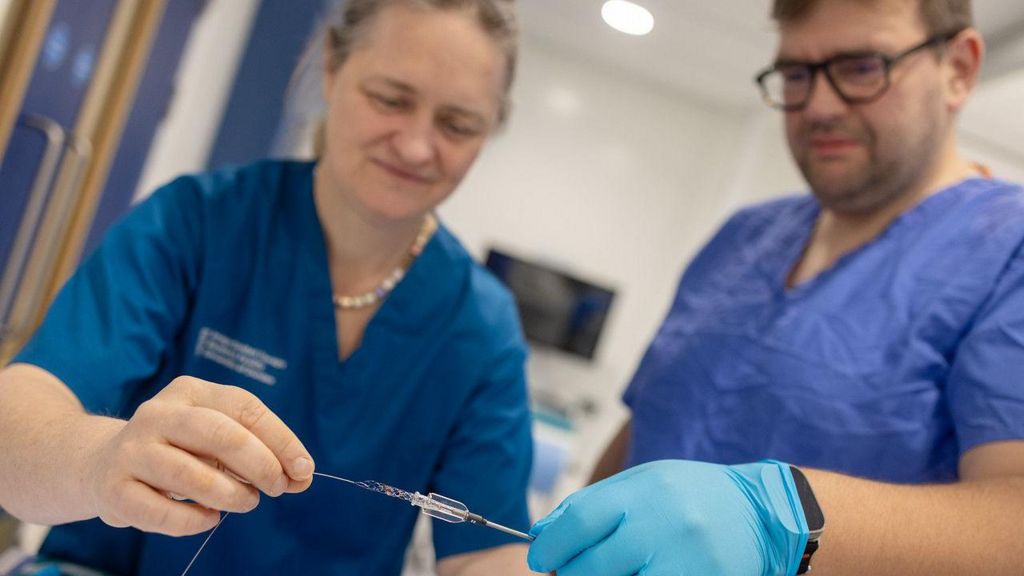
In a groundbreaking medical achievement, doctors from Scotland and the United States have successfully completed what is believed to be the world’s first remote stroke procedure using robotic technology. The pioneering procedure, known as a thrombectomy, involves the removal of blood clots from stroke patients. Led by Professor Iris Grunwald of the University of Dundee, the team performed the surgery on a human cadaver donated to medical science. Prof. Grunwald operated from Ninewells Hospital in Dundee, while the cadaver was located at the university’s facility across the city. Hours later, Dr. Ricardo Hanel, a neurosurgeon based in Jacksonville, Florida, replicated the procedure, performing the first-ever transatlantic thrombectomy on a body in Dundee, over 4,000 miles away. The team utilized robotics developed by Lithuanian firm Sentante, marking a significant leap in remote medical intervention. The procedure, described as a potential ‘game changer,’ could revolutionize stroke care by eliminating geographical barriers to accessing specialist treatment. Prof. Grunwald emphasized the transformative potential of the technology, stating, ‘It felt as if we were witnessing the first glimpse of the future.’ The University of Dundee, a global training center for stroke treatment, is the only UK facility where doctors can practice on cadavers with circulated human blood to simulate live procedures. The experiment involved four cadavers, with human blood used to mimic real-life conditions. The team now aims to proceed with clinical trials in 2026. Stroke treatment is highly time-sensitive, with delays significantly impacting recovery chances. Currently, only a small percentage of stroke patients in the UK receive thrombectomies due to limited access to specialists. This innovation could democratize access to life-saving treatment, particularly for those in remote areas. Juliet Bouverie of the Stroke Association hailed the development as ‘a remarkable innovation,’ highlighting its potential to address inequities in stroke care. The Sentante robotics system, supported by tech giants Nvidia and Ericsson, ensures minimal lag time, enabling precise real-time operations. Dr. Hanel described the 120-millisecond delay as ‘truly remarkable.’ Prof. Grunwald and Sentante CEO Edvardas Satkauskas expressed optimism about the technology’s future, with Satkauskas noting, ‘Sometimes, the future is way closer than we think.’