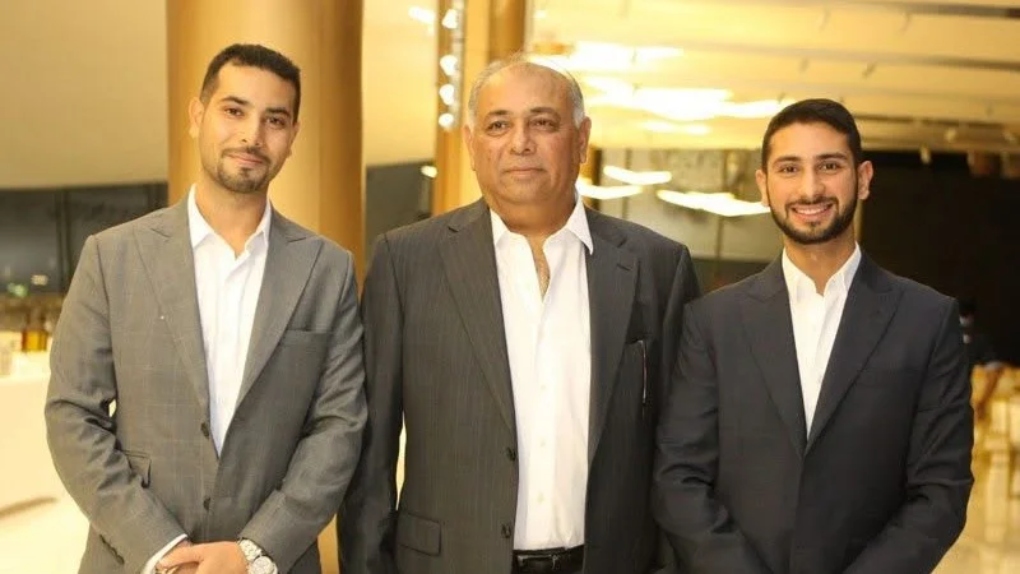
In an exclusive revelation from court documents obtained by Middle East Eye, a Dubai court has removed a travel ban imposed on a British-Pakistani father and son duo previously found liable for conspiracy and deceit in a major UK fraud case, triggering deep anxiety among creditors who fear the pair will flee the United Arab Emirates. British citizens Muhammad Tahir Lakhani and his son Muhammad Ali Lakhani were first held liable for fraudulent misrepresentation at London’s Commercial Court in 2024, over false claims they made to secure a $45 million loan for Astir Maritime, a shipping firm ultimately controlled by the pair and another family member.
The loan, the court heard, was reportedly requested to shore up the family’s ship-recycling operations amid a global trade and market downturn, with the funds earmarked for the purchase of ageing vessels that would later be sold to shipyards for dismantling and resale of parts. The Lakhani pair has already admitted to fabricating explanations for their repeated failure to repay the outstanding debt to lenders, who are led by London-based investment firm Njord Partners Sma-Seal LP. To date, no final settlement has been reached in the case, and the pair has remained based in Dubai, where the Lakhani family has built a decades-long portfolio of shipping and ship-recycling enterprises.
As part of enforcement efforts to recover the unpaid debt, UAE authorities issued a travel ban barring the Lakhanis from leaving the country in 2025. However, court filings confirm that the ban was formally lifted on 26 August this year, following a formal request from the Lakhani family. In their submission to the Dubai court, the pair argued that unrestricted travel was necessary for them to conduct business operations, restructure their financial affairs, and ultimately meet their outstanding repayment obligations to creditors.
This decision has drawn fierce criticism from sources close to the creditor group, who note that the lifting of the travel ban is both concerning and contradictory to the Lakhanis’ own claims. During the period the travel ban was in effect, the family paid $5 million to resolve separate enforcement proceedings, and later offered a lump sum settlement of between $4 million and $5.5 million to address the outstanding 2024 High Court judgment. This track record of transactions, the source argues, directly undermines the claim that travel restrictions prevented the Lakhanis from organizing their finances to settle the debt. Creditors, including institutional stakeholders such as pension fund managers, now fear the pair will use their newly restored freedom of movement to escape to Pakistan, where the Lakhani family has its ancestral roots.
Middle East Eye’s repeated requests for comment from Muhammad Tahir Lakhani, who was born in Karachi, went unanswered, including inquiries about whether he planned to leave the UAE. The family’s Dubai-based legal representative also declined to respond to questions about the case. UK authorities have also maintained silence on the matter: the UK Home Office confirmed it does not comment on individual cases, while the Foreign, Commonwealth and Development Office noted it had not been approached for consular assistance but remained ready to provide support if requested. Sources close to the proceedings confirm that Geraldine McCafferty, the newly appointed British ambassador to the UAE, has been fully briefed on the situation.
The 2024 fraud judgment is not the first legal controversy the Lakhani family has faced in UK courts. In 2020, UK judges issued worldwide asset freezing orders against Tahir Lakhani and his sons after a separate group of lenders accused the family of fraud in connection with other ship-recycling ventures. The 2020 proceedings ultimately resulted in a $77 million judgment awarded to the lenders, which the Lakhanis settled in 2025 for just $5 million, a outcome Tahir Lakhani described as an “amicable” resolution. During the 2020 case, Tahir Lakhani was described in court filings as an “internationally recognised visionary shipping executive”, credited with founding Dubai Trading Agency, the first Middle East-based company to enter the large-scale ship recycling market.
More recently, in 2024 the Financial Times linked one of Lakhani’s companies to Russia’s so-called “shadow fleet” of vessels used to evade Western sanctions imposed over the Ukraine conflict. In response to the reporting, Tahir Lakhani denied any involvement or facilitation of sanctions breaches, and has long positioned himself as a key figure in the development of the UAE as a global maritime hub. His professional biography, published by Thrive Global, the media firm founded by Ariana Huffington, notes he has played a “critical role in advocating the UAE as an essential zonal and global centre for maritime trade and logistics”.
A prominent industry figure, Tahir Lakhani, 63, served as vice chairman of the UAE Shipping Association until 2019. Beyond his shipping career, he has claimed to be the youngest player ever to represent Pakistan in tennis’ Davis Cup, and got his start in the industry as a supervisor at a family friend’s ship recycling yard in Pakistan. He inherited a stake in a Dubai trading business through his marriage to wife Uneza in 1985, before renaming the venture Dubai Trading Agency; by the late 1990s, the firm had grown to become one of the world’s largest ship recyclers, purchasing more than 100 end-of-life vessels annually for cash.
The case has also raised questions about the implementation of the 2021 UK-UAE Illicit Finance Partnership Agreement, a bilateral deal the British government hailed as a landmark effort to crack down on transnational crime, terrorist financing, and illicit money flows between the two nations. In March this year, Democratic Unionist Party MP Jim Shannon formally asked the Home Office to assess how the agreement applies to the Lakhani case, but Security Minister Dan Jarvis declined to comment on individual proceedings while reaffirming the stated benefits of the partnership.
Middle East Eye, which publishes independent coverage of the Middle East, North Africa and global affairs, first obtained the court documents confirming the lifting of the travel ban on an exclusive basis.