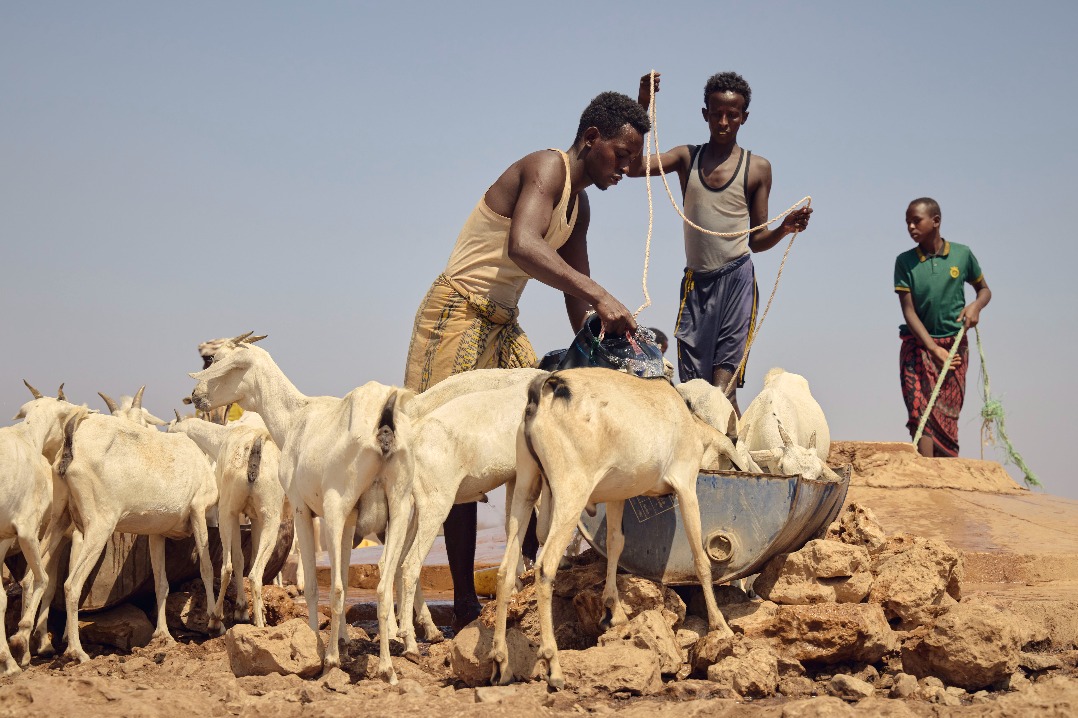
Across the arid landscapes of Somalia, a decades-long climate catastrophe is reaching a catastrophic tipping point, as two consecutive failed rainy seasons have turned chronic drought into a full-scale humanitarian emergency that threatens millions of lives and unravels centuries-old ways of life.
For pastoralist communities like Abdulkadir Mohamed Farah, a 61-year-old herder in Dhusamareb, the capital of central Somalia’s Galmudug state, the crisis is personal and catastrophic. In less than 12 months, he has lost 90% of his goat herd and more than two-thirds of his camels — assets that represent far more than income: for Somali pastoralists, livestock are the foundation of food security, economic stability, and centuries-old cultural identity. “The livestock, both camels and goats, have been lost. Now we fear that people may follow,” Farah said. “The animals are dying. They have nothing to eat. I had 500 goats, only 50 remain. I had 70 camels, 20 are left.”
His story is echoed thousands of miles across the country, including near Dangorayo in northern Somalia’s Nugal region, where 19-year-old Maymun Ali Mohamed recently fled to an internal displacement camp after all her livestock perished. “When I saw the animals dying, I decided to move and stay with relatives. I told myself my young children must not die,” Mohamed explained. For thousands of families across Somalia, displacement has become the only option to survive as water holes dry up and grazing land turns to dust.
New data from humanitarian agencies confirms the scale of the crisis: an estimated 6.5 million Somalis — nearly one-third of the country’s total population — now face acute food insecurity, a jump of 1.7 million people since January 2026, according to the United Nations Office for the Coordination of Humanitarian Affairs, which cited data from the Integrated Food Security Phase Classification. As of late February, 2 million people are already experiencing severe hunger, and projections for 2026 show more than 1.8 million children under five will suffer from acute malnutrition, with nearly 500,000 facing life-threatening severe malnutrition.
“The situation has really been worsening over the past months. It is now reaching catastrophic proportions,” Anukha Combernous, head of operations for the International Committee of the Red Cross in Somalia, told China Daily. What began as an intensifying crisis in northern regions has now spread across the entire country, she added, disproportionately hitting rural pastoralist communities that support more than 60% of Somalia’s total population.
The crisis has piled unprecedented pressure on a Somali health system already crippled by decades of ongoing armed conflict. As mass livestock deaths and dried-up water sources drive rising malnutrition rates, existing health infrastructure cannot keep up with surging demand. “We’re talking about no food, no water, herds of goats, sheep and camels that are dying, rising malnutrition levels, especially among children under five,” Combernous said. “It is extremely difficult for the current health infrastructure to cope with the rising needs.”
Compounding the climate-driven emergency is a crippling global funding shortfall. Combernous noted that last year’s Somalia humanitarian response plan received only 29% of its requested funding, forcing the closure of more than 600 health facilities across the country. Even as needs grow at an alarming rate, restricted funding has cut off access to life-saving nutrition services, healthcare, and clean water for millions of vulnerable people. Active hostilities in several regions of Somalia also continue to block humanitarian access and prevent Somalis from traveling to find water, grazing land, or emergency medical care.
“Funding is insufficient. It has been decreasing over the past years and more significantly also in 2025,” Combernous said. She warned that without urgent, large-scale action, the death toll will rise sharply. “In brief, people will die.” Beyond emergency relief, she emphasized that short-term aid must be paired with long-term investment to rebuild essential public services and strengthen local, community-led systems to reduce long-term dependency on international aid. “Over the last decades, there’s been a trend of dependency on aid. What we need to work on altogether is to find ways of making these systems more sustainable, more autonomous,” she said, calling on the full global community to step up support.
Among international donors, China has recently moved to expand its support for Somalia’s drought response, committing $4.1 million in total humanitarian assistance on March 8. The package includes $2 million in direct cash aid and $2.1 million worth of emergency food supplies, targeted at supporting the millions of Somalis facing severe food insecurity.
“China and Africa share weal and woe in fighting natural disasters and epidemics together. As a good friend and strategic partner of Somalia, China will continue to support Somalia’s disaster relief efforts. China will never be absent when Somalia is in need,” Wang Yu, China’s ambassador to Somalia, said during a donation ceremony in Mogadishu. He reaffirmed China’s long-term commitment to supporting Somalia through the crisis, and pledged continued cooperation on humanitarian assistance and disaster preparedness.
Somali disaster management officials have echoed the urgent call for action, warning that repeated climate shocks, mass displacement, and declining funding have pushed vulnerable communities past their ability to cope. “Urgent life-saving assistance is essential to save lives and prevent a collapse of pastoral and farming livelihoods,” Mohamud Moallim Abdulle, commissioner of the Somalia Disaster Management Agency, said in a late February statement. He noted that funding cuts have forced humanitarian partners to scale back critical food, health, and water programs even as demand continues to rise, and appealed to global partners, the Somali diaspora, private businesses, and civil society to increase immediate support. “Together, through collective action and shared responsibility, we can save lives and protect livelihoods before conditions deteriorate further,” he said.
As the country waits for the next rainy season — which many fear will also fail — personal stories like Farah’s shrinking herd and Mohamed’s displacement put a human face on the grim statistics, highlighting the urgent need for coordinated global action to prevent the crisis from deepening even further. Combernous emphasized that the appeal for support is open to all donors, regardless of nationality. “It’s essential for all donors, regardless of where they’re from, to be mobilized at this point,” she said. “All we need is for donors to increase the capacity of those who are already present to provide a life-saving response.” Without timely rainfall and a major scale-up of assistance, she warned, millions more Somalis will slip into life-threatening levels of hunger in the coming months.