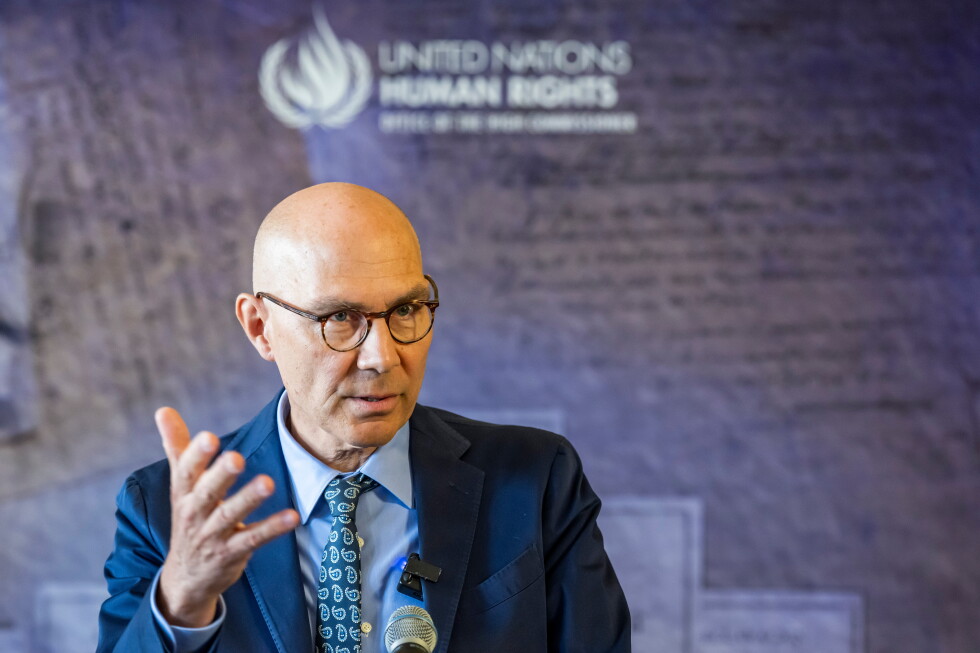
GENEVA – A senior United Nations official has sounded the alarm over a catastrophic escalation of civilian harm in Sudan’s four-year ongoing conflict, confirming that drone strikes alone have killed more than 1,000 non-combatant civilians across the war-torn northeast African nation between January and May 2026. U.N. High Commissioner for Human Rights Volker Türk announced the grim findings during an address to the UN Human Rights Council in Geneva on Monday, highlighting that the growing deployment of unmanned aerial vehicles has drastically raised the death toll for civilian populations caught in the crossfire between Sudan’s warring factions.
Türk’s remarks detailed a documented sharp uptick in three devastating trends of the conflict: expanded drone warfare, widespread sexual violence, and mass atrocities that meet international definitions of war crimes and crimes against humanity. The Sudanese conflict first erupted on April 15, 2023, when a long-simmering power struggle between Sudan’s formal national military and the paramilitary Rapid Support Forces (RSF) broke out into open armed combat, starting in the capital Khartoum before spreading to every major region of the country.
Data from the Armed Conflict Location & Event Data Project (ACLED), a U.S.-based conflict monitoring organization, underscores the scale of the drone-driven surge in fatalities. By ACLED’s count, at least 2,670 people — a mix of combatants and civilians — died in drone-related incidents across Sudan in 2025. That marked a 600% jump in total drone-linked deaths and an 81% rise in the number of drone attacks compared to 2024 figures. Over the full first three years of the conflict, ACLED recorded at least 59,000 total fatalities, though the organization has cautioned that the actual death toll is almost certainly much higher, as widespread insecurity and collapsed communication infrastructure make full, accurate on-the-ground reporting nearly impossible.
Most recently, a drone strike carried out by the RSF last week hit civilian sites in Sudan’s central city of el-Obeid, targeting a public cemetery and a commercial gas station. Local health officials confirmed that the attack left at least 15 people dead.
According to Türk’s briefing, both the Sudanese military and the RSF have increasingly deployed explosive-laden drones in their operations, with repeated strikes targeting civilian infrastructure that is protected under international humanitarian law. Documented targets have included hospitals, hydroelectric dams, schools, open-air public markets, and camps for internally displaced people. Today, drone strikes have emerged as the deadliest single threat to civilians in Sudan’s conflict, a crisis that has been largely overshadowed by higher-profile international conflicts in Gaza and Iran in recent months.
Beyond the growing carnage from drone attacks, Türk confirmed that rape and other forms of sexual violence have become rampant across regions controlled by both warring parties. The United Nations and independent international human rights organizations have documented mass rape and ethnically targeted killings that rise to the level of systematic crimes against humanity.
The protracted conflict has also spiraled into what the UN describes as the world’s most severe ongoing humanitarian catastrophe. Approximately 34 million Sudanese — nearly two-thirds of the country’s entire population — currently require life-saving humanitarian assistance, while widespread fighting has reduced major urban centers to rubble and left critical basic services nonfunctional across most of the country.