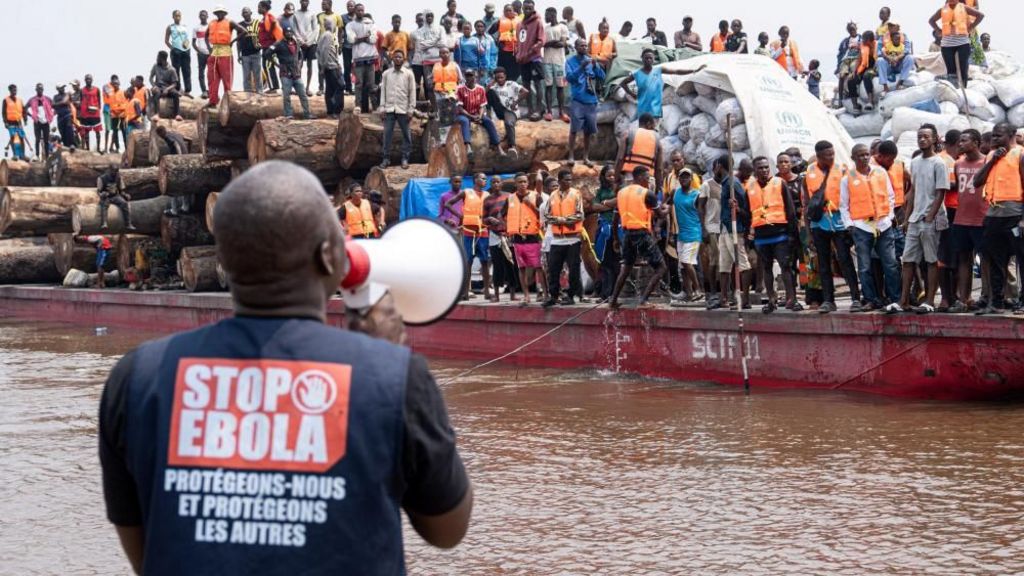
Congolese public health officials have halted the Chinese-operated cargo-passenger vessel *Yingfeng 2* on the Congo River, 65 kilometers upstream from the capital Kinshasa near Bende Bende port, launching immediate Ebola and cholera screenings for all 255 people on board. The interception comes after a passenger who displayed fever and diarrhoea – symptoms consistent with both Ebola and cholera – disembarked at an earlier stop along the route and later died in hospital, with four additional deaths (two adults, a three-year-old child, and a newborn) also linked to the incident.
Joint response teams from the Congolese Ministry of Health and the World Health Organization (WHO) have boarded the intercepted vessel and deployed a mobile testing laboratory to process samples from all passengers and crew. As of the latest update, Health Minister Roger Kamba confirmed that none of the tested individuals have returned positive results for either virus. “For now, no-one has tested positive, and it is likely no one will be positive after 21 days of incubation has elapsed,” Kamba told reporters.
According to BBC intelligence, the *Yingfeng 2* departed Kisangani – the Democratic Republic of the Congo’s (DRC) third-largest city – approximately two weeks ago, travelling more than 1,700 kilometers downstream toward Kinshasa before the interception. Recent Ebola transmissions have been recorded in Kisangani, accounting for at least four local deaths. Kamba also clarified a key point of earlier misreporting: the deceased passenger disembarked in Mongala Province, which has not recorded any confirmed Ebola cases to date.
To comply with WHO public health protocols, security forces have been ordered to quarantine the vessel offshore, preventing any potential movement of people that could spread the virus into the densely populated capital. Public health response teams remain on high alert to take further action once the quarantine perimeter is fully secured.
The interception comes as the DRC grapples with its 17th Ebola outbreak, declared on 15 May this year. Caused by the rare Bundibugyo Ebola species – a variant not detected globally for more than a decade – the outbreak has continued to spread three months after it was first announced, with infections and fatalities still rising.
As of current official counts, the outbreak has recorded 3,973 confirmed cases and 1,801 deaths, making it the second deadliest Ebola outbreak in the country’s history. No specific antiviral treatments or approved vaccines exist for the Bundibugyo variant, though the first human clinical trials for a candidate vaccine are currently ongoing in the United Kingdom. More than 17,000 people who have had close contact with confirmed cases remain under active public health monitoring, 674 patients are currently in isolation or receiving treatment across five affected provinces, and 776 people have recovered from infection, per DRC health authority data.
In Kinshasa, officials have stepped up preparations for a potential response to a Bundibugyo introduction, reinforcing disease surveillance and rapid response capacity at Maluku, the capital’s main overland and river entry point. While officials stress that the interception and quarantine of the *Yingfeng 2* are strictly precautionary measures, they underscore the severe public health risk the ongoing outbreak poses to the country.