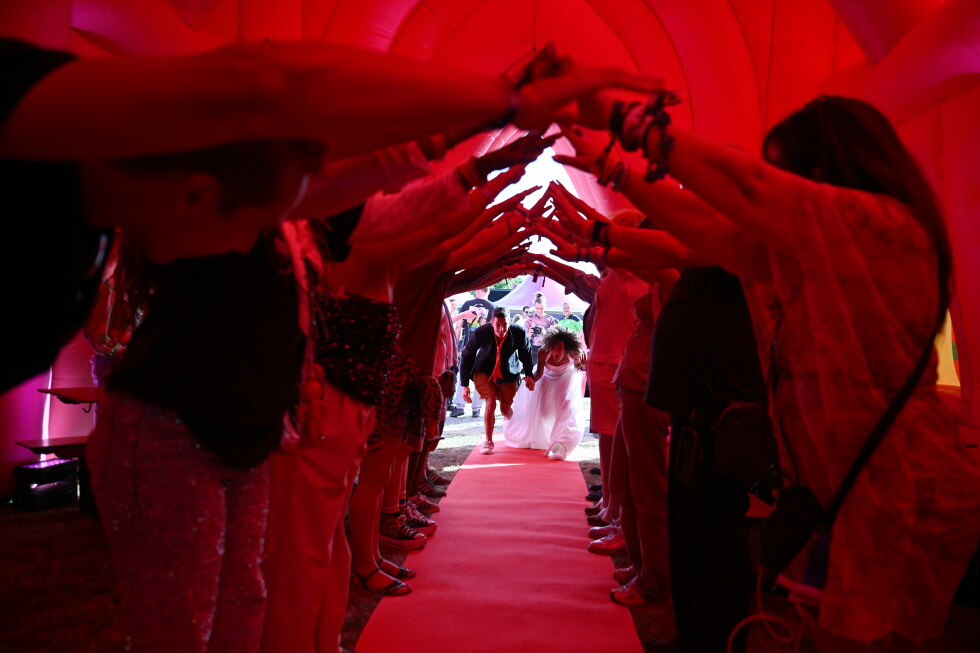
Twenty-five years after the Netherlands made history as the first nation on Earth to legalize same-sex marriage, Amsterdam’s annual Pride festival opened with a heartfelt, one-of-a-kind celebration that nods to both progress and changing social norms. On Thursday, dozens of LGBTQ+ couples gathered inside a repurposed pink church, adorned in everything from glittering sequins to rainbow flags, to take part in the popular “Married For A Day” initiative, a pop-up wedding experience that honors the fundamental right to marital equality. The venue sits just a short walk from the spot where the world’s first legal same-sex union was held in 2001, making the location a deeply symbolic backdrop for the event.
For Jan Derksen-Wynn and John Wijfjes, the first couple to tie the symbolic knot at this year’s gathering, the fight for marital access remains as urgent today as it was a quarter-century ago. Though the pair have only been together for two years and plan to formalize their partnership permanently in the future, Derksen-Wynn stressed the unshakable importance of maintaining the right to marry in an interview with the Associated Press, his veil catching the breeze as he spoke.
A quarter-century after the groundbreaking legal change, same-sex weddings have become a normalized, accepted part of Dutch life. Official data from the Netherlands’ national statistics office shows more than 36,000 same-sex couples have married legally within the country’s borders since 2001. Even the nation’s highest office reflects this progress: Prime Minister Rob Jetten, the first openly gay person to hold the role, is set to marry his partner Nicolás Keenan, an Argentine Olympic field hockey bronze medalist who claimed the honor at the 2024 Paris Games. Jetten also made history this year as the first sitting Dutch prime minister to join Amsterdam’s iconic Pride canal boat parade, where he warned that hard-won LGBTQ+ freedoms are facing growing threats globally. He highlighted rising discriminatory legislation, persistent anti-queer violence on public streets, and last week’s deadly attack on the LGBTQ+ community in Berlin as urgent reminders that celebration and advocacy must go hand in hand.
Against this backdrop of progress for queer couples, the Netherlands as a whole is seeing a steady, long-term decline in the popularity of marriage among all demographics. In 1995, 56% of Dutch adults were married; by 2025, that share has plummeted to just 44%, a drop of nearly 10 percentage points that predates but has continued since the legalization of same-sex marriage. For comparison, 62% of U.S. adults are currently married, according to U.S. Census Bureau data. Instead of formal marriage, growing numbers of Dutch couples of all sexual orientations are opting for cohabitation agreements: legally binding contracts that outline financial responsibilities and asset division in the event of a relationship split. The Dutch notary association reports that 42,500 such agreements were signed in 2025 alone.
Despite this national shift away from marriage as a default relationship status, event organizer Julia van den Beek argues that celebrating marital equality remains a critical act of affirmation for the LGBTQ+ community. “Love comes in every shape, in every form, in every way,” she told the AP moments before officially uniting Derksen-Wynn and Wijfjes in “eternal matrimony — or until the sun comes up.” Hundreds of thousands of visitors are expected to take part in the festival’s iconic canal boat parade, one of the largest Pride events in the world, in the coming days.