As leaders of the world’s seven largest industrialized economies prepare to gather for the 2019 G7 Summit in the French lakeside town of Evian-les-Bains, security forces across the France-Switzerland border have enacted unprecedented safety measures to head off potential unrest, while businesses and local residents brace for planned mass anti-summit demonstrations on Sunday.
The three-day summit, running June 15 to 17, brings together U.S. President Donald Trump and other G7 leaders to discuss high-stakes global issues including tensions in the Middle East, the ongoing conflict in Ukraine, and persistent global economic imbalances. But the elite gathering has drawn fierce opposition from a broad coalition of activist groups, ranging from environmental campaigners and feminist organizers to anti-capitalist activists, who have organized a large-scale march and protest to coincide with the summit’s opening.
Pre-protest actions began days ahead of the main demonstration. On Friday evening, Swiss local media reported that roughly 20 protesters were taken into custody by authorities. On Saturday, a flotilla of nearly 20 small boats cruised across Lake Geneva just off Evian’s shore, unfurling large banners with anti-G7 and pro-Palestinian messaging. A day earlier, public broadcaster RTS documented a protest bicycle ride through downtown Geneva that drew between 100 and 150 participants, who chanted anti-G7 and pro-Palestinian slogans and slowed downtown vehicle traffic.
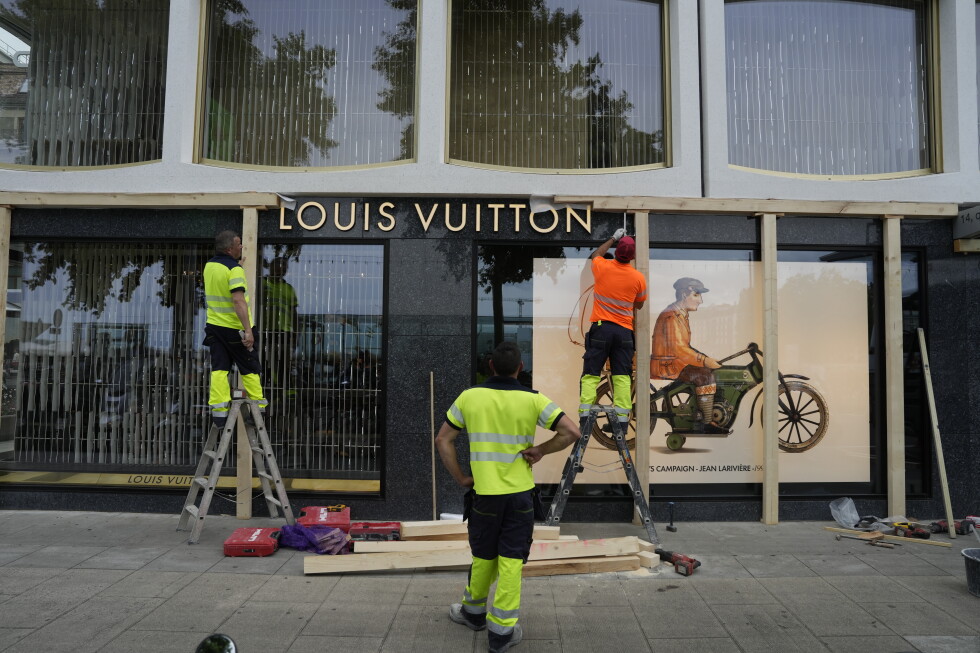
In central Geneva, just kilometers from the summit site, dozens of retail shops and local businesses have boarded up their storefronts with plywood panels, a precaution driven by memories of violent unrest that damaged dozens of commercial properties during the 2003 G8 Summit, when Russia was still part of the group of major industrialized nations. Local resident Robin Hedz described seeing “wood-walls everywhere” across the city center, expressing confusion at the extreme preparations while acknowledging the lingering trauma of the 2003 property damage that left the city center a “mess.”
To contain potential unrest, authorities on both sides of the border have rolled out massive joint security deployments. The Swiss government confirmed it will deploy approximately 4,000 army personnel to support local and national police forces throughout the summit period. Security operations include enforced restrictions on airspace and key road corridors, regular patrols across Lake Geneva, and the closure of 28 of 35 existing roadway border crossings, leaving only seven open for authorized traffic. City officials in Geneva have also closed a major downtown park that activists had targeted as a gathering space for demonstrators.
Across the border in France, law enforcement has matched that scale of deployment: more than 13,000 police and gendarmerie officers have been assigned to secure the summit perimeter and surrounding areas, while the number of active border control officers has been boosted from the usual 60 to over 800. On Saturday, French gendarmes could be seen patrolling Evian’s waterfront in motorboats, with one officer displaying a large drone-interception device to demonstrate the scope of anti-intrusion and security measures in place.
Activist organizers say their demonstration is driven by widespread frustration with the policy agendas of G7 leaders, particularly the Trump administration’s approach to issues ranging from international trade tariffs and climate change to Middle East conflict. Some activists have also raised criticism of Trump’s past ties to convicted sex offender Jeffrey Epstein. Francoise Nyffeler, a spokesperson for the NoG7 coalition organizing Sunday’s main demonstration, emphasized that opposition extends across all G7 member nations’ leadership.
“We are very afraid of the policy and the politics of Mr. Trump and also of the other leaders of the G7, because they are fighting, making war all over the place,” Nyffeler said. “The planet is in danger and we are very scared about it and we want to protest and say that the people of the world are against their policies.”
Mass protest action has long been a fixture of high-level global summits like the G7, and both security forces and local communities remain on high alert for potential escalation of unrest as the summit gets underway.